

While major AI developers like OpenAI and Anthropic focus on training ever-larger, more powerful models, a different approach is emerging: the creation of smaller, highly efficient models, often made publicly available. A notable contributor to this trend is Zyphra, a startup from Palo Alto that recently unveiled its new language model, ZAYA1-8B.
Featuring just over 8 billion parameters and activating only 760 million per query—significantly fewer than the trillions associated with leading labs—ZAYA1-8B demonstrates competitive performance on benchmarks when compared to models like GPT-5-High and DeepSeek-V3.2. This model is now available for free download on Hugging Face under the permissive Apache 2.0 license, allowing immediate use and customization by enterprises and independent developers. Individuals can also explore its capabilities through Zyphra Cloud.
Crucially, ZAYA1-8B was trained using a suite of AMD Instinct MI300 GPUs. This marks a significant development, showcasing the capability of AMD’s hardware platform to produce sophisticated AI models and presenting a viable alternative to the dominant position Nvidia currently holds among AI developers.
ZAYA1-8B: A Deep Dive into its Training and Architecture
Zyphra attributes the model’s “intelligence density” to a comprehensive “full-stack innovation” strategy, encompassing architecture design, pretraining methodologies, and reinforcement learning (RL). ZAYA1-8B is built upon Zyphra’s proprietary MoE++ architecture, detailed in a technical report. This architecture introduces three key enhancements to the standard Transformer model that underpins most large language models (LLMs) and generative AI:
- Compressed Convolutional Attention (CCA): Unlike traditional attention mechanisms that consume significant memory with expanding context windows, CCA processes sequence mixing within a compressed latent space. This innovation leads to an 8x reduction in KV-cache size compared to full multi-head attention, facilitating more efficient reasoning over extended contexts.
- The ZAYA1 MLP Router: Standard Mixture-of-Experts (MoE) models typically employ a linear router to direct tokens to specific “experts.” Zyphra replaces this with a more expressive, multi-layer MLP-based design. To ensure training stability, a common challenge for MoE models, they incorporated a bias-balancing mechanism inspired by PID controllers from control theory.
- Learned Residual Scaling: This technique manages the “residual norm” as data progresses through the model’s 40 layers, effectively preventing gradient vanishing or explosion with minimal computational overhead.
Reasoning-First Pretraining Approach
A core innovation of ZAYA1-8B is the integration of reasoning capabilities from the initial pretraining phase, rather than as an afterthought. To manage lengthy chain-of-thought (CoT) sequences that might exceed the initial 4K token context window, Zyphra developed Answer-Preserving (AP) Trimming.
AP-trimming functions akin to an editor selectively removing less critical parts of a narrative while preserving the essential beginning and end. This ensures the model learns the relationship between complex problems and their solutions, even when the complete internal logical steps cannot fit into memory during training.
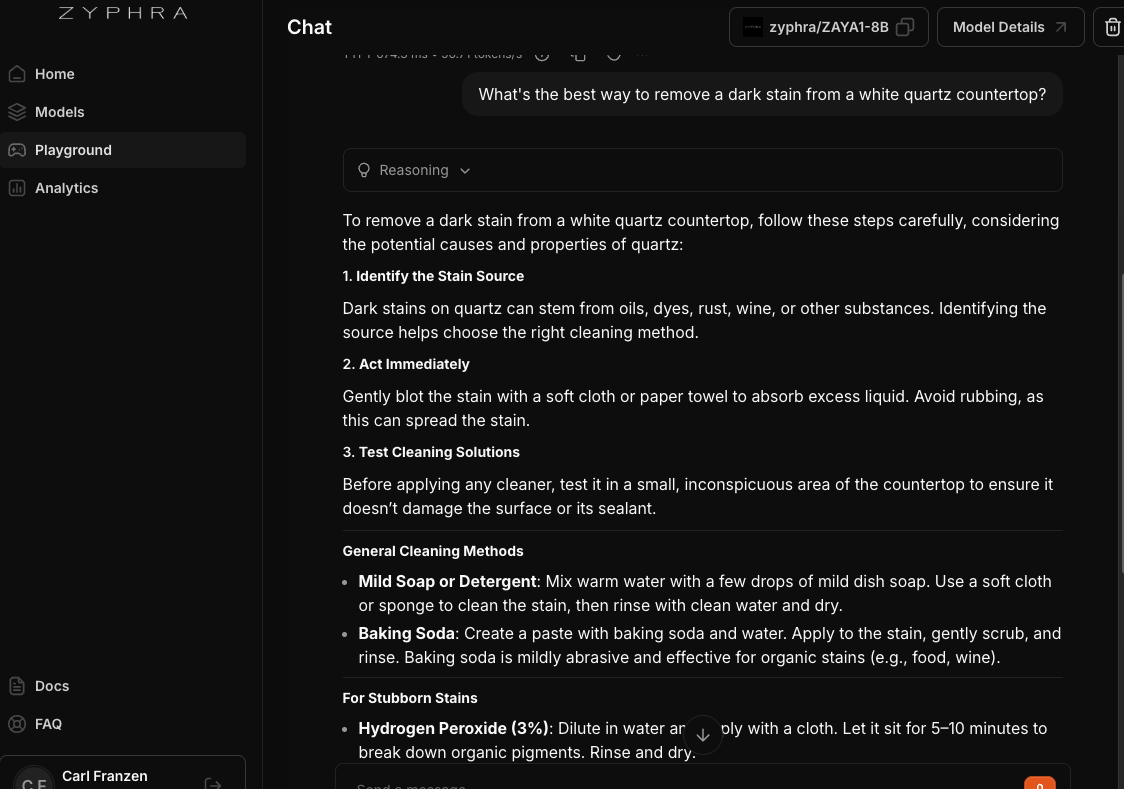
Testing ZAYA1-8B on Zyphra Cloud for advice on countertop stain removal yielded satisfactory results, demonstrating its practical application.
Markovian RSA: Enhancing Reasoning at Inference Time
The model’s most significant performance gains stem from Markovian RSA, a novel test-time compute (TTC) methodology. Traditional approaches that increase a model’s “thinking depth” by extending the generation of its thought process often lead to context bloat and loss of focus.
Markovian RSA addresses this by separating “thinking depth” from “context size.” It operates similarly to a peer-review process, where:
- The model generates multiple parallel reasoning paths.
- It then extracts only the final segments (e.g., the last few thousand tokens) of these paths.
- These segments are subsampled and fed back into the model via an “aggregation prompt,” tasking it with synthesizing a more refined solution.
By maintaining only these critical “tails” within a constrained context window, the model can perform extensive reasoning without the limitations of its initial context size. This technique enables the 700M active parameter ZAYA1-8B to achieve a 91.9% score on the AIME ’25 benchmark, rivaling models with substantially more active parameters.
The relatively small total parameter count (8.4B) of ZAYA1-8B positions it ideally for on-device deployment and local LLM applications. This capability allows enterprises to integrate high-level reasoning functions, typically requiring massive cloud infrastructure, directly onto local or edge devices, addressing concerns related to data privacy, latency, and the costs associated with continuous API usage.
Performance Benchmarks: A Small Model Outperforming Expectations
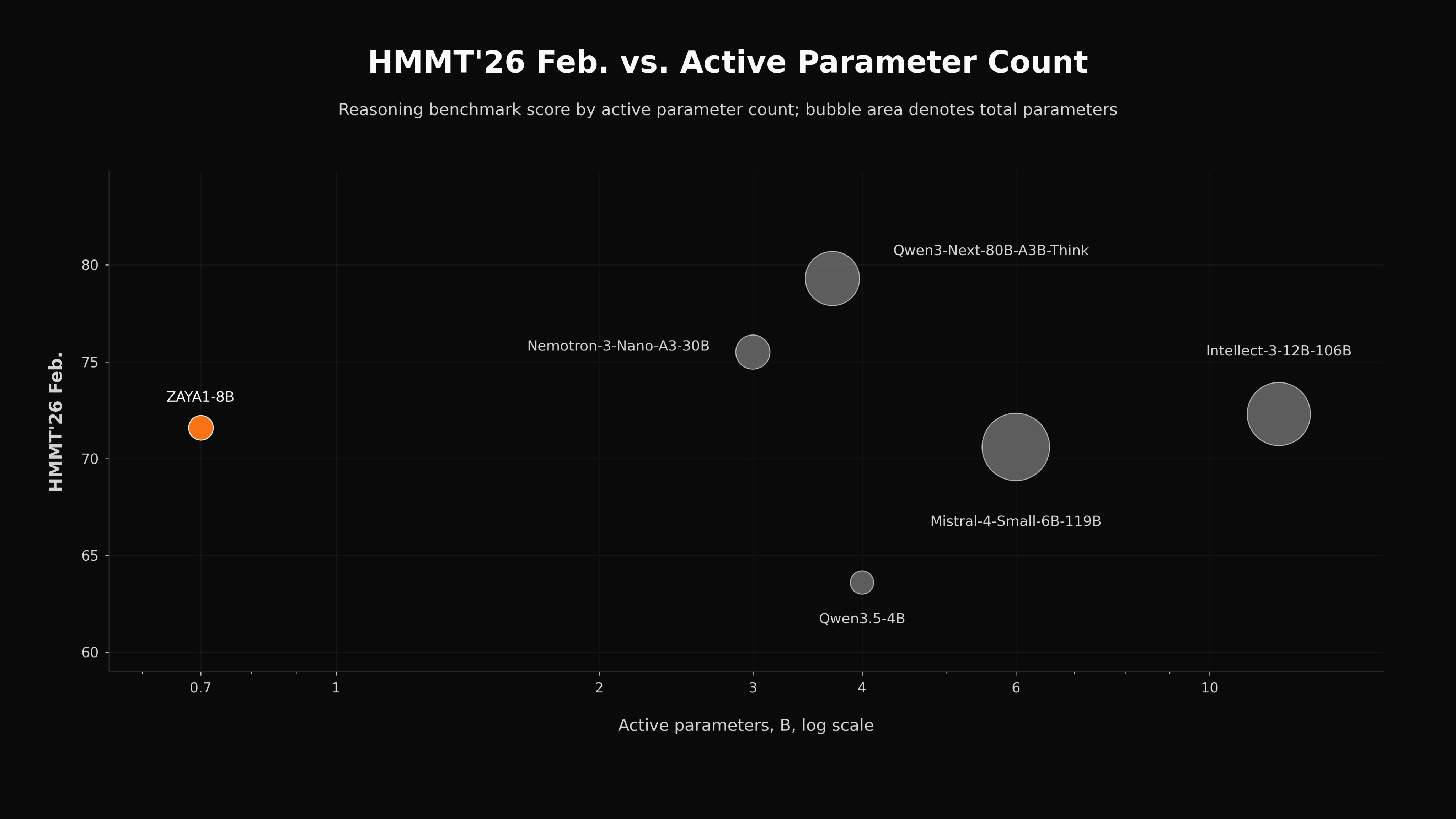
Zyphra positions ZAYA1-8B as a high-performance model for developers needing advanced reasoning capabilities without the expense and latency of massive frontier models. Its low active parameter count makes it particularly cost-effective and compute-efficient during inference.
- Instruction Following: With an 85.58 score on IFEval, ZAYA1-8B remains competitive against significantly larger models, including Intellect-3 (106B).
- Agentic Capabilities: On the τ² benchmark, the model achieves a score of 43.12, and 39.22 on BFCL-v4, demonstrating proficiency in tasks involving tool-calling and multi-turn interactions.
Without the enhanced reasoning of Markovian RSA, ZAYA1-8B already surpasses models of similar size in specific areas. It outperforms Qwen3.5-4B and Gemma-4-E4B on math and coding benchmarks.
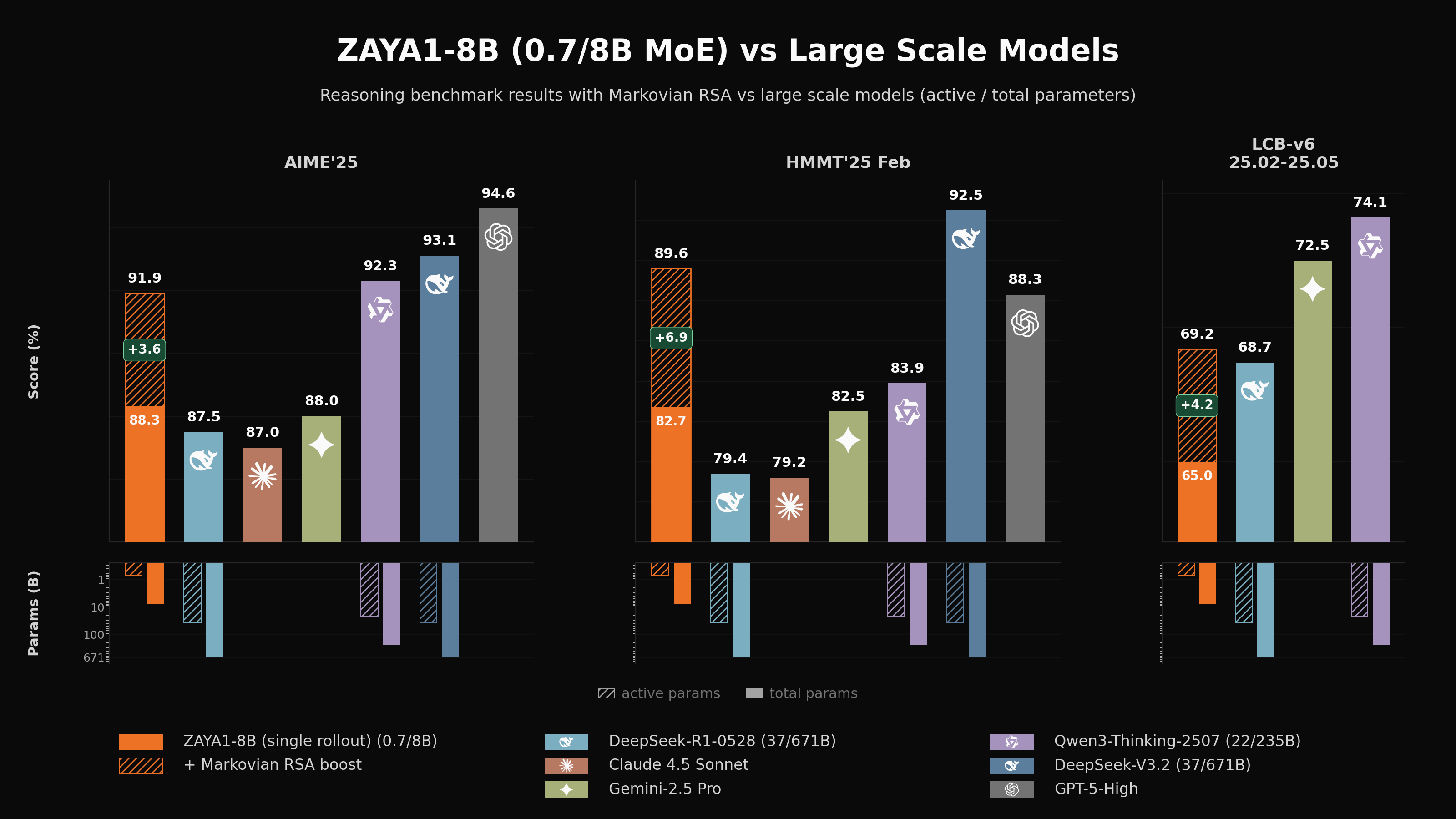
When Markovian RSA is activated, ZAYA1-8B’s performance dramatically improves:
- HMMT ’25 (Mathematics): The model achieves an impressive 89.6%, outperforming Claude 4.5 Sonnet (79.2%) and GPT-5-High (88.3%).
- LiveCodeBench (Coding): ZAYA1-8B reaches 69.2%, surpassing DeepSeek-R1-0528.
Zyphra notes that while ZAYA1-8B excels in algorithmic reasoning, its performance on highly factual retrieval tasks (like MMLU-Pro) is slightly behind larger models. This suggests that while reasoning efficiency can be achieved with fewer parameters, extensive factual recall still benefits from a larger parameter count.
Apache 2.0 License: Fostering Open-Source Innovation
Zyphra’s decision to release ZAYA1-8B under the Apache-2.0 license is a strategic move to encourage broader adoption within the developer community. Unlike copyleft licenses such as GPL, Apache-2.0 is highly permissive, allowing ZAYA1-8B to be integrated into proprietary commercial applications without requiring derivative works to be open-sourced.
Furthermore, the license includes an explicit grant of patent rights from contributors, offering legal protection for developers building on Zyphra’s technology. By choosing Apache-2.0 over the more restrictive licenses often employed by frontier AI labs, Zyphra signals a strong commitment to the open-weight ecosystem.
To effectively deploy ZAYA1-8B, developers will need to utilize specific branches from Zyphra’s customized forks of core libraries:
- Custom Forks: Installation requires the `zaya1` branch from Zyphra’s versions of the `vllm` and `transformers` libraries.
- Deployment Flags: When initializing a `vLLM` server, specific flags are necessary for handling the reasoning and tool-calling parsers (e.g., `–reasoning-parser qwen3` and `–tool-call-parser zaya_xml`).
- Parallelism Strategy: For multi-GPU setups, Zyphra recommends a combination of Data Parallelism (DP) and Expert Parallelism (EP). Tensor Parallelism (TP) is not currently supported for the model’s CCA mechanism, making DP+EP the optimal configuration for maximizing inference throughput.
Zyphra: Pioneering Intelligence Density in AI
Zyphra Technologies, founded in 2021 and based in Palo Alto, California, is an AI laboratory focused on developing human-aligned artificial general intelligence (AGI) through an open-source framework. Their core principle of “intelligence density” aims to maximize reasoning and logic output per parameter and per FLOP, challenging the dominance of large, centralized cloud models.
Zyphra CEO and Co-Founder Krithik Puthalath emphasizes that this strategy is crucial for enabling high-performance AI to operate locally on devices like tablets and wearables, thereby enhancing user privacy and reducing reliance on cloud infrastructure.
The company’s technical direction is heavily influenced by computational neuroscience, spearheaded by Co-Founder and Chief Scientist Beren Millidge. Millidge’s research at the University of Oxford, focusing on deep credit assignment and mathematical models of the brain, informs Zyphra’s pursuit of multimodal architectures capable of long-term memory and continuous learning.
This neuroscientific foundation was instrumental in the design of Zyphra’s previous model, Zamba, which employed a cortex-hippocampus interaction mechanism for information sharing across layers. A recent TED Talk by Millidge further elaborates on the intersection of neuroscience and AI that guides Zyphra’s model architectures.
Zyphra has demonstrated significant technical achievements through deep integration with AMD’s hardware ecosystem. The company is venture-backed, achieving “Unicorn” status in June 2025 after a $110 million Series A funding round. Key investors include AMD, IBM, Bison Ventures, and BC VC. With approximately 31 employees, Zyphra continues to expand its offerings through the Zyphra Inference Cloud and Maia, an intelligent assistant platform for enterprise teams.
Industry Context and Community Reception
The release of ZAYA1-8B has generated considerable excitement within the AI community, with significant online engagement. Key points of interest include the viability of the AMD hardware stack for AI development and the efficiency of Zyphra’s reasoning techniques.
Technical observers have highlighted the rigor of Zyphra’s post-training process, a four-stage RL cascade that includes a “reasoning warmup” and adaptive puzzle environments before behavioral refinement. A particularly praised feature is Router Replay, which mitigates training instability in MoE models by ensuring the trainer uses the same expert choices made during inference, thereby “pinning” the computation path for greater learning stability.
As the AI industry potentially reaches a point where simply increasing model size yields diminishing returns, ZAYA1-8B presents a compelling case for innovation through algorithmic efficiency and smarter “thinking” processes, advocating for achieving more with less computational resources.
Business Style Takeaway: Zyphra’s ZAYA1-8B model, trained on AMD hardware and open-sourced under Apache 2.0, signifies a critical shift towards more accessible and efficient AI development. This innovation challenges the resource-intensive approaches of larger players and opens new avenues for on-device AI deployment, data privacy, and reduced operational costs for businesses.
Based on materials from : venturebeat.com