


Z.ai, a prominent Chinese artificial intelligence startup formerly known as Zhipu AI, has officially launched GLM-5.2. This new 753-billion parameter large language model (LLM) with open weights is specifically engineered to excel in complex, long-horizon autonomous coding and engineering tasks.
The model is immediately accessible through Hugging Face, the Z.ai API, and over 20 third-party coding environments. GLM-5.2 features a robust 1-million-token context window and offers enterprise subscription tiers starting at an accessible $12.60 per month.
In a move that will appeal to businesses prioritizing cost-effectiveness and data security, Z.ai has released the core weights of GLM-5.2 under an unrestricted MIT open-source license. This enables enterprises to download the model freely from Hugging Face, customize or fine-tune it according to their specific needs, and potentially operate it locally or on virtual machines, incurring only compute and electricity costs.
This offering becomes particularly attractive for enterprises navigating the increasingly uncertain regulatory landscape surrounding state-of-the-art proprietary American models. Recent export control directives, such as the one from the Trump Administration prohibiting foreign nationals from using specific models, have created hesitations. These concerns were amplified when a leading AI company responded to such directives by making certain models entirely offline for all users.
For technical decision-makers in enterprises, Z.ai’s GLM-5.2 presents a viable and high-capability pathway to deploy advanced AI locally, thereby circumventing geographical restrictions and commercial limitations.
IndexShare Architecture Optimizes Compute for Long Contexts
At its core, GLM-5.2 operates with 753 billion parameters and incorporates a significant architectural innovation known as “IndexShare.”
Traditional large language models often face computationally prohibitive challenges when processing attention mechanisms across extensive documents. The IndexShare technology addresses this by enabling the reuse of the same indexer across every four sparse attention layers.
This singular optimization dramatically reduces the per-token compute floating-point operations (FLOPs) by a factor of 2.9 when operating at the maximum 1-million-token context length.
Furthermore, the model integrates an enhanced Multi-Token Prediction (MTP) layer designed for speculative decoding. This feature boosts the accepted token length during inference by up to 20%.
Z.ai has also introduced flexible, selectable “Thinking Modes.” Users can choose between “Max” mode, designed to push the boundaries of logical problem-solving, and “High” mode, which balances high-end performance with token efficiency for latency-sensitive applications.
State-of-the-Art Benchmarks Compete with Proprietary Leaders
On standardized third-party benchmark evaluations, GLM-5.2 demonstrates superior performance compared to most leading open-source models, including DeepSeek v4. It also achieves scores that are on par with, or even surpass, its closed-weights counterparts, such as OpenAI’s GPT-5.5 and Anthropic’s Claude Opus 4.8.
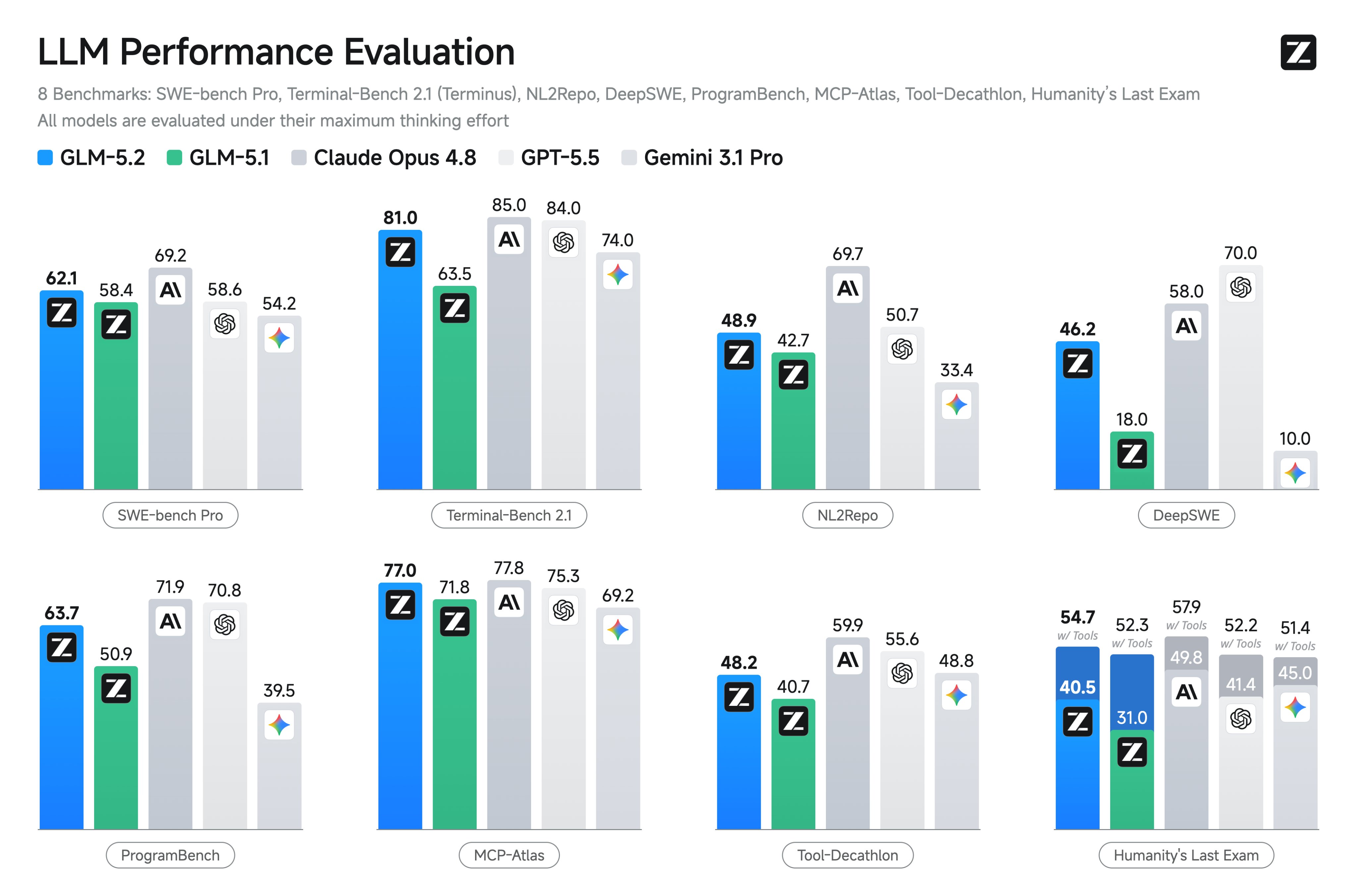
The model particularly excels in agentic tool use and long-horizon software engineering tasks:
-
SWE-bench Pro: GLM-5.2 achieved a score of 62.1, outperforming GPT-5.5 (58.6) and its own predecessor, GLM-5.1 (58.4).
-
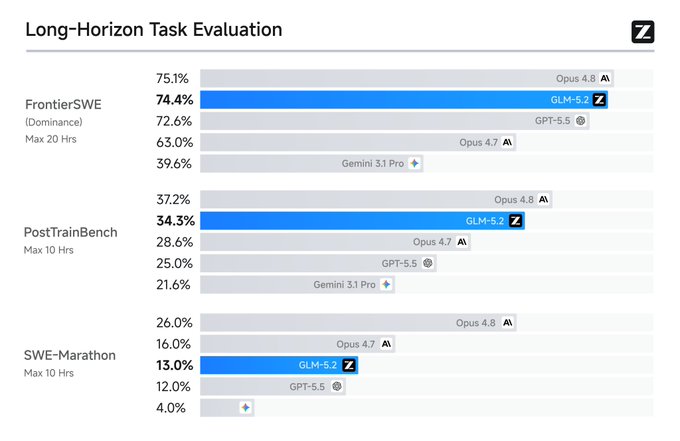
FrontierSWE (Dominance): In a benchmark designed to assess long-horizon task completion, GLM-5.2 reached 74.4%, surpassing GPT-5.5 (72.6%) and closely trailing Claude Opus 4.8 (75.1%).
-
MCP-Atlas: In a tool-usage evaluation, GLM-5.2 scored 77.0, exceeding GPT-5.5 (75.3) and closely matching Claude Opus 4.8 (77.8).
-
Humanity’s Last Exam (w/ Tools): When equipped with external tools, GLM-5.2 achieved a score of 54.7, outperforming GPT-5.5 (52.2) and tracking near Claude Opus 4.8 (57.9).
-
PostTrainBench & SWE-Marathon: For extended, multi-hour engineering workloads, GLM-5.2 consistently outperformed GPT-5.5, scoring 34.3% on PostTrainBench compared to GPT-5.5’s 25.0%, and 13.0% on SWE-Marathon versus GPT-5.5’s 12.0%.
While GLM-5.2 shows slightly lower scores than Claude Opus 4.8 and GPT-5.5 on raw Terminal-Bench 2.1 metrics (81.0 versus 85.0 and 84.0, respectively), it significantly surpasses Google’s Gemini 3.1 Pro (74.0).
Beyond traditional coding benchmarks, GLM-5.2 secured a leading position on the crowdsourced design task benchmark, Design Arena, achieving an ELO score of 1360, which surpassed even the advanced Claude Fable 5.
Moreover, the impact of Z.ai’s new selectable “thinking modes” is evident in performance data. In “Max” effort mode, GLM-5.2 reaches peak intelligence, utilizing approximately 85,000 output tokens per task. Switching to “High” effort mode results in a minor performance decrease while approximately halving the token output, offering a critical optimization for latency-sensitive applications.
Accessible via Dedicated Coding Plans and API
To facilitate the model’s adoption, Z.ai has introduced the GLM Coding Plan, specifically designed for developer workflows rather than simple conversational interfaces. This plan provides out-of-the-box support for various third-party agentic coding tools and harnesses, including Claude Code, OpenClaw, Cline, Kilo Code, Crush, and Factory, among others.
The Coding Plan offers highly competitive pricing tiers (when billed annually):
-
Lite: $12.60 per month ($151.20 annually after the first year), suitable for iterative development on smaller codebases.
-
Pro: $50.40 per month, designed for day-to-day development on mid-sized repositories, offering 5x the usage allowance of the Lite plan.
-
Max: $112.00 per month, intended for intensive workloads, providing 20x the Lite usage and dedicated resources during peak hours.
For enterprise developers integrating the raw model into their custom applications, Z.ai’s API pricing is notably competitive, undercutting Western rivals while aligning with the rates of the previous GLM-5.1 generation.
GLM-5.2 API access is priced at $1.40 per million input tokens and $4.40 per million output tokens, positioning it as a mid-tier offering globally, but significantly more cost-effective than many competing proprietary solutions.
VentureBeat Frontier AI Model API Pricing Snapshot
Sorted by total cost (input + output) from least to most expensive. Pricing shown is standard pay-as-you-go pricing per 1 million tokens.
|
Model |
Input |
Output |
Total Cost |
Source |
|
MiMo-V2.5 Flash |
$0.10 |
$0.30 |
$0.40 |
Xiaomi MiMo |
|
deepseek-v4-flash |
$0.14 |
$0.28 |
$0.42 |
DeepSeek |
|
deepseek-v4-pro |
$0.435 |
$0.87 |
$1.305 |
DeepSeek |
|
MiniMax-M3 |
$0.30 |
$1.20 |
$1.50 |
MiniMax |
|
Gemini 3.1 Flash-Lite |
$0.25 |
$1.50 |
$1.75 |
|
|
Qwen3.7-Plus |
$0.40 |
$1.60 |
$2.00 |
Alibaba Cloud |
|
MiMo-V2.5 |
$0.40 |
$2.00 |
$2.40 |
Xiaomi MiMo |
|
Grok 4.3 (low context) |
$1.25 |
$2.50 |
$3.75 |
xAI |
|
MiMo-V2.5 Pro (≤256K) |
$1.00 |
$3.00 |
$4.00 |
Xiaomi MiMo |
|
Kimi-K2.6 |
$0.95 |
$4.00 |
$4.95 |
Moonshot/Kimi |
|
GLM-5.2 |
$1.40 |
$4.40 |
$5.80 |
Z.ai |
|
Grok 4.3 (high context) |
$2.50 |
$5.00 |
$7.50 |
xAI |
|
MiMo-V2.5 Pro (>256K) |
$2.00 |
$6.00 |
$8.00 |
Xiaomi MiMo |
|
Qwen3.7-Max |
$2.50 |
$7.50 |
$10.00 |
Alibaba Cloud |
|
Gemini 3.5 Flash |
$1.50 |
$9.00 |
$10.50 |
|
|
Gemini 3.1 Pro Preview (≤200K) |
$2.00 |
$12.00 |
$14.00 |
|
|
GPT-5.4 |
$2.50 |
$15.00 |
$17.50 |
OpenAI |
|
Gemini 3.1 Pro Preview (>200K) |
$4.00 |
$18.00 |
$22.00 |
|
|
Claude Opus 4.8 |
$5.00 |
$25.00 |
$30.00 |
Anthropic |
|
GPT-5.5 |
$5.00 |
$30.00 |
$35.00 |
OpenAI |
|
Claude Fable 5 / Claude Mythos 5 |
$10.00 |
$50.00 |
$60.00 |
Anthropic |
To further optimize costs for long-context workloads, Z.ai provides a cached input rate of $0.26 per million tokens and a limited-time offer for complimentary cached input storage.
The pronounced disparity between open-weights innovators and proprietary Western AI labs has not gone unnoticed by the developer community. An influential AI observer, Lisan al Gaib (@scaling01), commented on X that “frontier labs are absolutely scamming you on API pricing.”
The post highlighted that while large open models like the 744-billion-parameter GLM-5.2 charge $4.40 per million output tokens and DeepSeek-V4-Pro (1.6 trillion parameters) charges $0.87, proprietary models command significant premiums. For instance, Anthropic’s Sonnet 4.6 and Opus 4.8 are priced at $15.00 and $25.00, respectively, while OpenAI’s GPT-5.5 costs $30.00 per million output tokens.
The commentator pointed out that open-model developers operate profitably without proprietary hardware, suggesting that leading proprietary labs may be achieving profit margins exceeding 90%.
Unrestricted MIT License Empowers Enterprise Adoption
Perhaps the most significant aspect of the GLM-5.2 release is its licensing framework. Z.ai has released the model’s weights under an MIT open-source license, establishing it as a “Pure Open” system.
The company’s technical documentation explicitly states that this license ensures “no regional limits” and permits “technical access without borders.”
For enterprise technology leaders, an MIT license offers the freedom to use, modify, and commercialize the software without incurring royalties or adhering to restrictive “acceptable use” policies often associated with dual-use licenses. This empowers engineering teams to deploy frontier-level AI on their own sovereign infrastructure, effectively eliminating vendor lock-in.
Enthusiastic Reception from Developers and Toolmakers
The developer response to GLM-5.2 has been swift and overwhelmingly positive. The Kilo Code team announced immediate integration, stating on X, “GLM-5.2 runs in Kilo Code on day one. The 1M context window and Max effort mode are both live. Point your config at it and go!”
The open-source coding environment Cline IDE echoed this enthusiasm, emphasizing the economic benefits: “GLM-5.2 is the first open-weights model to cross 80% on Terminal-Bench, and beats every other open model available. It also beats Gemini, making it a frontier-level model for a fraction of the cost. Open weights is back. This model is a game changer. Available in Cline now!”
Similarly, the rival open-source coding desktop agent Eigent AI tested the model’s advanced capabilities on complex agentic workflows. The team noted on X, “threw a real long-horizon task: research 30 companies across 6 sectors of the AI infrastructure stack, structure it into JSON, then build an interactive HTML report… where 5.2 pulls ahead: -> plans…”
Business Style Takeaway: The release of GLM-5.2 signifies a major advancement in accessible, high-performance AI, particularly for complex coding and engineering tasks. Its open-weights MIT license provides enterprises with unprecedented flexibility and control, challenging the economics and accessibility of proprietary models and potentially accelerating AI adoption across industries.
Details can be found on the website : venturebeat.com