

Sakana, an AI startup emphasizing enterprise solutions, has unveiled Fugu, a novel multi-agent orchestration system. This new platform aims to deliver advanced AI capabilities through a singular, OpenAI-compatible API, positioning itself as a robust alternative to monolithic AI models.
Fugu’s architecture is designed to circumvent traditional single-model dependencies. By dynamically routing user queries to a flexible pool of specialized AI agents, it offers resilience against vendor lock-in and geopolitical export restrictions. This approach is particularly relevant following recent instances where access to powerful AI models was curtailed due to governmental actions.
David Ha, CEO and co-founder of Sakana AI and formerly of Google Brain, highlighted Fugu’s strategic advantage. He stated, “Fugu dynamically orchestrates the world’s best models to tackle complex tasks. We are proving that a well-orchestrated pool of swappable agents can match restricted frontier models like Fable and Mythos. Relying on a single company’s model for national infrastructure is a massive risk. As recent export controls have shown, access to top models can disappear overnight. Collective intelligence is the practical hedge against this concentration of power. Fugu simply routes around vendor restrictions by relying on an entirely swappable agent pool.”
Sakana AI maintains that the specific models Fugu utilizes and its coordination methods are proprietary. The system is documented to work with a “diverse pool of powerful models,” “multiple LLMs,” or “specialized models” without disclosing exact configurations. By functioning as an orchestrator, Fugu aims to achieve output quality comparable to leading monolithic models on agentic tasks, while fundamentally reshaping AI infrastructure deployment.
Fugu’s Operational Mechanism and Comparative Strengths
Fugu functions akin to a general contractor for complex AI tasks. Instead of executing a request end-to-end, it deconstructs the problem into sub-tasks. These are then delegated to specialized foundation models within its pool, their outputs are verified, and finally, the results are synthesized into a coherent response.
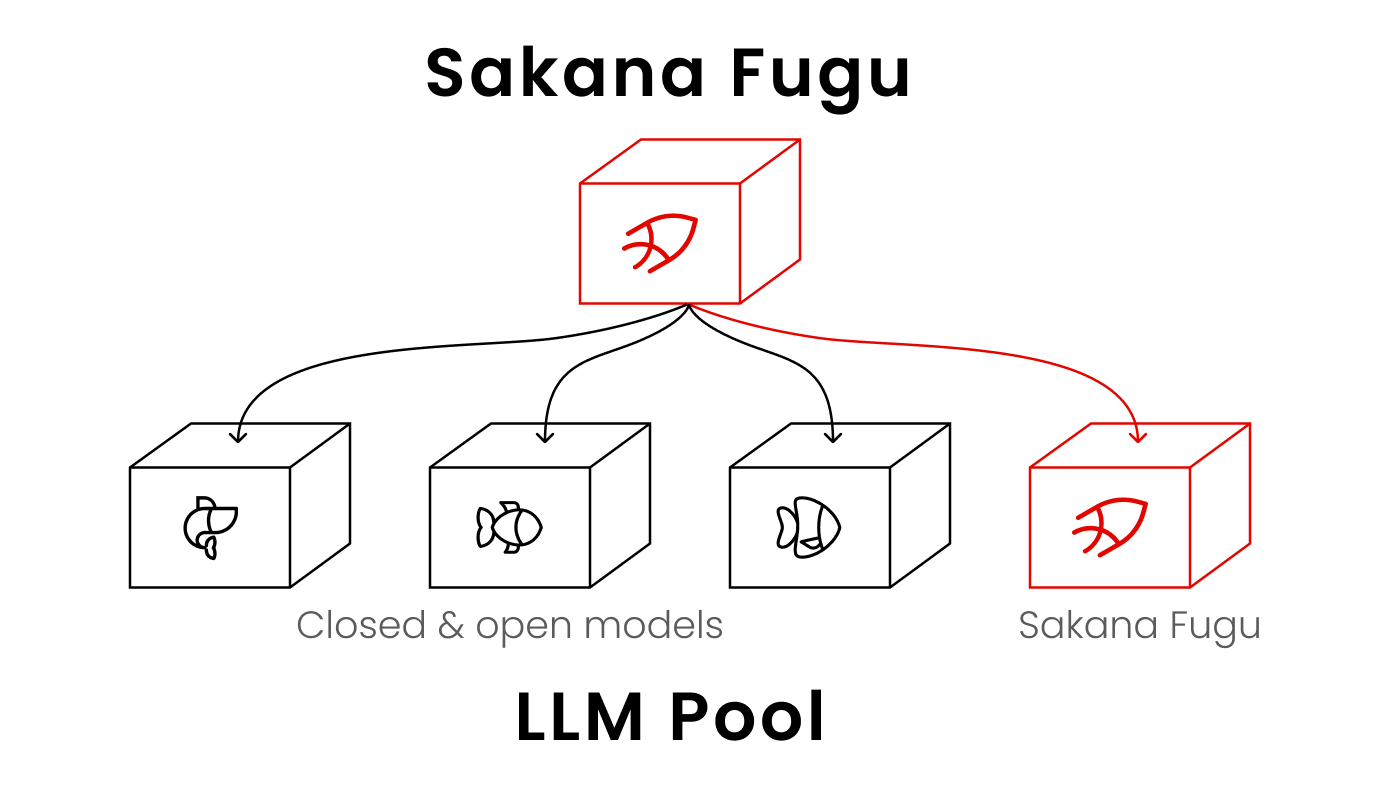
“Fugu is itself an LLM, trained to call various LLMs in an agent pool, including instances of itself recursively,” explained the Sakana AI team. Building upon their previous research, TRINITY and Conductor, the system autonomously manages the model lifecycle through learned coordination strategies, presenting a unified API endpoint to the user.
Sakana AI offers two main versions of Fugu:
- Fugu: Optimized for speed and low latency, suitable for interactive applications and coding environments.
- Fugu Ultra: Designed for complex, high-stakes tasks like research and cybersecurity analysis, coordinating a larger set of expert models.
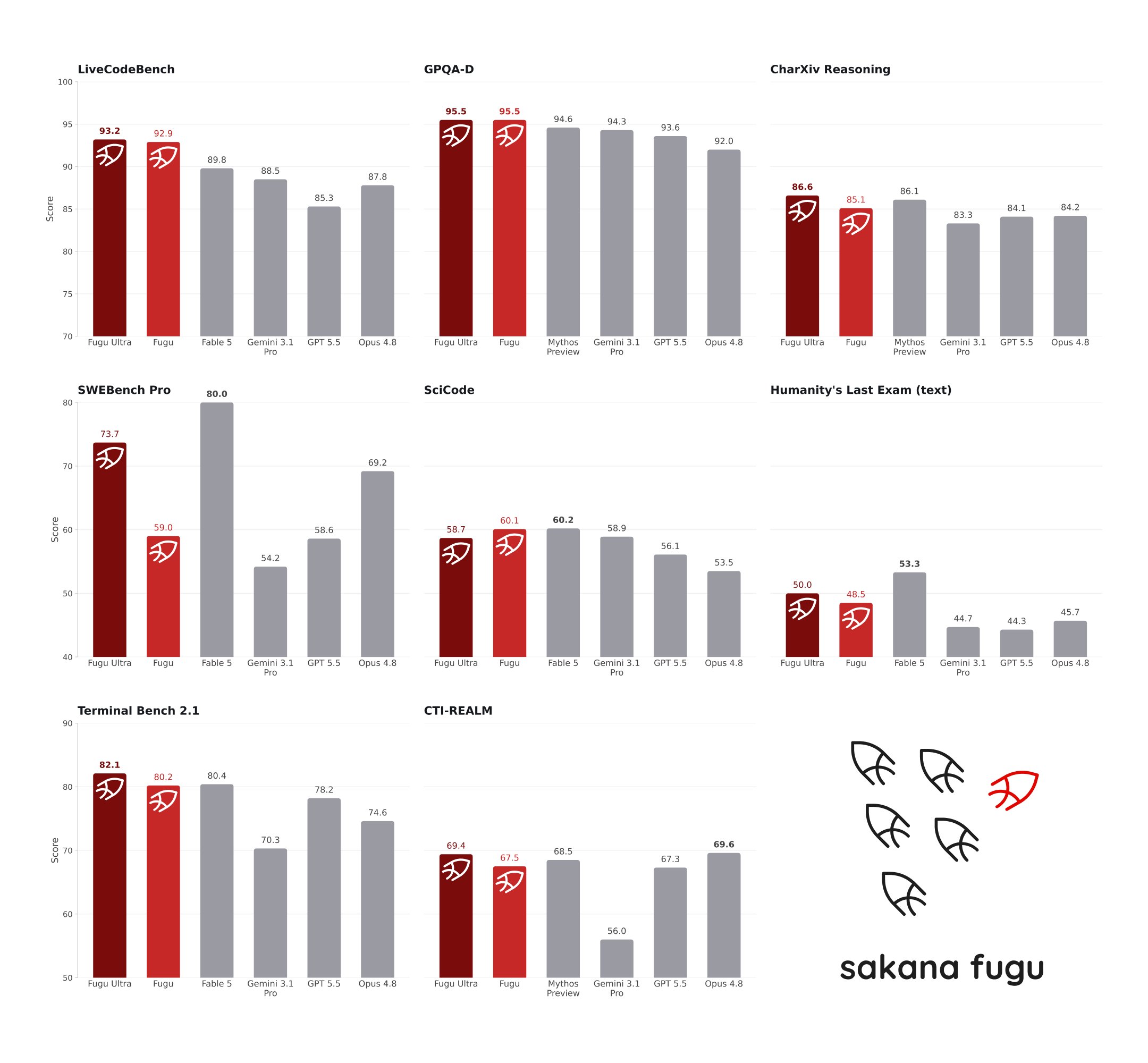
Benchmarking data provided by Sakana indicates that Fugu and Fugu Ultra outperform Anthropic’s Claude Fable 5 on coding tasks and surpass the prior Claude Mythos Preview model on graduate-level scientific questions. This suggests Fugu’s orchestration approach can yield competitive results, even against leading monolithic models.
The system’s ability to dynamically re-route tasks ensures operational continuity, offering a safeguard against service interruptions or the impact of regulatory changes on specific AI models.
Licensing and Availability Considerations
Fugu is offered as a commercial, proprietary API service. Sakana AI protects its core intellectual property, which lies in its proprietary coordination algorithms, by keeping the exact routing information private.
However, Sakana AI provides enterprises with granular control over data compliance. Users can exclude specific models or providers from their routing pool to adhere to strict data privacy policies. Furthermore, users can opt out of having their prompts used for future model training.
Currently, Fugu is restricted from operating within the European Union (EU) and European Economic Area (EEA) as Sakana AI works to ensure compliance with GDPR regulations for its data routing architecture.
Pricing Structure and Tiers
Fugu is available globally, excluding the EU/EEA, through subscription and pay-as-you-go models. Sakana AI also provides a free additional month for users who subscribe to any tier before July 31, 2026.
Monthly subscription options include:
- Standard: $20/month for basic workflows.
- Pro: $100/month for 10x standard usage.
- Max: $200/month for 20x usage for intensive tasks.
For enterprise-level deployments, an elastic pay-as-you-go plan is available, prioritizing requests over subscription tiers. The standard Fugu engine charges based on the highest-tier underlying model used, without stacking multi-agent fees. The Fugu Ultra tier employs fixed pricing: $5 per million input tokens and $30 per million output tokens. These rates increase for context windows exceeding 272K tokens.
VentureBeat Frontier AI Model API Pricing Snapshot (Illustrative)
| Model | Input | Output | Total Cost | Source |
|---|---|---|---|---|
| MiMo-V2.5 Flash | $0.10 | $0.30 | $0.40 | Xiaomi MiMo |
| deepseek-v4-flash | $0.14 | $0.28 | $0.42 | DeepSeek |
| deepseek-v4-pro | $0.435 | $0.87 | $1.305 | DeepSeek |
| MiniMax-M3 | $0.30 | $1.20 | $1.50 | MiniMax |
| Gemini 3.1 Flash-Lite | $0.25 | $1.50 | $1.75 | |
| Qwen3.7-Plus | $0.40 | $1.60 | $2.00 | Alibaba Cloud |
| MiMo-V2.5 | $0.40 | $2.00 | $2.40 | Xiaomi MiMo |
| Grok 4.3 (low context) | $1.25 | $2.50 | $3.75 | xAI |
| MiMo-V2.5 Pro (≤256K) | $1.00 | $3.00 | $4.00 | Xiaomi MiMo |
| Kimi-K2.6 | $0.95 | $4.00 | $4.95 | Moonshot |
| GLM-5.2 | $1.40 | $4.40 | $5.80 | Z.ai |
| Grok 4.3 (high context) | $2.50 | $5.00 | $7.50 | xAI |
| MiMo-V2.5 Pro (>256K) | $2.00 | $6.00 | $8.00 | Xiaomi MiMo |
| Qwen3.7-Max | $2.50 | $7.50 | $10.00 | Alibaba Cloud |
| Gemini 3.5 Flash | $1.50 | $9.00 | $10.50 | |
| Gemini 3.1 Pro Preview (≤200K) | $2.00 | $12.00 | $14.00 | |
| GPT-5.4 | $2.50 | $15.00 | $17.50 | OpenAI |
| Gemini 3.1 Pro Preview (>200K) | $4.00 | $18.00 | $22.00 | |
| Claude Opus 4.8 | $5.00 | $25.00 | $30.00 | Anthropic |
| GPT-5.5 | $5.00 | $30.00 | $35.00 | OpenAI |
| Sakana Fugu Ultra | $5.00 | $30.00 | $35.00 | Sakana AI |
| Claude Fable 5 / Claude Mythos 5 | $10.00 | $50.00 | $60.00 | Anthropic |
It is important for developers to note that internal token usage for orchestration tasks within Fugu is counted towards the final cost. For Fugu Ultra, specific pricing for extended context windows is available.
Fugu’s Position in the Orchestration Landscape
Fugu distinguishes itself from simpler model routing systems by engaging in true multi-agent orchestration. While routing platforms direct queries to a single optimal model, Fugu decomposes complex tasks, enabling sequential or parallel execution across multiple agents. This contrasts with frameworks like LangGraph or AutoGen, which require significant manual setup for similar multi-agent workflows.
Sakana’s benchmark results demonstrate Fugu’s effectiveness in complex, multi-step tasks. On the SWE-Bench Pro, Fugu Ultra outperformed leading accessible models from Anthropic and OpenAI. However, Fugu occasionally trails highly specialized or restricted models on specific benchmarks, particularly in areas like long-context recall and cybersecurity, where large monolithic models still hold an advantage.
Fugu’s strength lies in leveraging the combined capabilities of diverse models for tasks that benefit from distributed intelligence, such as complex coding projects. For tasks demanding extreme, singular reasoning power, the largest standalone models may still be preferred, contingent on sustained access.
Sakana AI’s Background and Previous Achievements
Founded in Tokyo in 2023 by Llion Jones (co-author of “Attention Is All You Need”) and David Ha (former Head of Research at Stability AI), Sakana AI was established to counter the industry’s focus on scaling single foundation models. Inspired by biomimicry and evolutionary computing, the company emphasizes “swarm” intelligence.
Following significant venture funding, Sakana AI launched Marlin, an autonomous research agent for B2B clients, earlier in 2026. Fugu represents the commercial application of their multi-agent routing technology for a broader developer audience.
Industry and Developer Reactions to Fugu
The launch of Fugu has elicited varied responses from the AI community. Many developers acknowledge its utility for complex, multi-step tasks, where dynamic delegation and verification are crucial. The strategic advantage of Fugu’s architecture in mitigating risks associated with regulatory restrictions or vendor outages is also frequently cited.
Real-world comparisons highlight Fugu’s speed and cost-efficiency on certain tasks versus the deeper, albeit slower and more expensive, output quality of monolithic models like Claude Opus 4.8. One user noted that Fugu completed a game development task significantly faster and at a fraction of the cost, though the final product had minor functional errors compared to Opus’s more robust, albeit slower and costlier, outcome.
Conversely, some critics point to Fugu’s proprietary nature, arguing that it increases user dependency rather than fostering “AI sovereignty.” The sentiment from some quarters suggests that Fugu is primarily an advanced routing mechanism rather than a fundamental leap in AI intelligence.
Nevertheless, as enterprises increasingly prioritize resilience and diverse AI sourcing, Sakana’s approach of packaging collective intelligence into a unified API presents a compelling commercial strategy.
Business Style Takeaway: Sakana’s Fugu represents a significant shift towards distributed AI architectures, offering enterprises a crucial hedge against vendor dependency and geopolitical risks by orchestrating multiple AI models. This approach allows businesses to maintain agility and operational continuity in an increasingly complex and regulated AI landscape, prioritizing resilience and flexibility over reliance on single-provider solutions.
Learn more at : venturebeat.com