


OpenAI has unveiled a limited preview of its latest generation of advanced AI models, the GPT-5.6 family, which comprises three distinct variants: Sol, Terra, and Luna. These models are engineered to cater to a spectrum of computational demands, from highly complex problem-solving to high-volume business operations and routine automation tasks.
Sol is positioned for the most demanding challenges, including intricate coding, advanced security research, and complex agentic workflows. Terra is optimized for high-throughput business applications such as customer support, internal workflow management, and extensive document analysis. Lastly, Luna is designed for rapid, cost-effective execution of everyday tasks like summarization, content drafting, and standard automation.
Early benchmarks indicate that Sol and Terra have established new high scores on critical performance metrics. Luna, while positioned as the fastest and most economical option within the GPT-5.6 family, performs at levels comparable to GPT-5.5 on several benchmarks, despite its efficiency-focused design.
Initially, access to these models is restricted to approximately 20 selected organizations, following consultations and previews shared with the U.S. government. A broader public release is anticipated in the coming weeks.
This phased rollout is aligned with the U.S. government’s strategic approach to AI safety and governance, notably influenced by an executive order issued on June 2, 2026. This order mandates federal agencies to establish processes for benchmarking and assessing the capabilities of new AI models prior to their widespread deployment, ensuring safety and appropriateness. Although this assessment process is ongoing, OpenAI proactively previewed its new models and their capabilities to government officials.
The company’s cautious release strategy also follows recent regulatory actions impacting OpenAI’s competitors. The U.S. government imposed export controls on Anthropic, a leading U.S.-based AI firm, citing security vulnerabilities found in its Claude Fable 5 model. Anthropic’s response involved temporarily withdrawing access to that model and its specialized counterpart, Claude Mythos 5.
As OpenAI collaborates with the White House on its release framework, enterprise clients are navigating a new environment characterized by real-time safety interventions, mandatory compliance parameters, and structured systems for managing computational context (token caching).
Key Differentiators: GPT-5.6 Sol, Terra, and Luna
The GPT-5.6 family introduces three models tailored for distinct enterprise needs and performance profiles:
Sol: Positioned as the premium offering, Sol excels in high-complexity tasks. This includes advanced reasoning, extended coding projects, sophisticated agent-driven operations, and security-critical applications. It offers the highest capability ceiling but comes at a premium price point of $5.00 per million input tokens and $30.00 per million output tokens, mirroring GPT-5.5’s pricing but promising significant performance gains in coding, cybersecurity, and agentic tasks.
Terra: This model strikes a balance between robust performance and operational efficiency. It is designed for large-scale production environments that require consistent, reliable results across high volumes of work without the expense of the most advanced tier. Terra is priced at $2.50 per million input tokens and $15.00 per million output tokens.
Luna: As the most lightweight and cost-effective option, Luna is optimized for speed and everyday use cases. It is ideal for less complex tasks, routine automation, and applications where responsiveness and scalability are prioritized over deep analytical capabilities. Luna is the most affordably priced at $1.00 per million input tokens and $6.00 per million output tokens.
Internal insights suggest OpenAI’s new naming convention—Sol, Terra, and Luna—moves away from previous tier descriptors like “nano” or “mini,” emphasizing distinct use cases rather than perceived model size or raw intelligence differences. The number (5.6) denotes the generation, while the celestial names represent distinct capability tiers that can evolve independently, offering clearer choices for users regarding intelligence, speed, and cost.
The “Sol” designation also aligns with OpenAI’s “Daybreak” program, an opt-in initiative focused on using AI for cyber defense enhancements. The “Sol” voice style in ChatGPT is unrelated and is expected to be renamed.
A significant update for businesses is OpenAI’s classification of all three GPT-5.6 models at its “High” risk level for both cyber and biological/chemical capabilities. This classification implies that even the more affordable Terra and Luna tiers may introduce new governance and compliance obligations for organizations deploying them in sensitive sectors.
A comparative pricing analysis positions OpenAI’s offerings within the broader frontier AI model landscape. While Luna is its most economical option, it remains a mid-priced model compared to some competitors. The table below provides a snapshot of API pricing for leading models:
VentureBeat Frontier AI Model API Pricing Snapshot
|
Model |
Input |
Output |
Total Cost |
Source |
|
MiMo-V2.5 Flash |
$0.10 |
$0.30 |
$0.40 |
Xiaomi MiMo |
|
deepseek-v4-flash |
$0.14 |
$0.28 |
$0.42 |
DeepSeek |
|
deepseek-v4-pro |
$0.435 |
$0.87 |
$1.305 |
DeepSeek |
|
MiniMax-M3 |
$0.30 |
$1.20 |
$1.50 |
MiniMax |
|
Gemini 3.1 Flash-Lite |
$0.25 |
$1.50 |
$1.75 |
|
|
Qwen3.7-Plus |
$0.40 |
$1.60 |
$2.00 |
Alibaba Cloud |
|
MiMo-V2.5 |
$0.40 |
$2.00 |
$2.40 |
Xiaomi MiMo |
|
Grok 4.3 (low context) |
$1.25 |
$2.50 |
$3.75 |
xAI |
|
MiMo-V2.5 Pro (≤256K) |
$1.00 |
$3.00 |
$4.00 |
Xiaomi MiMo |
|
Kimi-K2.6 |
$0.95 |
$4.00 |
$4.95 |
Moonshot/Kimi |
|
GLM-5.2 |
$1.40 |
$4.40 |
$5.80 |
Z.ai |
|
GPT-5.6 Luna |
$1.00 |
$6.00 |
$7.00 |
OpenAI |
|
Grok 4.3 (high context) |
$2.50 |
$5.00 |
$7.50 |
xAI |
|
MiMo-V2.5 Pro (>256K) |
$2.00 |
$6.00 |
$8.00 |
Xiaomi MiMo |
|
Qwen3.7-Max |
$2.50 |
$7.50 |
$10.00 |
Alibaba Cloud |
|
Gemini 3.5 Flash |
$1.50 |
$9.00 |
$10.50 |
|
|
Gemini 3.1 Pro Preview (≤200K) |
$2.00 |
$12.00 |
$14.00 |
|
|
GPT-5.6 Terra |
$2.50 |
$15.00 |
$17.50 |
OpenAI |
|
GPT-5.4 |
$2.50 |
$15.00 |
$17.50 |
OpenAI |
|
Gemini 3.1 Pro Preview (>200K) |
$4.00 |
$18.00 |
$22.00 |
|
|
Claude Opus 4.8 |
$5.00 |
$25.00 |
$30.00 |
Anthropic |
|
GPT-5.5 |
$5.00 |
$30.00 |
$35.00 |
OpenAI |
|
GPT-5.5 Instant (chat-latest) |
$5.00 |
$30.00 |
$35.00 |
OpenAI |
|
Sakana Fugu Ultra (≤272K) |
$5.00 |
$30.00 |
$35.00 |
Sakana AI |
|
GPT-5.6 Sol |
$5.00 |
$30.00 |
$35.00 |
OpenAI |
|
Claude Fable 5 / Claude Mythos 5 |
$10.00 |
$50.00 |
$60.00 |
Anthropic |
Technological Advancements: Enhanced Reasoning and Sub-Agent Capabilities
The core technical innovation in the GPT-5.6 series lies in its enhanced inference capabilities, allowing models more time and structured approaches for complex computations. GPT-5.6 Sol introduces a new “max reasoning” setting designed for tasks requiring extended deliberation.
Furthermore, OpenAI is implementing an “ultra mode” that leverages sub-agents. These agents can dynamically split and manage complex projects, distributing tasks among themselves rather than relying on a single agent’s sequential processing. This approach is expected to significantly accelerate the completion of intricate workflows.
Benchmark Performance: Surpassing Previous Generations and Setting New Standards
The GPT-5.6 models demonstrate a marked improvement over GPT-5.5, particularly in complex reasoning and long-horizon tasks. Benchmarks highlight notable achievements:
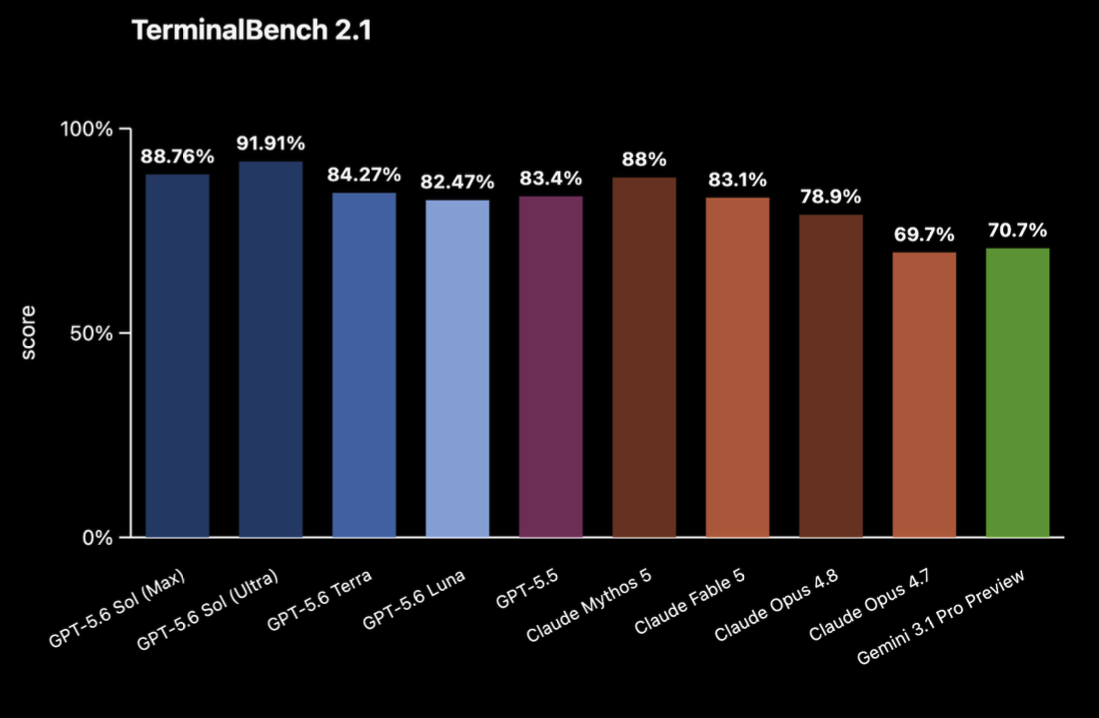
TerminalBench 2.1: In command-line automation tasks, both Sol and Terra significantly outperformed GPT-5.5. Sol, utilizing the new “ultra thinking mode,” achieved a leading score of 91.91% on the benchmark. The “max mode” also delivered strong results at 88.76%, surpassing GPT-5.5’s 83.4% and rivaling Claude Mythos 5’s 88%.
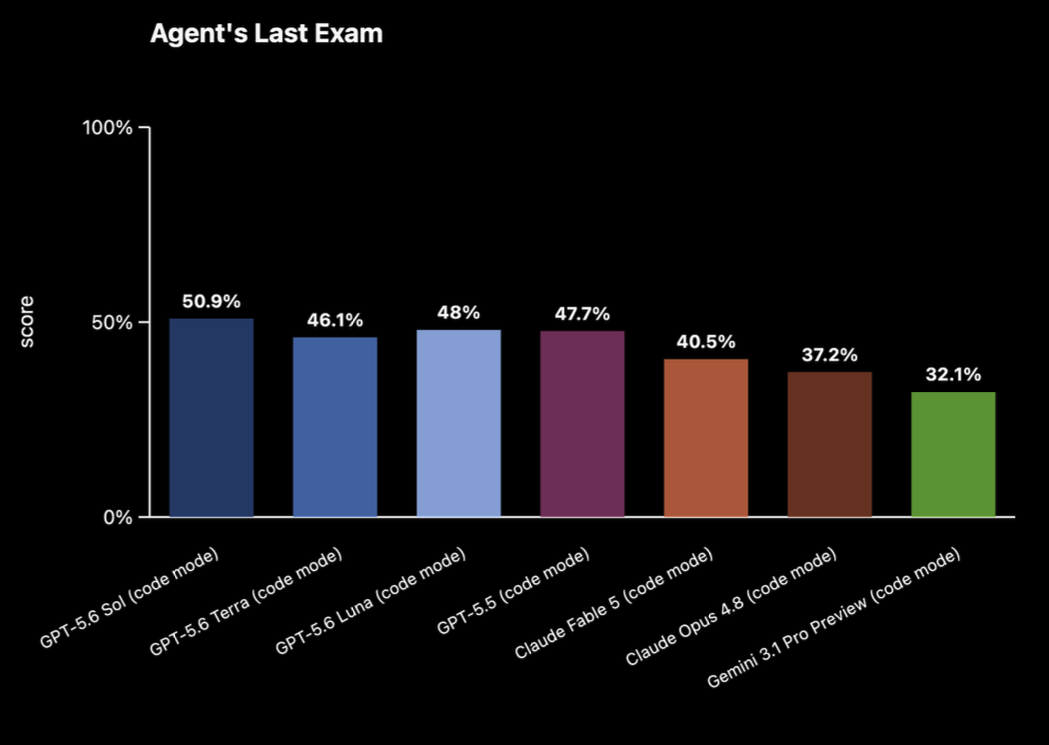
Agent’s Last Exam: In professional workflows, Sol is the only model to surpass the 50% task completion mark in “code mode” (50.9%). The Luna tier also shows marginal improvement over the previous generation’s flagship model.
Quantitative Biology and Genomics: Sol and Terra demonstrate higher accuracy rates compared to GPT-5.5 and GPT-5.4, with Sol achieving these improvements while consuming fewer tokens.
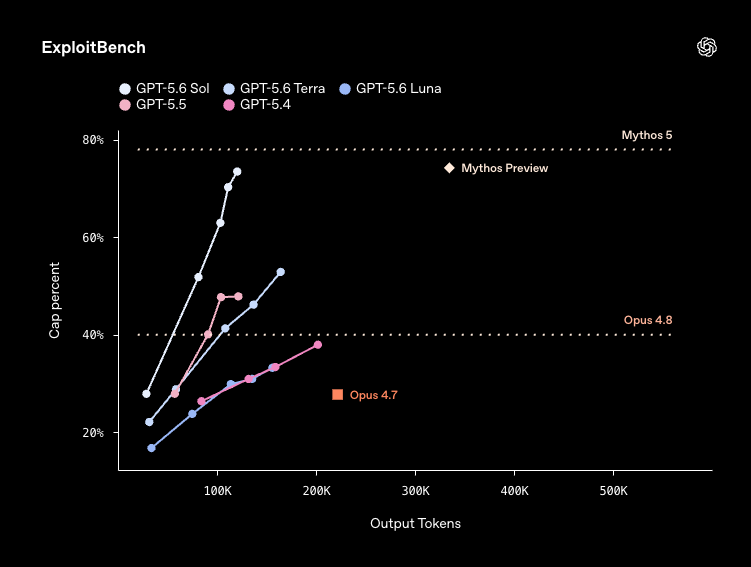
Cybersecurity Evaluations: On benchmarks like ExploitBench, Sol achieves results close to the previously previewed Claude Mythos model but uses approximately one-third of the output tokens. This efficiency is critical for cost management in demanding security workflows.
Predictable Costs with Caching and High-Speed Inference on Cerebras Hardware
To enhance cost predictability for enterprise applications leveraging agentic workflows, OpenAI is introducing a refined prompt caching mechanism for the GPT-5.6 API. This system guarantees a minimum cache lifetime of 30 minutes. Initial cache writes are priced at 1.25 times the standard input token rate, while subsequent cache reads benefit from a significant 90% discount.
This pricing structure incentivizes businesses to invest upfront in establishing caches for repetitive or similar operations, leading to substantial cost savings for repeated usage within the 30-minute window. This provides a crucial financial safeguard for operations involving large context windows or extensive code definitions.
For latency-sensitive enterprise applications, OpenAI is partnering with Cerebras to deploy GPT-5.6 Sol. This collaboration aims to deliver processing speeds of up to 750 tokens per second, targeting specialized use cases that demand real-time, state-of-the-art reasoning capabilities.
Enterprise Considerations: Robust Security Measures and Operational Guardrails
The deployment of GPT-5.6 necessitates a rigorous examination of its security architecture by corporate engineering, information security, and compliance teams. OpenAI reports dedicating approximately 700,000 A100e GPU hours to automated red-teaming GPT-5.6, focusing on identifying systemic “universal jailbreaks” rather than isolated vulnerabilities.
OpenAI has implemented a multi-layered, real-time safeguard system designed to mitigate risks:
- Model-level Refusals: GPT-5.6 is programmed to decline requests that mask malicious intent, seek assistance with prohibited cyber activities, or attempt to circumvent safety protocols.
- Live Misuse Screening: Dedicated detectors for cybersecurity and biological threats continuously monitor generations as they are produced.
- Activation-based Screening: For Sol and Terra models, activation classifiers monitor internal model signals during inference. If a risky pattern is detected, output streaming can be paused for an additional safety review. Luna, while not featuring this specific layer, is still subject to other monitoring systems.
- Reasoning Review Pauses: When potential risks are identified, generation may halt to allow a more comprehensive reasoning system to evaluate the exchange and context. If the output is deemed disallowed, it is blocked before reaching the user.
OpenAI acknowledges that the sophisticated nature of legitimate security research (code review, vulnerability discovery, patch engineering) can sometimes trigger false positives due to similarities with offensive exploit techniques. The system’s evaluation reports indicate a 94.8% recall rate for biology evaluations and an 81.6% recall rate for cybersecurity evaluations, demonstrating strong but not infallible protection.
Persistent flagging may lead to automated account-level reviews to distinguish between malicious behavior and standard security research. OpenAI is actively developing longer-term enterprise safety controls, including customer-operated overrides and privacy-preserving detection, to reduce the need for manual review of corporate data.
Notably, OpenAI emphasizes that Sol is optimized for defensive applications. While it can identify bugs and exploit primitives within large codebases like Chromium and Firefox, it has not demonstrated the capability to autonomously engineer complete, functional exploit chains, keeping it below OpenAI’s “Cyber Critical” alert threshold. However, all three GPT-5.6 models crossed OpenAI’s “High” cyber threshold in internal capture-the-flag tests, with scores of 96.7% for Sol, 91.84% for Terra, and 85.19% for Luna.
This distinction is critical for enterprise security procurement: GPT-5.6 is positioned as a powerful tool for automating aspects of vulnerability research and exploit analysis, but not as a fully autonomous system for advanced attack campaigns under current testing conditions.
Geopolitical Implications of a Phased Release Strategy
The staged release of the GPT-5.6 series underscores the increasing integration of frontier AI development with national security frameworks. The decision to grant initial access to a select group of vetted partners, whose details are shared with the U.S. government, reflects direct coordination concerning the evolving cyber executive order framework.
OpenAI has publicly voiced concerns regarding this governmental oversight, stating, “We don’t believe this kind of government access process should become the long-term default. It keeps the best tools from users, developers, enterprises, cyber defenders, and global partners who need them.”
This dynamic highlights the complex position of leading AI companies. While enterprises stand to gain significant advantages in agentic efficiency and defensive capabilities through models evaluated on benchmarks like ExploitGym and ExploitBench, access to these cutting-edge tools is increasingly subject to diplomatic and regulatory approvals.
Business Style Takeaway: OpenAI’s GPT-5.6 release, with its tiered Sol, Terra, and Luna models, signifies a strategic shift towards specialized AI applications for distinct business needs, balancing advanced capabilities with cost-efficiency. The emphasis on robust, government-aligned safety protocols and customizable caching mechanisms signals a maturing enterprise AI market where security, compliance, and predictable cost management are paramount for adoption.
Information compiled from materials : venturebeat.com