


The effectiveness of real-world AI applications is increasingly dependent on specialized “agent skills.” These skills, typically stored as collections of markdown (.md) files, serve as instructions that enable large language models (LLMs) to adapt to specific enterprise needs and complex operational workflows. However, optimizing these skills has historically been a cumbersome and error-prone process.
Unlike the parameters of the underlying AI model, agent skills cannot be trained through conventional deep learning methods. Instead, users often resort to manual updates of instructional text within each file, engaging in a form of guesswork to improve agent performance and mitigate errors.
Microsoft has introduced SkillOpt, a novel, open-source framework designed to revolutionize this optimization process. SkillOpt treats agent skills as trainable objects, allowing them to evolve based on performance feedback derived from execution. This innovative approach utilizes deep-learning-inspired optimization techniques to systematically refine the skill document, enhancing agentic AI capabilities without altering the core AI model’s weights.
Demonstrated on various industry benchmarks, SkillOpt significantly outperforms existing methods, yielding substantial accuracy improvements for models such as GPT-5.5 and Qwen. The framework generates compact, transferable skill artifacts that empower AI agents to adapt fluidly to new domains.
The Challenge of Optimizing Agent Skills
Agent skills encapsulate procedural knowledge through natural language specifications. These include domain-specific heuristics, guidelines for tool utilization, output constraints, and methods for handling known failure modes. By serving as an external interface, these skills allow AI agents to integrate seamlessly into intricate enterprise workflows. In practice, skills are typically stored as text documents and provided to the agent within its context window before execution.
A key advantage of this skill-based approach is its ability to customize agent behavior without modifying the fundamental parameters of the AI model. However, the skill document itself requires meticulous tuning and optimization to achieve peak performance from the agent.
While deep learning benefits from precise mathematical controls for stability, manual prompt engineering often relies on iterative trial and error. When attempting to automate the updating of skill documents based on performance feedback, the inherent volatility of text poses a significant challenge without a structured mathematical approach.
Yifan Yang, Senior Research SDE at Microsoft Research Asia, highlighted that the core issue is not the ability to make changes, but the inability to guarantee that these changes are mathematically sound and lead to genuine improvement. He stated, “The breaking point isn’t whether a team can change a skill, it’s that they can’t guarantee the change is an improvement. Three failure modes recur: no step-size control, so skills drift; no validation, so a fix that reads as reasonable gets written in and can quietly regress performance; and no negative memory, so the same failed edit keeps coming back.”
These challenges are exacerbated in multi-step workflows, as Yang noted, “because that’s where frontier models are weakest zero-shot. Not on reasoning, but on procedural discipline: format, self-verification, tool policy.” Previously, agent skills were largely handcrafted, generated in a single instance, or evolved through loosely controlled self-revision pipelines that struggled to reliably improve under feedback.
Existing prompt optimization techniques, such as TextGrad and GEPA, treat textual artifacts as optimizable entities and use feedback trajectories to refine prompts. However, their focus is on single-prompt configurations rather than generating persistent, reusable skill artifacts. Concurrently, skill evolution and discovery methods like EvoSkill and Trace2Skill convert agent execution experiences into learning lessons to refine skill folders, build domain-specific libraries, or perform evolutionary searches. Crucially, none of these methods incorporate deep-learning-style controls—such as learning rates, validation gates, and momentum—essential for continuously training a single, compact skill document.
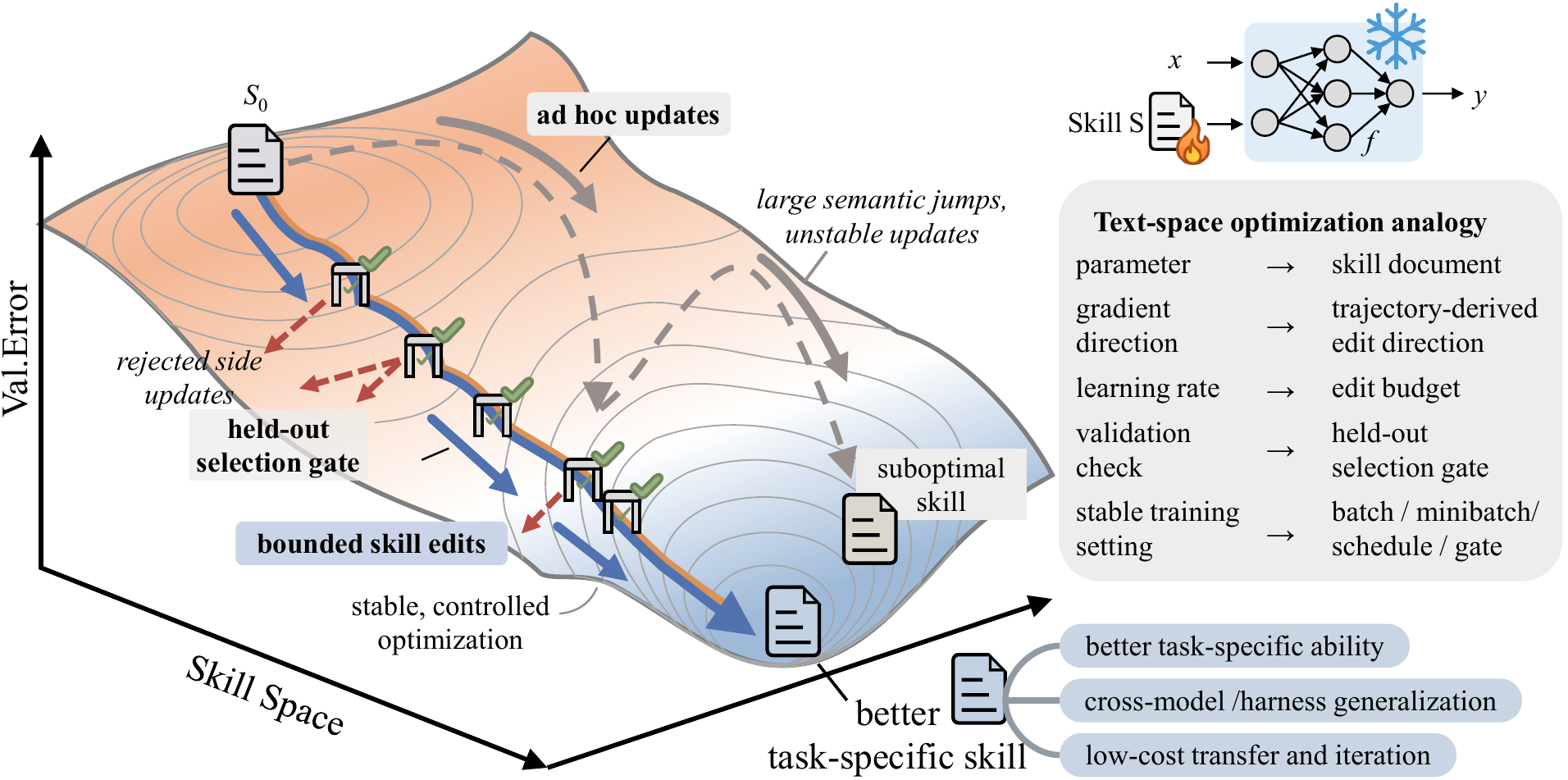
Yang observed that manual edits could easily degrade performance, citing an instance where “an ungated rewrite pushed GPT-5.5 on SpreadsheetBench from 41.8 down to 41.1.” He further elaborated that these issues are particularly pronounced in complex, multi-step workflows, which represent a key weakness for even advanced AI models in terms of “procedural discipline: format, self-verification, tool policy.”
Introducing Mathematical Rigor to Text Optimization
SkillOpt employs an iterative propose-and-test loop to optimize text documents, distinguishing between the model that executes tasks and the model responsible for skill optimization. The process involves several key stages:
-
SkillOpt commences with an initial skill document and a fixed target AI model. This model processes a batch of tasks, generating execution trajectories that serve as performance evidence for the current optimization step.
-
An offline optimizer model analyzes these trajectories, categorizing successful and failed task executions into minibatches. This minibatch analysis helps identify systematic procedural errors rather than isolated anomalies. Based on these observed patterns, the optimizer generates proposed modifications—additions, deletions, or replacements—for the skill document.
-
Candidate edits are then subjected to a review process to eliminate duplicates or conflicting suggestions. Following this, the optimizer ranks these candidate edits based on their projected utility.
-
Instead of applying all proposed changes, SkillOpt limits the number of edits applied in each step according to a defined budget, thereby creating a candidate skill document.
-
This candidate skill is rigorously evaluated on a separate validation dataset using the target AI model. If the candidate skill demonstrably improves the validation score, it is accepted and becomes the new operational skill. Conversely, if it fails to improve performance, the edits are discarded and logged into a rejection buffer, providing negative feedback to prevent the optimizer from repeating ineffective changes.
SkillOpt directly addresses the challenge of treating text as an optimizable object by integrating principles from deep learning optimization. The framework’s creators emphasize that this analogy is “operational rather than decorative,” enabling it to circumvent the instability issues common in alternative optimization methods.
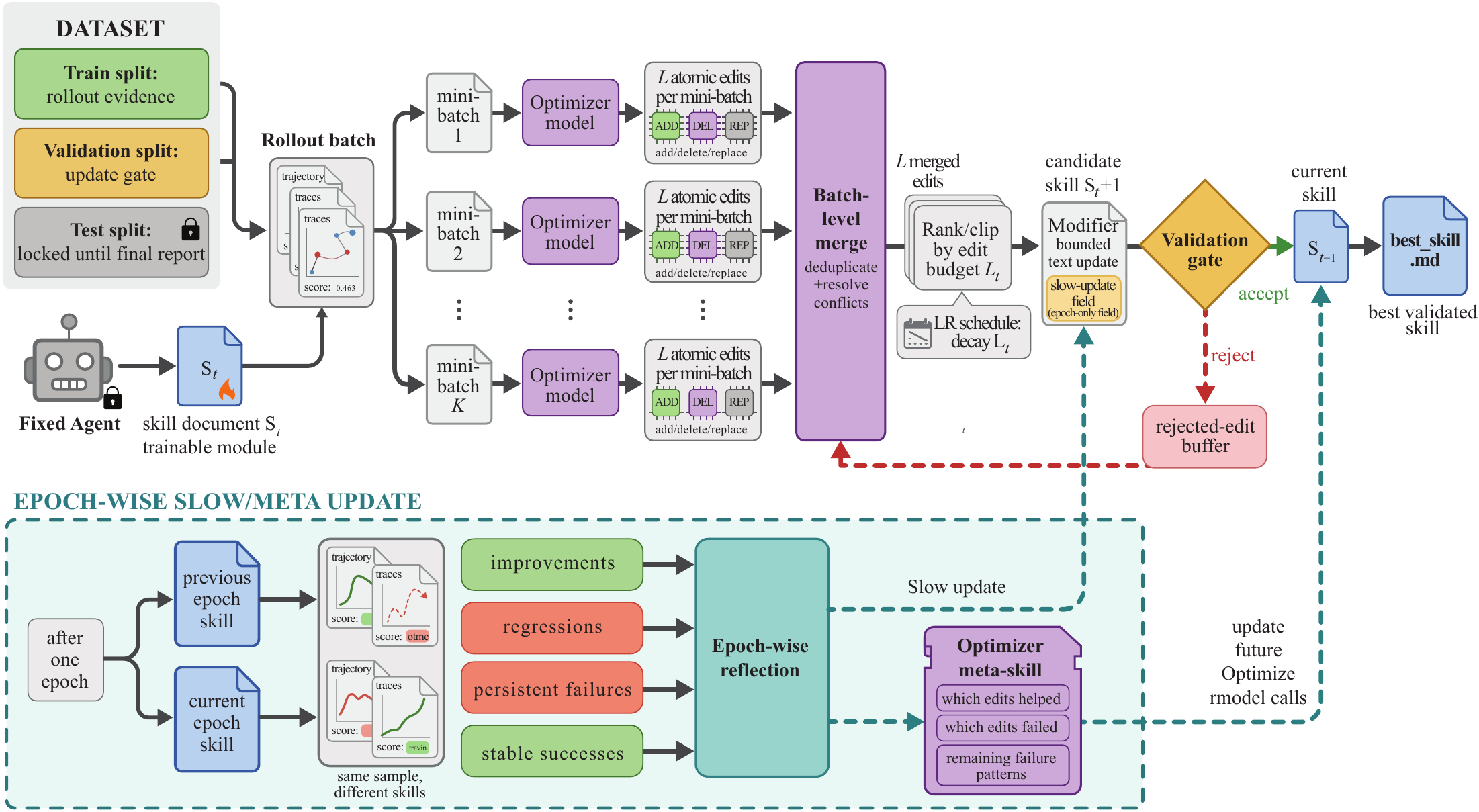
The concept of an “edit budget” functions analogously to a learning rate in deep learning. By constraining the number of edits applied per iteration, SkillOpt prevents the skill from diverging significantly from its previous state, ensuring continuity while facilitating the acquisition of new procedural knowledge. This methodical approach guarantees that only text edits proven to mathematically enhance the agent’s performance on validation tasks are incorporated.
Furthermore, SkillOpt incorporates a “momentum” mechanism by comparing task performance under the previous and current skill versions at the conclusion of each optimization epoch. This helps retain robust, long-term procedural lessons while isolating them from short-term, potentially unstable step-level edits.
SkillOpt in Practice
To validate its efficacy, researchers tested SkillOpt across a range of AI models, including large-scale frontier models like GPT-5.5, as well as smaller models such as GPT-5.4-mini and Qwen3.5-4B. The framework was deployed within various execution environments, encompassing simple chat interfaces and more complex coding environments like the Codex CLI and Claude Code. Evaluations were conducted using diverse industry benchmarks, covering single-turn question-answering, multi-turn code generation with tool integration, and multimodal document reasoning.
SkillOpt consistently outperformed multiple baselines, including scenarios with no skills, human-authored skills, and single-prompt LLM-generated skills. It also demonstrated superiority over advanced prompt optimization and skill evolution methods like Trace2Skill, TextGrad, GEPA, and EvoSkill. Across 52 tested combinations of models, benchmarks, and harnesses, SkillOpt proved highly effective, achieving an average absolute improvement of +23.5 points against the no-skill baseline on GPT-5.5. Notably, it even surpassed a hypothetical “oracle” baseline that selects the best-performing competing method for each specific task.
The framework yielded remarkable relative gains for smaller AI models, underscoring its ability to imbue these models with procedural knowledge absent in their core weights. For instance, GPT-5.4-nano experienced nearly a twofold increase in performance on multimodal document QA and a threefold improvement in tasks involving embodied interaction and sequential decision-making.
These academic results directly address critical enterprise pain points. Advanced AI models often struggle with tasks requiring precise formatting or correct tool utilization in multi-step processes. Yang highlighted that the most significant performance enhancements were observed in areas that have historically posed challenges for enterprise automation, such as “document data extraction… exact figures out of contracts, invoices, and forms — AP automation, claims, compliance.” He added, “What improves is reliability: precise formatting, self-verification, auditable outputs. And the gains come from learning procedure, not memorizing answers.”
For enterprise practitioners, SkillOpt’s primary advantages lie in its portability, efficiency, and compatibility with existing technological infrastructures. Experiments confirm that the framework is harness-agnostic; the same optimization loop successfully integrated into tool-based execution environments like the Codex CLI and Claude Code yielded substantial improvements on industry benchmarks. A spreadsheet skill trained within the Codex loop, for example, was seamlessly transferred to Claude Code, resulting in a +59.7 point gain over Claude Code’s native baseline without any further adjustments.
Moreover, SkillOpt artifacts demonstrate robust transferability across different model scales. A skill optimized for GPT-5.4 was effectively deployed onto smaller models like GPT-5.4-mini and GPT-5.4-nano, yielding positive performance gains. This indicates that the learned procedures encode reusable workflows rather than exploiting model-specific architectural nuances. The framework also excels in token efficiency, with final deployed skills rarely exceeding 2,000 tokens (median length around 920 tokens), ensuring readability and manageability for human practitioners.
Implementation Strategies and Enterprise Considerations
For enterprise technology leaders considering the adoption of SkillOpt, understanding the associated overhead and limitations is crucial. While academic benchmarks might involve substantial training token counts (up to 210 million), typical enterprise use cases are considerably lighter. Yang clarified, “The real upfront work is the verifier and a representative held-out split. The optimizer is light; the evaluation harness is where the engineering goes.” He estimates that for routine applications within community frameworks like GBrain, running SkillOpt updates on Claude Sonnet averages only $1–$5 per skill, a one-time cost that is fully amortized upon deployment.
However, the framework necessitates specific conditions for optimal performance, including a dataset of several dozen representative examples and a quantifiable feedback signal. SkillOpt is best suited for tasks with clear success criteria, and teams should avoid applying it to open-ended or subjective tasks. “With no clean automatic scorer you have to design a human- or model-based evaluator and watch its stability,” Yang advised.
SkillOpt integrates seamlessly with existing orchestration stacks, alleviating a significant adoption barrier. Developers utilizing pipeline compilers can run SkillOpt in conjunction with these systems. Yang noted, “DSPy is a different, complementary layer. It compiles declarative LM pipelines and optimizes program structure; SkillOpt optimizes the external skill state a frozen agent loads. You can run them together.”
The open-source community is already exploring periodic SkillOpt execution over agents’ historical trajectories, fostering an ecosystem of self-optimizing code-agent plugins. This continuous feedback loop signifies a pivotal evolution in how AI systems achieve adaptability. Yang concluded, “The valuable version of self-improvement is an agent autonomously discovering knowledge to improve its own behavior and the user experience, under verification and audit. Skills are the fastest, cheapest, most reversible first step, and the same mindset points toward agents eventually optimizing themselves, all the way down to their own weights.”
Business Style Takeaway: Microsoft’s SkillOpt framework introduces a mathematically grounded approach to optimizing AI agent skills, moving beyond manual prompt engineering. This innovation promises more reliable, adaptable, and efficient AI agents, directly addressing critical enterprise needs for accuracy and procedural discipline in automated workflows.
According to the portal: venturebeat.com