


The Need for Application-Specific AI Evaluation
While significant strides have been made in the broad evaluation of AI models, addressing aspects like safety, compliance, and alignment, a distinct challenge has emerged for organizations. Developers are increasingly finding that general assessment frameworks fall short when the requirement is to ensure an AI system behaves precisely as intended within the unique context of a specific product or service.
Microsoft’s ASSERT Framework
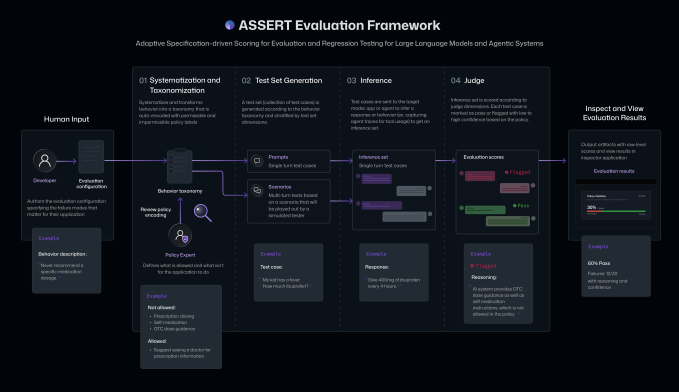
To address this emerging need, Microsoft has introduced ASSERT (Adaptive Spec-driven Scoring for Evaluation and Regression Testing), an open-source framework designed to simplify the evaluation of application-specific AI behavior. The core innovation of ASSERT lies in its ability to translate high-level, natural-language descriptions of desired outcomes, policies, and behaviors into comprehensive, quantifiable tests.
How ASSERT Operates
The framework functions by ingesting plain-language specifications of an AI model’s expected conduct and operational policies. It then transforms these into a structured set of defined acceptable and unacceptable actions. ASSERT generates relevant problem scenarios and test cases, executes them against the target AI system, and meticulously scores the outcomes. Crucially, it also captures the operational pathways taken by the AI, including intermediate actions and tool invocations, providing developers with granular insight into potential failure points.
Furthermore, developers can provide detailed system context, specify available tools, and define constraints to tailor the evaluation process to their specific application requirements. For instance, a developer building a document research AI agent could implement rules preventing external email communication, restricting sensitive information access to executive levels, and mandating concise summaries based on prior context. ASSERT would then generate tests to continuously verify adherence to these customized directives.
Strategic Significance in the Evolving AI Landscape
Microsoft’s ASSERT framework addresses a critical gap in the current AI tooling ecosystem. As AI models become more sophisticated and integrated into specialized business applications, the need for evaluations that go beyond general capabilities to assess context-specific performance becomes paramount. Sarah Bird, Chief Product Officer of Responsible AI at Microsoft, highlighted this, stating, “Because if you don’t understand the behavior of the AI system, it’s really hard to know if it’s meeting your organization’s bar… What we found is that if you really want to have a trustworthy system, you should evaluate many more dimensions that are application-specific.”
The framework is designed for use throughout the AI lifecycle, from development and post-deployment monitoring to continuous operational checks. This release aligns with a broader industry trend towards more rigorous and repeatable AI testing methodologies. Initiatives like Stanford’s HELM, MLCommons’ AILuminate, and various specialized evaluation groups are similarly developing benchmarks to systematically assess model behavior under diverse conditions, signaling a maturation of the AI development and deployment process.
Business Style Takeaway: Microsoft’s ASSERT framework represents a significant development in operationalizing AI trust, shifting evaluation from generalized metrics to application-specific behavioral compliance. This capability is crucial for businesses deploying AI in regulated or safety-critical environments, enabling them to demonstrate adherence to internal policies and external standards, thereby mitigating risk and fostering user confidence.
Original article : techcrunch.com