

Enabling Large Language Models (LLMs) to continuously acquire new knowledge post-training presents a significant challenge for enterprise AI. Existing solutions often face trade-offs involving high costs, slow processing times, or limitations imposed by context window sizes.
A novel framework, dubbed MeMo (Memory as a Model), developed by researchers from multiple academic institutions, proposes a solution by encoding new information into a specialized, smaller memory model that operates independently of the main LLM. This modular design is compatible with both open-source and proprietary models, circumventing the complexities typically associated with Retrieval-Augmented Generation (RAG) pipelines and full model retraining.
Experimental results indicate that MeMo demonstrates robust performance in handling complex queries, even when faced with noisy retrieval inputs. It effectively avoids the “catastrophic forgetting” phenomenon often seen in direct fine-tuning methods and offers a more cost-efficient approach for perpetual knowledge updates.
The Challenge of Updating LLM Knowledge
Large language models, once trained, possess static internal knowledge. Updating this knowledge requires computationally intensive retraining processes.

Current methods for integrating external knowledge into LLMs fall into three primary categories, each with inherent limitations:
- Non-parametric methods, such as Retrieval-Augmented Generation (RAG) and in-context learning, retrieve relevant data from external sources and embed it directly into the model’s prompt. However, these approaches are constrained by the fixed size of the model’s context window. Furthermore, the semantic similarity of retrieved embeddings does not always align with the user’s query intent. Processing extensive retrieved text introduces significant computational overhead and inference latency. Crucially, RAG systems are highly susceptible to noise; irrelevant or poorly retrieved information can degrade the quality of the model’s output.
- Parametric methods, including continual pretraining and supervised fine-tuning, aim to directly incorporate new knowledge into the LLM’s internal parameters (weights). For contemporary, large-scale LLMs, this process is prohibitively expensive and often unfeasible for proprietary models accessed via APIs. Fine-tuning also risks causing “catastrophic forgetting,” where the model loses previously acquired reasoning abilities or safety protocols when adapting to new data.
- Latent memory methods, such as context compression, represent a middle ground by compressing knowledge into compact “soft tokens” or representations added to the model’s context during inference. The primary drawback is “representation coupling,” where the compressed memory is intrinsically tied to the specific model architecture that generated it, preventing its transfer to different model architectures.
MeMo: A Modular Memory Framework
The MeMo framework introduces a modular architecture comprising two distinct components: a MEMORY model and an EXECUTIVE model. The MEMORY model is a smaller language model specifically trained to encapsulate new knowledge within its parameters. The EXECUTIVE model is a pre-existing, static LLM that serves as the reasoning engine. When a query is posed, the EXECUTIVE model interacts with the MEMORY model as an external knowledge source, issuing targeted sub-queries to gather facts and then synthesizing these into a comprehensive answer.
Central to MeMo’s design is the concept of “reflections.” These are structured question-answer pairs generated to comprehensively cover a knowledge corpus. Instead of processing vast amounts of raw text, MeMo employs a GENERATOR model to distill information into thousands of targeted QA pairs. The MEMORY model is subsequently fine-tuned on this dataset, enabling it to answer questions based solely on its learned parametric knowledge without needing direct access to retrieved context.
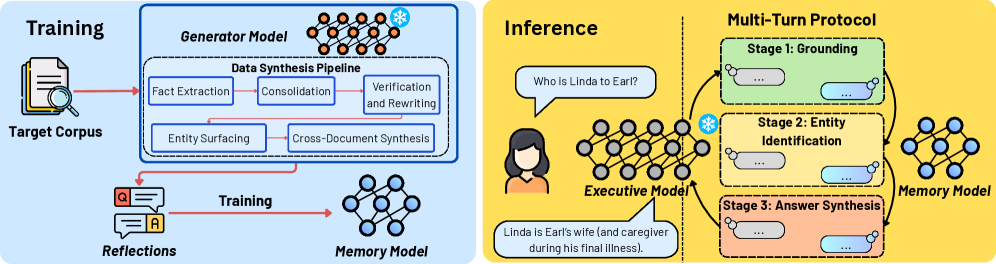
During inference, the interaction between the EXECUTIVE and MEMORY models follows a three-stage protocol:
- The EXECUTIVE model first breaks down a complex user query into simpler sub-questions. The MEMORY model responds to each of these to establish foundational facts.
- Using these initial facts, the EXECUTIVE model formulates follow-up queries to progressively narrow down candidate entities until a definitive target is identified.
- Finally, the EXECUTIVE model requests supporting factual information from the MEMORY model regarding the identified target entity and then synthesizes these details into a coherent answer.
This architecture elegantly merges the advantages of existing AI memory paradigms while mitigating their respective drawbacks. By maintaining separate storage for knowledge and reasoning, it ensures compatibility with both open-weight and closed API models. It internalizes knowledge into parameters but isolates updates to a dedicated, smaller MEMORY model, thereby safeguarding the core reasoning engine. Furthermore, it generates a queryable memory artifact that is independent of any specific LLM, allowing it to be utilized across different model families.
Efficient Continual Knowledge Updates
Keeping an AI’s knowledge base current is essential as enterprise policies evolve and new data emerges. Traditional methods involve retraining the entire model on a combined dataset of old and new information, a process that becomes increasingly costly and time-consuming as the knowledge base expands.
MeMo addresses this by employing a “model merging” technique. Instead of a full retraining cycle, it trains a new, independent MEMORY model exclusively on the updated documents. A “task vector,” representing the parameter changes learned from the new data, is then mathematically merged into the weights of the existing MEMORY model. This approach significantly reduces the computational resources required for updates and prevents the disruptive interference that leads to catastrophic forgetting.
A noted trade-off of this method is a slight reduction in accuracy, estimated between 11% and 19% compared to a full retraining, depending on the reasoning model used.
MeMo in Practice
To assess MeMo’s efficacy, the research team conducted evaluations on industry benchmarks requiring complex, multi-hop reasoning across extensive documents. The GENERATOR model used for distilling raw text into reflections was Qwen2.5-32B-Instruct, with Qwen2.5-14B-Instruct serving as the primary MEMORY model. The framework’s versatility was further demonstrated using smaller models like Gemma3-1B.
For the EXECUTIVE reasoning component, tests included both the open-weight Qwen2.5-32B and Google’s proprietary Gemini 3 Flash. MeMo was benchmarked against an optimal “Perfect Retrieval” scenario and advanced retrieval systems such as BM25, dense vector retrieval, and the state-of-the-art graph-based RAG (HippoRAG2). Additionally, a method called “Cartridges,” which loads a trained KV-cache during inference, was included in the comparison.
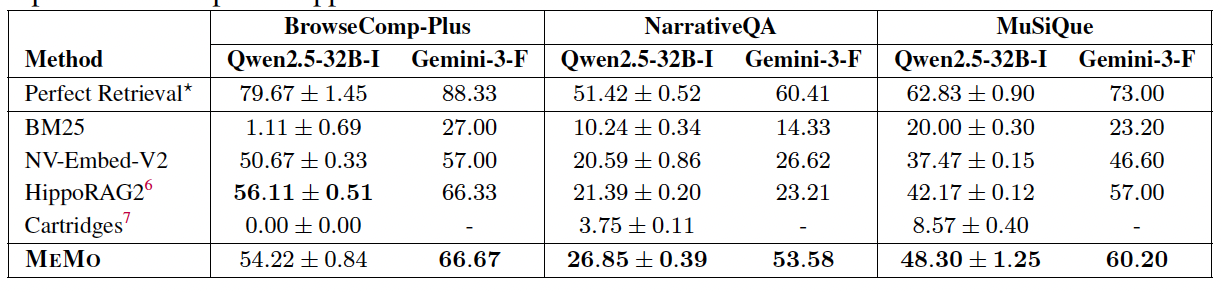
On the NarrativeQA benchmark, MeMo achieved an accuracy of 53.58% when paired with Gemini 3 Flash, significantly outperforming HippoRAG2, which reached a maximum of 23.21%. This capability is crucial for enterprise applications that require synthesizing complex information from disparate sources, such as navigating intricate regulatory frameworks or consolidating insights from extensive documentation and codebases. Unlike traditional RAG systems, which struggle with context limitations and identifying cross-document relationships, MeMo excels because these connections are internalized within the MEMORY model during its training.
A notable advantage is the ability to upgrade the reasoning engine without requiring any retraining. Switching the EXECUTIVE model from an open-source option to the proprietary Gemini 3 Flash resulted in substantial performance improvements—a 26.73% increase on NarrativeQA and 11.90% on the MuSiQue benchmark. This allows organizations to securely train a MEMORY model on private data and then seamlessly integrate it with the latest commercial LLMs, continuously enhancing system intelligence without incurring additional training costs.
The integration process is described as straightforward: “The base (or Executive) LLM that teams are already using in RAG can be configured to query the Memory model directly. These queries are done in natural language, similar to sending a message request to an API, with no additional setup required.”
MeMo also demonstrates remarkable resilience to noisy data. When confronted with datasets intentionally contaminated with irrelevant documents, HippoRAG2 experienced a significant performance drop, while MeMo’s accuracy remained largely stable. This robustness is critical for enterprise knowledge bases, which are often characterized by disorganization and outdated information. By interacting with a synthesized knowledge source rather than raw document chunks, MeMo avoids the issues of hallucinations caused by RAG systems processing incorrect information.
Limitations and Considerations
For engineering teams considering the deployment of MeMo, several limitations warrant attention:
- Upfront Training Costs: Unlike traditional RAG systems that involve indexing raw documents into a vector database, MeMo requires an initial training investment for each new corpus. The data generation pipeline for creating “reflections” is computationally intensive. The research team reported approximately 240 GPU-hours for dataset generation and 180 H200 GPU-hours for training a 14B parameter MEMORY model. Reducing these training costs is identified as a key area for future research.
- Capacity Limits: As a fixed-size neural network, the MEMORY model has a finite capacity for knowledge internalization. While the researchers did not encounter a hard limit in their experiments, they suggest that very large or information-dense corpora might exceed its representational capabilities.
- Provenance Obscurity: MeMo synthesizes answers from its parametric memory rather than retrieving exact text snippets. This lack of direct source attribution can pose a compliance challenge for enterprise applications that require strict audit trails and clear evidence of information provenance.
The choice between MeMo and traditional RAG hinges on the nature of the task and data volatility. Traditional RAG is generally preferred for queries where answers reside within a single document or have a clearly defined source. MeMo is more advantageous when the task involves synthesizing information scattered across multiple documents. For knowledge bases that change rapidly and require precise source citations, RAG remains the more suitable option due to MeMo’s upfront training costs. Conversely, for slowly evolving, generalized domain knowledge, MeMo offers superior reasoning capabilities. Hybrid architectures, routing queries to either a vector database or the MEMORY model based on the query type, present a pragmatic approach for production environments.
As Daniela Rus, a co-author of the paper and director of MIT’s Computer Science and Artificial Intelligence Lab (CSAIL), noted, “Looking further out, I would expect memory models to become a standard architectural component alongside retrieval, in the same way that caching and indexing are standard components of any serious data system today.”
Business Style Takeaway: The MeMo framework offers a significant advancement in managing and updating LLM knowledge, addressing key enterprise challenges like cost, latency, and information obsolescence. Its modular, independent memory component allows for continuous knowledge integration without costly full model retraining, making it a potentially transformative solution for dynamic data environments.
Based on materials from : venturebeat.com