


The widespread adoption of AI agents within enterprise environments faces a significant hurdle: their inherent inability to immediately comprehend the nuanced operational specifics of individual businesses. Unlike a general-purpose AI, an enterprise-grade agent requires deep understanding of proprietary definitions, access controls, and internal workflows. This necessity often leads to AI vendors deploying engineers for customer-specific integration, highlighting a gap in readily deployable, context-aware AI solutions.
Jedify’s Context Graph Approach
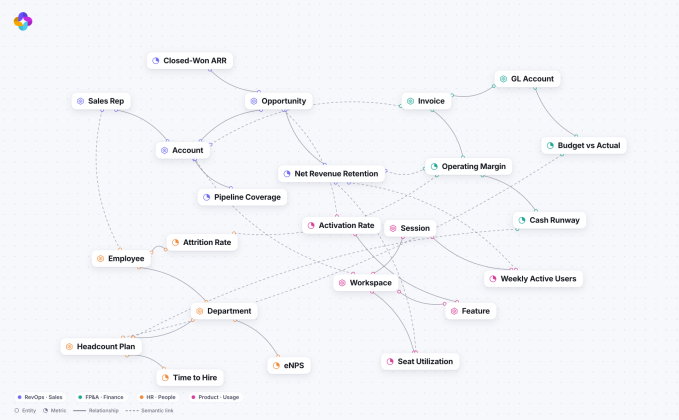
New York-based startup Jedify is addressing this critical integration gap with its proprietary platform. The company has developed a method to connect to an enterprise’s diverse knowledge sources via APIs, constructing a “context graph” that provides AI agents with a detailed understanding of the business’s operational landscape. These sources encompass structured data repositories such as databases, data warehouses, and BI tools, alongside unstructured content including internal documentation, code repositories, and communications from platforms like Slack.
Series A Funding and Strategic Partnerships
Jedify has successfully secured $24 million in a Series A funding round, spearheaded by Norwest. The investment round also saw continued participation from existing backers S Capital VC and Cerca Partners, alongside new investor Oceans Ventures. Notably, data analytics giant Snowflake joined as a strategic investor, signaling a commitment to integrating Jedify’s technology with its own AI offerings, including Cortex AI, Semantic Views, and CoWork.
The Value of Multi-Dimensional Context
Jedify’s core proposition is that effective AI agents require more than just access to raw data; they need to understand the intricate relationships between entities, data points, user permissions, domain-specific knowledge, established workflows, operational assumptions, and unique business terminology. This multi-dimensional context allows AI agents to precisely narrow their focus to task-relevant information, rather than undertaking exhaustive, inefficient searches across an entire organization’s data estate.
Co-founder and CEO Assaf Henkin illustrated Jedify’s application with Kiteworks, a compliance firm. By integrating data from Snowflake, Tableau, Notion, and internal playbooks, Kiteworks leveraged Jedify to create specialized agentic tools for various customer-facing workflows. Henkin described this as enabling sales and account teams with a sophisticated application that acts as both a dynamic dashboard and a real-time conversational assistant, proactively surfacing critical customer-specific information during client interactions.
Differentiating from Existing Data Architectures
Henkin posits that Jedify’s context graph offers a distinct advantage over traditional semantic layers, metadata catalogs, and knowledge graphs. Its multi-dimensional nature captures a broader spectrum of relationships, including those between entities, data, personnel, permissions, and customers. Crucially, the graph is model-agnostic and updates dynamically in real-time, reflecting the continuous flow of information within connected systems. He argues this architecture is superior for enabling autonomous AI agents that can drive decisions across disparate data sources, such as CRM, support tickets, and real-time telemetry data, compared to the limitations of a simpler semantic layer.
Addressing Permissions and Governance
The critical aspect of permission management is addressed by Jedify’s design. The platform inherits access controls from various identity and data systems, including granular row-, column-, and table-level rules. It further allows organizations to define custom permission groups for AI agents and workflows, ensuring that sensitive information is not inadvertently exposed. Jedify also provides robust observability and governance tools to ensure AI agent behavior aligns with enterprise policies.
Target Market and Competitive Landscape
Jedify is currently focused on mid-market and large enterprises with established data infrastructures and multi-system environments. The company reports having between 10 and 20 early customers, including The Weather Company, and is experiencing significant interest from data-intensive sectors like gaming, industrials, and consumer packaged goods. The partnership with Snowflake is particularly significant, as it positions Jedify as a complementary solution. Henkin contends that while large data platforms aim to centralize data, much of a company’s critical data and institutional knowledge remains distributed across various systems, a limitation that Jedify is designed to overcome.
Furthermore, Henkin points out the substantial cost and complexity for companies attempting to build comparable context layers independently, especially given the increasing scrutiny on AI token consumption. As AI models rapidly advance and become more commoditized, the proprietary, context-rich data layer that Jedify provides is poised to become a durable competitive moat.
The newly acquired capital will be allocated towards product development, talent acquisition, and scaling go-to-market initiatives. This funding brings Jedify’s total capital raised to approximately $33 million.
Business Style Takeaway: Jedify’s success in raising $24 million underscores the growing enterprise demand for AI solutions that move beyond generic capabilities to deeply understand and leverage specific business context. For organizations, investing in or adopting platforms that can build these proprietary “context graphs” is becoming crucial for unlocking the full potential of AI agents and maintaining a competitive edge in data utilization and operational efficiency.
Source: : techcrunch.com