


Enterprise teams consistently face a recurring challenge: AI agents that perform impressively during demonstrations falter in production. They operate effectively for a limited period before requiring human intervention to refine their context and validate their output, thereby diminishing the anticipated efficiency gains. This cycle of human oversight is a primary reason why numerous AI agent pilot programs fail to transition into robust production systems.
The compelling proposition that every team desires is an AI agent capable of autonomously completing extensive tasks, potentially running overnight, with human validation needed only for the final 10% of the output. The feasibility of this goal hinges on a fundamental problem that is often overlooked in discussions about AI agent orchestration. When Chroma, an AI firm, evaluated 18 leading models, every single one exhibited a decline in accuracy as the input volume increased. This phenomenon is an inherent property of how attention mechanisms function, not a deficiency that a more powerful model can inherently overcome. Consequently, an agent processing an ever-expanding volume of enterprise data does not become more reliable; it becomes less so.
This issue operates at a foundational layer beneath the current race for AI agent orchestration. Concepts like routing, durable execution, and observability all presuppose that each agent is sufficiently competent to coordinate effectively in the first place. The more critical question is the duration an agent can operate independently before human oversight becomes necessary, a factor intrinsically linked to the proximity of your organization’s knowledge base relative to the AI model. Both conventional solutions necessitate continuous human involvement.
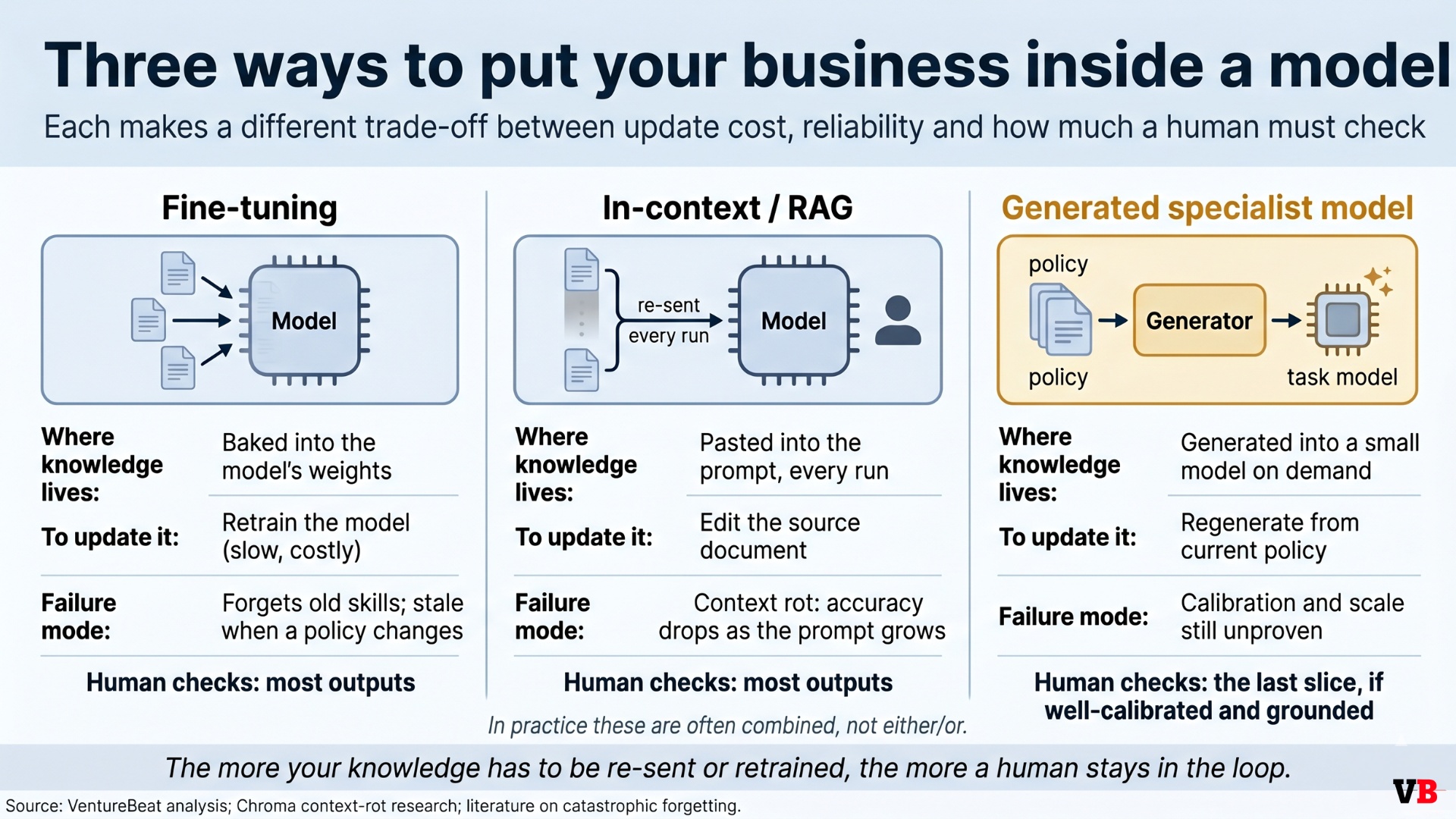
The Persistent Loop: Why Integrating Your Business Knowledge Remains Challenging
As artificial intelligence models continue to advance in capability, a fundamental challenge persists: it is not a matter of model power but rather the locus of an organization’s proprietary knowledge relative to the AI. Enterprises have historically relied on two primary methods to imbue models with specific business context:
The first method, fine-tuning, embeds knowledge directly into the model’s parameters. However, this approach remains susceptible to “catastrophic forgetting,” a problem documented since the 1980s and still unresolved. The process of teaching a model new information can degrade its existing knowledge. To mitigate this, organizations often isolate each task within its own fine-tuned model or adapter, leading to a complex and sprawling ecosystem of models that increases management overhead and governance challenges. Furthermore, a fine-tuned model represents a static snapshot; it becomes outdated the moment a policy changes, necessitating costly and time-consuming retraining cycles.
The second method, in-context learning, bypasses retraining by incorporating relevant information directly into the model’s prompt at runtime. This is where the issue of “context rot” becomes problematic. While retrieval mechanisms help narrow down the information fed into the prompt, a retrieval failure can be indistinguishable from a confident, albeit incorrect, answer. Moreover, both the computational cost and latency increase proportionally with the number of tokens added to the prompt.
These two approaches share a common drawback. With fine-tuning, the model might confidently operate based on outdated information, such as last quarter’s policies. With in-context learning, it could confidently rely on information lost within a lengthy prompt. In either scenario, the outputs appear equally authoritative, making it impossible to identify errors without a comprehensive review of all outputs. This inherent unreliability is why human oversight remains indispensable. Some organizations attempt to mitigate these issues by employing both methods concurrently, fine-tuning for stable knowledge while retrieving dynamic information. While this can soften the impact of each failure mode, it does not eliminate them. Consequently, on any given output, there remains uncertainty about whether the model is both current and utilizing the correct context, necessitating continued human verification.
A Novel Alternative: On-Demand Generation of Specialized Models
A third approach, emerging from research into practical applications, offers a potential solution. Instead of retraining a single model or stuffing its prompt with extensive context, this method involves a generator that constructs a small, task-specific model dynamically at inference time. This generator functions as a “hypernetwork”—a neural network whose output consists of the parameters (weights) of another network.
The concept of hypernetworks, first theorized in 2016, is now being applied to generate specialized language models from text or documents. This is a recent and rapidly evolving area of research. Sakana AI’s Text-to-LoRA, presented at ICML 2025, demonstrated the ability to generate a model adapter from a plain-language description in a single pass. Similarly, a 2026 system named SHINE champions hypernetwork adaptation as a promising frontier, precisely because it circumvents both the retraining expenses associated with fine-tuning and the context limitations inherent in prompting.
The advantage of generating model adapters on demand, rather than training and storing numerous individual adapters, is the ability to consolidate a sprawling library of per-task LoRAs (Low-Rank Adaptations) into a single, versatile network. This network can produce the necessary adaptations for tasks it has never encountered before.
The elegance of this approach lies in its direct resolution of the aforementioned challenges. The per-task adapters that teams painstakingly create to avoid catastrophic forgetting are precisely the artifacts that a hypernetwork can generate automatically. This transforms a potential “model zoo” governance headache into a streamlined, generated output.
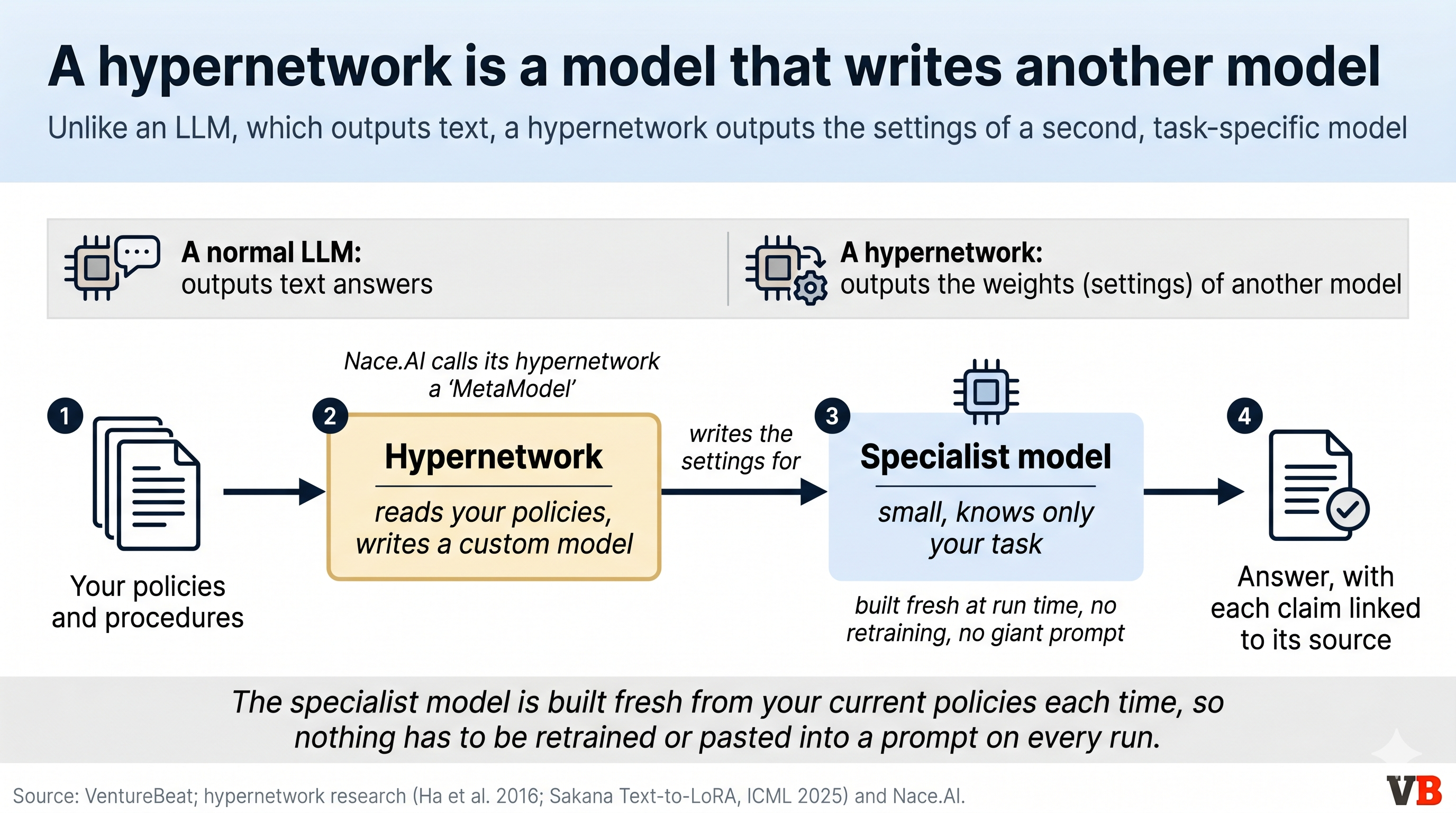
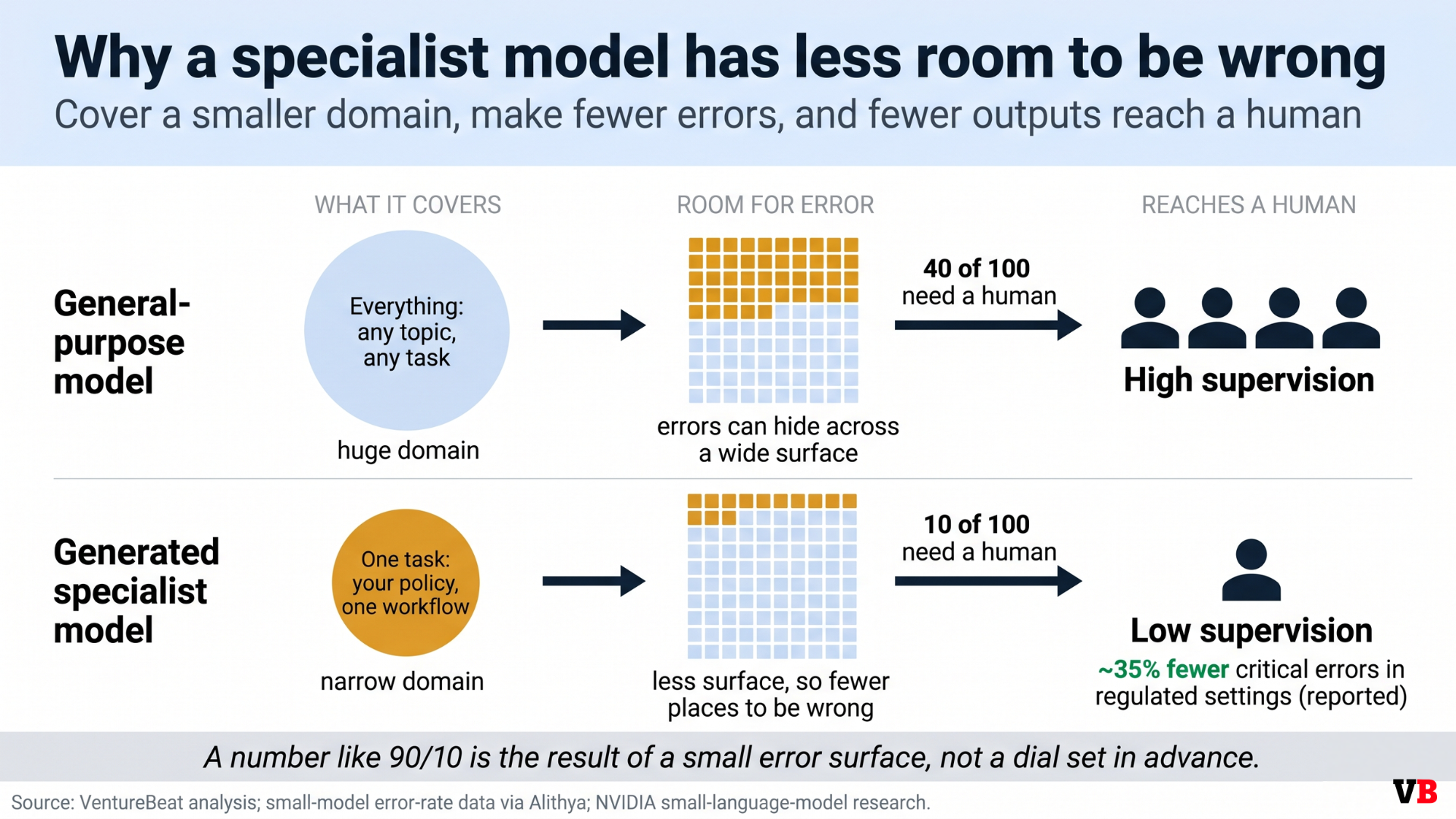
A significant finding from a 2025 paper by Nvidia researchers underscores the value of specializing models: for the narrow, repetitive tasks common in agent workflows, smaller, specialized models are often sufficiently capable and dramatically more cost-effective to operate than large, general-purpose models—up to 10 to 30 times cheaper. Nace.AI, a Palo Alto-based company that secured $21.5 million in seed funding in May, exemplifies this approach. Its core technology, termed a MetaModel, dynamically generates parameter adaptations for an AI model based on an enterprise’s specific policies, particularly for regulated domains such as audit, compliance, and risk assessment. The company claims its agents handle the majority of a workflow, with human experts validating the results, a process they market as a 90/10 split.
Comparative Analysis of AI Knowledge Integration Strategies
|
Fine-tuning |
In-context / RAG (Retrieval-Augmented Generation) |
Hypernetwork-Generated Models |
|
|
Location of Business Knowledge |
Embedded within the model’s weights. |
Supplied within the prompt for each run. |
Contained in dynamically generated weights. |
|
Cost of Policy Updates |
High: Requires full model retraining. |
Low: Involves editing the source data. |
Low: Primarily requires regeneration. |
|
Knowledge Staleness |
High: Represents a static snapshot. |
Low: Reflects the most current data source. |
Low: Regenerated from up-to-date policies. |
|
Runtime Cost & Latency |
Low. |
High: Increases with context length. |
Low during runtime. |
|
Primary Failure Mode |
Catastrophic forgetting; model proliferation. |
Context rot; silent retrieval errors. |
Quality of the generator; calibration issues. |
|
Ownership of Improvement Asset |
Belongs to the entity training the model. |
Belongs to the owner of the data store. |
Variable: depends on generator and feedback location. |
Elevating Autonomy: The Impact of Hypernetwork-Driven Models
A model that is specialized, current, and compact possesses a reduced surface area for potential errors. Fewer mistakes, confined to a well-defined domain, translate to fewer outputs requiring human escalation—a critical factor for any significant claim of autonomy. This efficiency is the basis for metrics like the 90/10 split, which is not a predetermined setting but rather an emergent outcome of minimal human intervention. Autonomy metrics should thus be interpreted as indicators of architectural effectiveness rather than configurable parameters.
Two critical design considerations determine whether this elevated autonomy is reliable or merely rapid. Firstly, grounding—the practice of linking every output to its source data—enables reviewers to verify rather than re-perform the work. Research models specifically designed for this purpose, such as HalluGuard, flag each assertion as supported or unsupported and cite the exact passage used. Nace integrates its agents with grounding models and reasoning traces to achieve the same objective. A 10% review process is only meaningful if human reviewers can confirm the provenance of information within seconds.
Secondly, the feedback loop is paramount, prompting a crucial question for any prospective buyer: when your experts validate an output, which model is improved, and where does it reside? This dictates whether the evolving asset benefits the vendor or your organization. The arrangements vary. Nace, for instance, utilizes an external network of certified experts for certain engagements and, for direct enterprise deployments, leverages the customer’s own staff, with the resulting model being retained within the customer’s cloud infrastructure. Each of these choices directs the learning process and ownership accordingly.
Potential Limitations of the Hypernetwork Approach
This methodology is still in its nascent stages, and its ultimate trajectory will depend on addressing several key challenges. Model calibration—the ability of the AI to accurately self-assess its certainty—is fundamental to its utility. Emerging research indicates that hypernetwork-generated adapters do not inherently improve calibration over standard fine-tuning; demonstrable gains are observed only under specific conditions.
Furthermore, the quality of the generated model is highly dependent on the accuracy and curation of the source policy data. Current research on hypernetworks typically involves relatively small-scale models. Nace’s work is particularly noteworthy in this context; the company reports scaling its generator significantly beyond published sizes and has identified a scaling law for performance enhancement. Initial findings are being shared publicly and are undergoing peer review. If validated, this could provide crucial insights into one of the field’s most pressing open questions, making this research a critical area to monitor.
Regardless of the chosen approach, human involvement remains the final stage. The transition from AI to human review presents its own set of design challenges. A notable example involved Deloitte Australia’s delivery of a government report, which, despite passing senior review, contained fabricated citations and a spurious court quotation. The reviewers had validated the conclusions, which were accurate, but had failed to scrutinize the provenance, which was not. Controlled research suggests a pattern of “automation bias,” where human experts are less likely to correct flawed recommendations when they are flagged as AI-generated.
The EU AI Act’s Article 14 directly addresses this phenomenon. The core lesson extends beyond specific vendors: high levels of automation concentrate human attention into a brief, terminal phase of the workflow. The effectiveness of this final review hinges entirely on the human reviewer’s ability to rapidly verify provenance, which, in turn, relies heavily on robust grounding mechanisms.
Strategic Considerations for Development and Procurement
The pragmatic conclusion is that the primary limitation of AI agents is typically not orchestration or model scale, but rather the model’s depth of understanding of a specific business, which dictates its capacity for independent operation. The optimal solution is contingent upon the specific task. For long-running, repetitive, high-volume processes requiring end-to-end automation, a hypernetwork-generated model offers the most cost-effective and sustainable solution, likely enabling the necessary operational duration. For shorter tasks involving a few discrete steps that do not require unattended operation, the benefits of integrating advanced methods like hypernetworks over a well-prompted frontier model may be marginal and not justify the integration costs.
When evaluating vendor claims of autonomous or specialized agents, four critical questions should guide your assessment:
-
Where is the proprietary business knowledge stored: within the model’s weights, the prompt, or dynamically generated?
-
What mechanisms are in place to allow a reviewer to verify outputs without re-execution?
-
What criteria determine when a task is escalated for human intervention?
-
From the feedback provided, which model is improved, and where is it deployed?
The answers to these questions, rather than headline performance ratios, will reveal the true value and capabilities of the solution being offered.
The hypernetwork approach represents the most promising strategy to date for enabling small, specialized models to effectively learn and retain specific business knowledge without forgetting prior information or requiring constant re-explanation. However, critical aspects such as model calibration and scalability are still undergoing rigorous peer review. For appropriate use cases, piloting this technology now is advisable. For misaligned applications, the integration complexities offer limited advantages over a well-prompted general-purpose model.
Business Style Takeaway: The challenge of maintaining AI agent accuracy and autonomy over extended operations is being addressed by novel “hypernetwork” architectures that dynamically generate specialized models. This approach promises to reduce costs and improve reliability by creating tailored, up-to-date AI components on demand, potentially overcoming the limitations of traditional fine-tuning and retrieval-augmented generation (RAG) methods.
Information compiled from materials : venturebeat.com