

Following its recent announcement of a merger with German AI firm Aleph Alpha, Canadian artificial intelligence laboratory Cohere has introduced a significant new large language model (LLM) designed for enterprise applications. Named Command A+, this 218-billion-parameter model is engineered for advanced reasoning, sophisticated multimodal document analysis, and the execution of agentic workflows, offering a powerful tool for businesses worldwide.
A pivotal aspect of this release is its unprecedented accessibility. Cohere has made the model weights available for free download on Hugging Face, a prominent AI code repository, under the permissive Apache 2.0 open-source license. This move, detailed by Cohere CEO Aidan Gomez on X, signifies the company’s strategic commitment to “sovereign AI”—the principle that organizations should have the autonomy to operate, govern, and customize cutting-edge AI within their own secure infrastructures without compromising performance.
Sparse Architecture and Advanced Quantization Techniques
Command A+ represents a substantial architectural departure from Cohere’s previous dense models. It employs a decoder-only Sparse Mixture-of-Experts (MoE) Transformer architecture. Although the model has a total of 218 billion parameters, only a fraction—25 billion—are actively engaged during any given inference task. This results in a considerably more efficient operational footprint, requiring less computational power for deployment compared to proprietary models from major US tech firms like OpenAI and Anthropic, which are estimated to possess trillions of parameters.
The MoE design allows incoming queries to be routed to specialized “expert” neural networks best equipped to handle them, keeping the remainder of the model inactive. This approach enables the model to retain extensive knowledge and complex reasoning capabilities while operating with the speed and reduced resource demands typically associated with smaller models, as only a subset of parameters are utilized at any moment.
Cohere has further optimized Command A+ for hardware efficiency through aggressive quantization. This process reduces the model’s memory requirements by lowering the precision of its parameters. The model is available in several formats: 16-bit (BF16), 8-bit (FP8), and a highly compressed 4-bit (W4A4) version.
The W4A4 quantization is a core innovation, as it typically introduces a performance penalty in complex reasoning tasks. Cohere mitigated this “quantization tax” by applying 4-bit quantization only to the MoE experts, while maintaining full precision for the critical attention pathways and utilizing a technique known as Quantization-Aware Distillation. This strategy achieves near-lossless compression, enabling the substantial model to operate on a single NVIDIA Blackwell B200 GPU or two NVIDIA H100 GPUs.
Performance metrics indicate significant speed improvements. The W4A4 quantized model, under low concurrency, achieves 375 tokens per second (TOPS) with a Time-to-First-Token (TTFT) latency of 113 milliseconds. This translates to an increase in output speed of up to 63% and a 17% reduction in latency compared to the previous Command A Reasoning model.
Additionally, Cohere has enhanced the model’s tokenizer, which is responsible for segmenting text for AI processing. The new tokenizer boasts native support for 48 languages and significantly improves tokenization efficiency for non-European languages. For instance, it reduces the token count for Arabic by 20%, Japanese by 18%, and Korean by 16%. This optimization directly lowers operational costs for global, multilingual applications, as inference expenses are typically calculated per token.
Enhanced Agentic Capabilities and Benchmark Performance
Beyond performance metrics, Command A+ is designed for practical utility, particularly in “agentic” workflows. These are processes where AI operates autonomously or semi-autonomously, interacting with external tools, querying databases, and synthesizing information across multiple stages.
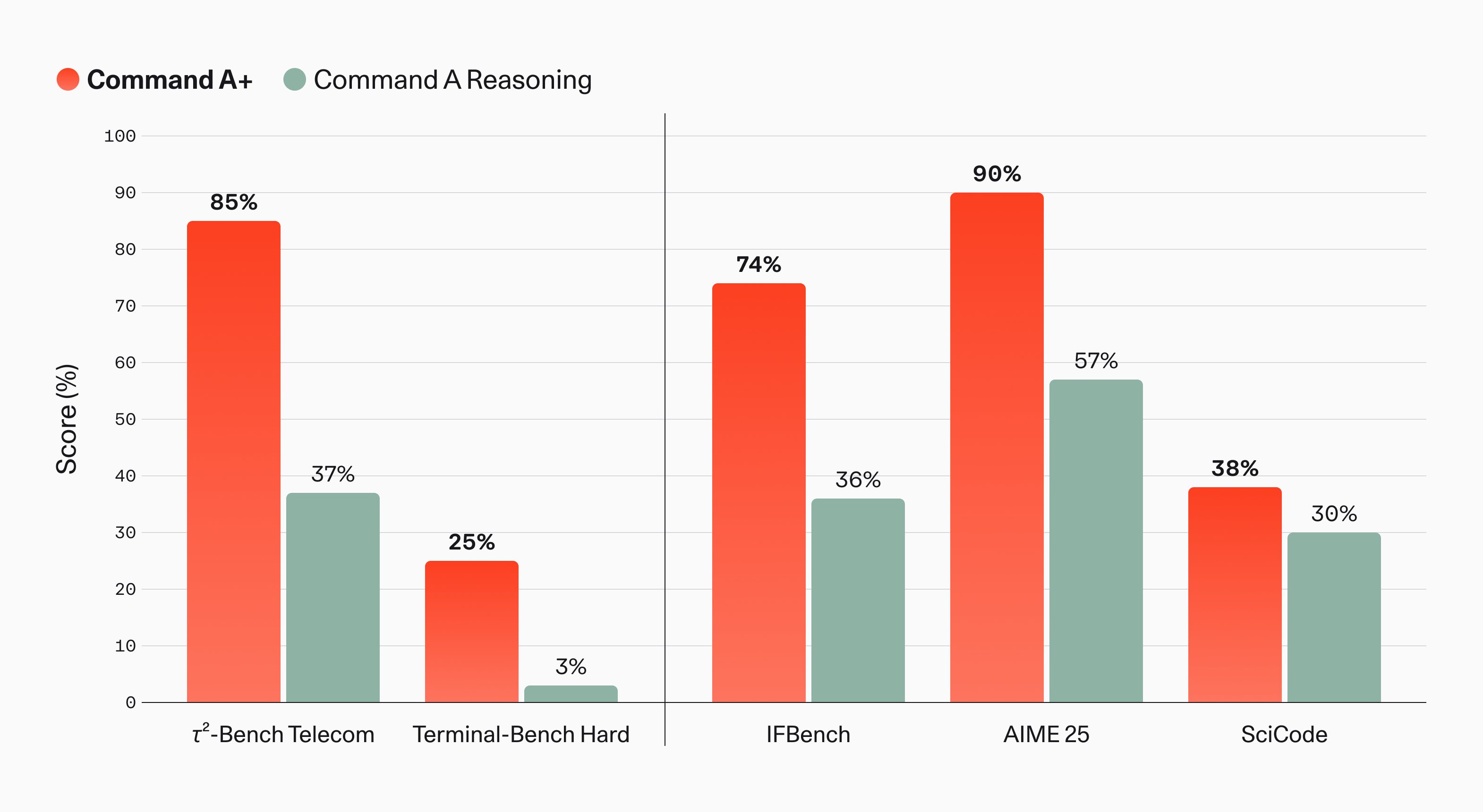
The model shows dramatic improvements in benchmark tests. On 𝜏²-Bench Telecom, which evaluates complex reasoning, its score increased from 37% to 85%. For agentic coding performance measured by Terminal-Bench Hard, the score rose from 3% to 25%. In advanced mathematics, Command A+ achieved 90% on the AIME 25 test, a significant jump from its previous 57%.
While Command A+ demonstrates competitive performance with much larger models in areas like reasoning and mathematics (with its 25B active parameters), it currently trails the leading generations from Chinese open-source competitors such as DeepSeek, Z.ai (GLM), and MiniMax in broad-scale intelligence indexing and deep agentic coding. However, direct comparisons often overlook Cohere’s primary advantage: hardware efficiency.
Beyond its benchmark achievements, Command A+ incorporates robust features for enterprise security and verification. It supports conversational tool use through standard chat templates, enabling seamless integration with internal APIs, search engines, and SQL databases. A standout feature is its native citation generation capability. When Command A+ accesses information from external sources, it provides explicit “grounding spans” by embedding special tags in its output. These tags link every factual assertion directly to the specific document or database record from which the information was retrieved.
This level of traceability is critical for regulated industries like finance, healthcare, and legal, transforming a prototype into a production-ready solution. For example, if a user requests a sales report, the model will present the total sales figure and precisely cite the database query result that provided it, significantly reducing the risk of undetected factual inaccuracies or hallucinations.
Furthermore, Command A+ is fully multimodal, processing both text and images within an extensive 128K input context window. This capability makes it highly effective for analyzing complex documents, such as scanned invoices, financial charts, or technical manuals.
First Apache 2.0 Licensed Model from Cohere
In the rapidly evolving AI landscape, the term “open source” often carries nuances and restrictions. Many leading AI companies release model weights under licenses that limit commercial use or prohibit their application in training competing AI systems, particularly for large enterprises.
Cohere’s previous models, including Command R and Command R+, were released under a CC-BY-NC 4.0 (Creative Commons NonCommercial) license. While these allowed for research and evaluation, commercial use required purchasing a separate enterprise license or utilizing Cohere’s API, a model similar to those offered by OpenAI, Anthropic, and Google.
With Command A+, Cohere has shifted its strategy by adopting the Apache 2.0 license. This is a significant distinction, as Apache 2.0 is a recognized, OSI-approved open-source license. It empowers individuals and corporations alike—from independent developers to Fortune 500 companies—to use, modify, distribute, and commercialize the model without licensing fees or restrictive non-compete clauses. Cohere co-founder Nick Frosst highlighted this decision, describing Command A+ as “the best model we’ve ever put out.”
For businesses, this licensing approach offers complete vendor independence. Companies can download Command A+ weights, fine-tune them with proprietary internal data, and deploy them on their own servers or within air-gapped networks. This freedom from reliance on Cohere’s infrastructure, pricing adjustments, or API availability embodies the ultimate realization of sovereign AI principles.
The release has been met with considerable enthusiasm within the AI developer community, bolstered by day-one integrations with major open-source inference frameworks like Hugging Face and vLLM.
Future Outlook
The introduction of Command A+ signifies a maturation of the open-source AI ecosystem. By integrating advanced reasoning, robust agentic capabilities, and multimodal functionalities with an architecture optimized for hardware efficiency, Cohere is fundamentally altering the landscape for enterprise AI adoption. The long-standing barrier posed by the need for massive, centralized compute clusters—particularly for organizations prioritizing data privacy and cost control—is being addressed.
Cohere’s decision to democratize access to a model of this caliber under a genuine open-source license provides the enterprise market with a solution long sought after: the power of advanced AI, capable of secure deployment within an organization’s own data center.
Business Style Takeaway: Cohere’s release of Command A+ under an Apache 2.0 license represents a strategic shift towards empowering enterprise autonomy in AI deployment, prioritizing data sovereignty and cost control. This move lowers the barrier to entry for advanced AI capabilities, enabling businesses to innovate securely within their own infrastructure rather than relying solely on third-party APIs.
Learn more at : venturebeat.com