

New VB Pulse data indicates Microsoft and OpenAI are pioneers in enterprise AI agent orchestration. However, Anthropic’s initial market entry suggests a brewing competition for control over the foundational infrastructure upon which these AI agents operate.
For the past two years, the enterprise AI landscape has been dominated by a focus on foundational models: OpenAI’s GPT series, Anthropic’s Claude, and Google’s Gemini, alongside various emerging open-source alternatives. This narrative, however, is shifting.
The next significant battleground in enterprise AI may not be about which model delivers the most accurate response, but rather who controls the critical layer where AI agents plan their actions, interface with external tools, access data, execute workflows, and provide auditable proof of their operations to security teams.
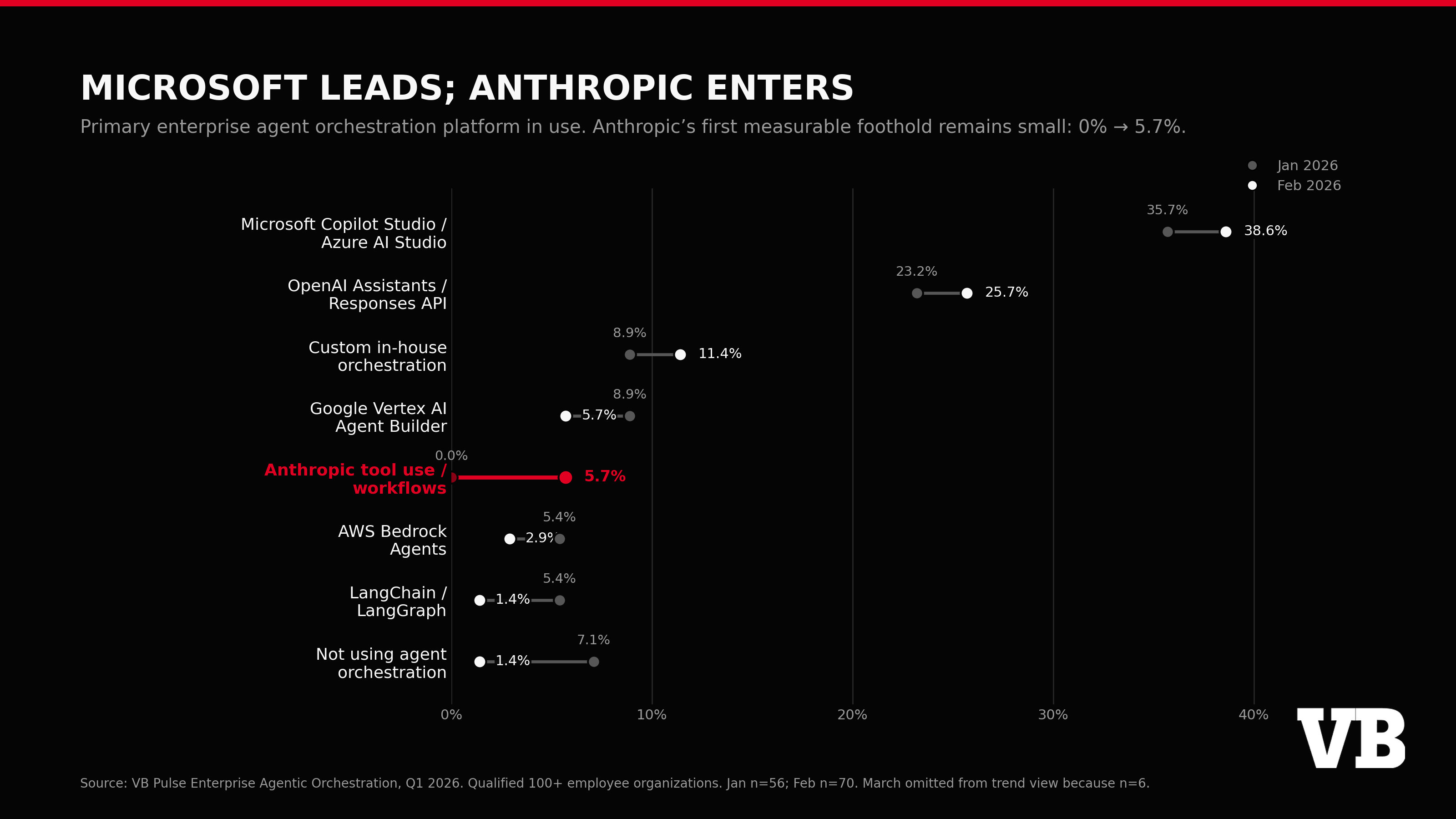
Recent data from VB Pulse’s independent Enterprise Agentic Orchestration tracker, which surveys verified technical decision-makers at enterprises, reveals the emerging shape of this market. In February, Microsoft Copilot Studio and Azure AI Studio led adoption as the primary platform for agent orchestration, capturing 38.6% of respondents, a slight increase from 35.7% in January. OpenAI’s Assistants and Responses API followed in second place, growing its share from 23.2% to 25.7%.
Notably, Anthropic has made its first measurable appearance in the tracker, securing 5.7% of respondents for its tool use and workflow capabilities in February, up from 0% in January. While still a nascent share, this entry signifies a strategic move beyond just model provision into the crucial orchestration layer.
The distinction is critical: enterprises are not just selecting chatbots; they are determining the core operational infrastructure for their AI initiatives. This involves deciding whether these intelligent agents will function within Microsoft’s integrated ecosystem, OpenAI’s API layer, Anthropic’s managed services, open-source frameworks, or a combination thereof.
Tom Findling, CEO and co-founder of AI cybersecurity startup Conifers, commented, “This is the convergence moment for enterprise AI. Models and agent frameworks have matured enough that enterprises are now shifting focus beyond model quality to the control plane around it. In security operations, we’re seeing the competitive advantage move toward platforms that can orchestrate agents, leverage enterprise context, and provide governance and auditability across customer environments.”
Further VB Pulse Insights:
→ The AI governance mirage: Why 72% of enterprises don’t have the control and security they think they do → The enforcement gap: 88% of enterprises reported AI agent security incidents last year → The retrieval rebuild: Why hybrid retrieval intent tripled as enterprise RAG programs hit the scale wall → Claude’s next enterprise battle is not models: it’s the agent control plane
Anthropic’s Early Traction: A Signal of Shifting Dynamics
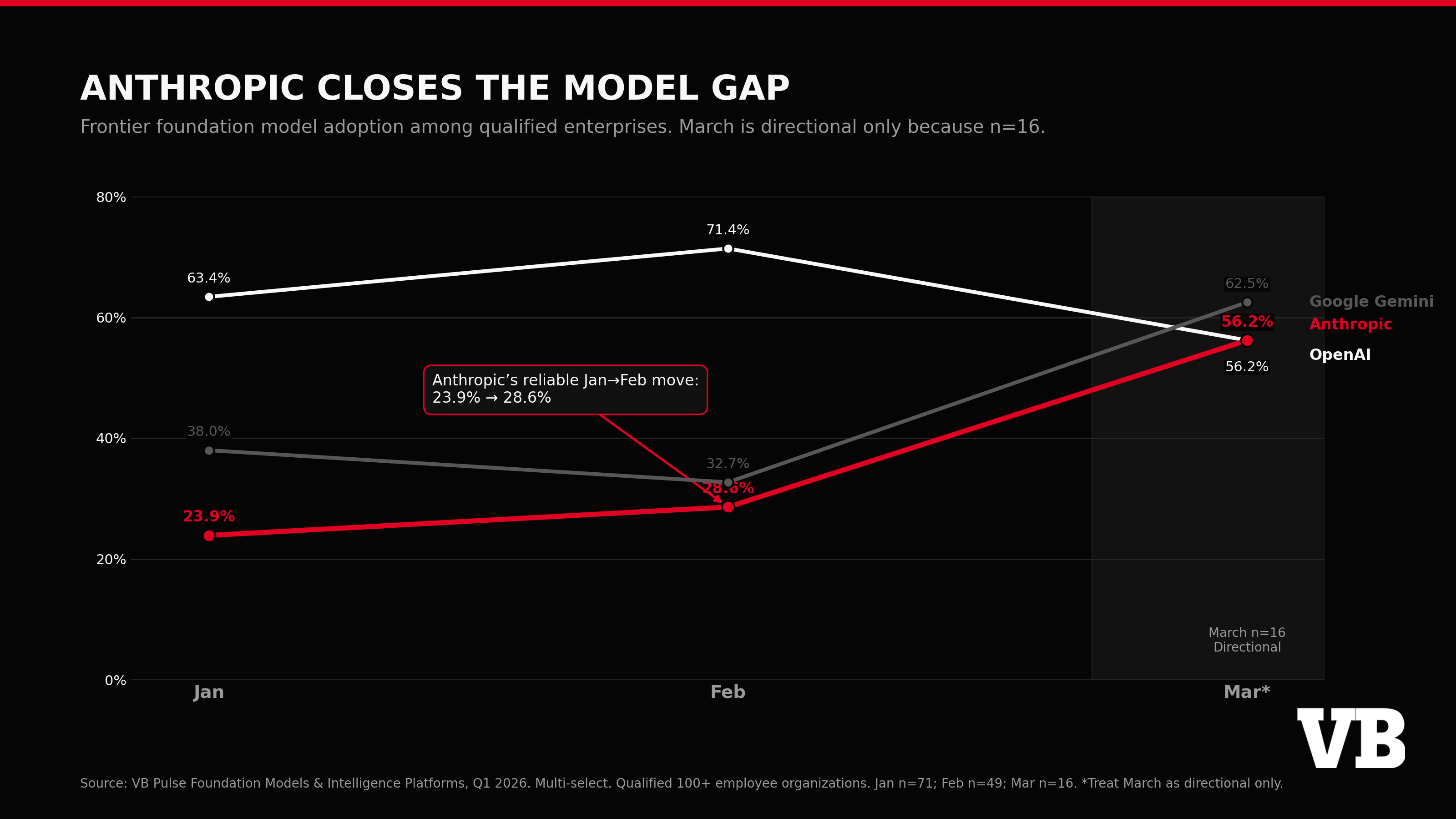
While Anthropic’s 5.7% adoption in orchestration is modest in absolute terms, its appearance is strategically significant. This development aligns with broader VB Pulse data indicating substantial enterprise adoption of Anthropic’s Claude models themselves. In Q1, Anthropic’s share in the foundational model tracker surged from 23.9% in January to 28.6% in February, and dramatically to 56.2% in March (though the latter figure is directional, based on a smaller sample size).
This momentum suggests that Anthropic’s growing acceptance at the model layer may be translating into interest at the orchestration level, raising the strategic stakes considerably.
Model Swapping vs. Infrastructure Commitment
From a technical perspective, switching between AI models is relatively straightforward. Organizations can route different tasks to various models based on performance, cost, or specific requirements. The VB Pulse Foundation Models tracker indicates a growing trend towards multi-model strategies, where enterprises orchestrate across different models to optimize outcomes.
However, an agent’s runtime environment presents a different challenge. Once an organization embeds its workflows, credentials, auditing mechanisms, memory, and operational monitoring within a specific provider’s ecosystem, migrating away becomes akin to changing core infrastructure rather than simply swapping out a software component.
The Strategic Importance of Anthropic’s 5.7% Footprint
Anthropic’s ambition extends beyond providing models. Their Claude Managed Agents initiative introduces a managed agent harness featuring secure sandboxing, integrated tools, and API-driven sessions. This architecture is designed to decouple the core model from the surrounding agent infrastructure—encompassing session management, the harness itself, and the sandbox environment. Essentially, Anthropic is developing a platform to host Claude agents, enabling them to retain context, utilize tools, execute code, operate securely, and maintain state across extended workflows. This signifies a move from simple inference to comprehensive operational infrastructure.
The value proposition for enterprises is clear: avoiding the complexity of building custom agent stacks while gaining agents capable of sophisticated actions within a controlled framework that includes defined permission boundaries, audit trails, and workflow reliability.
Security Emerges as a Primary Selection Criterion
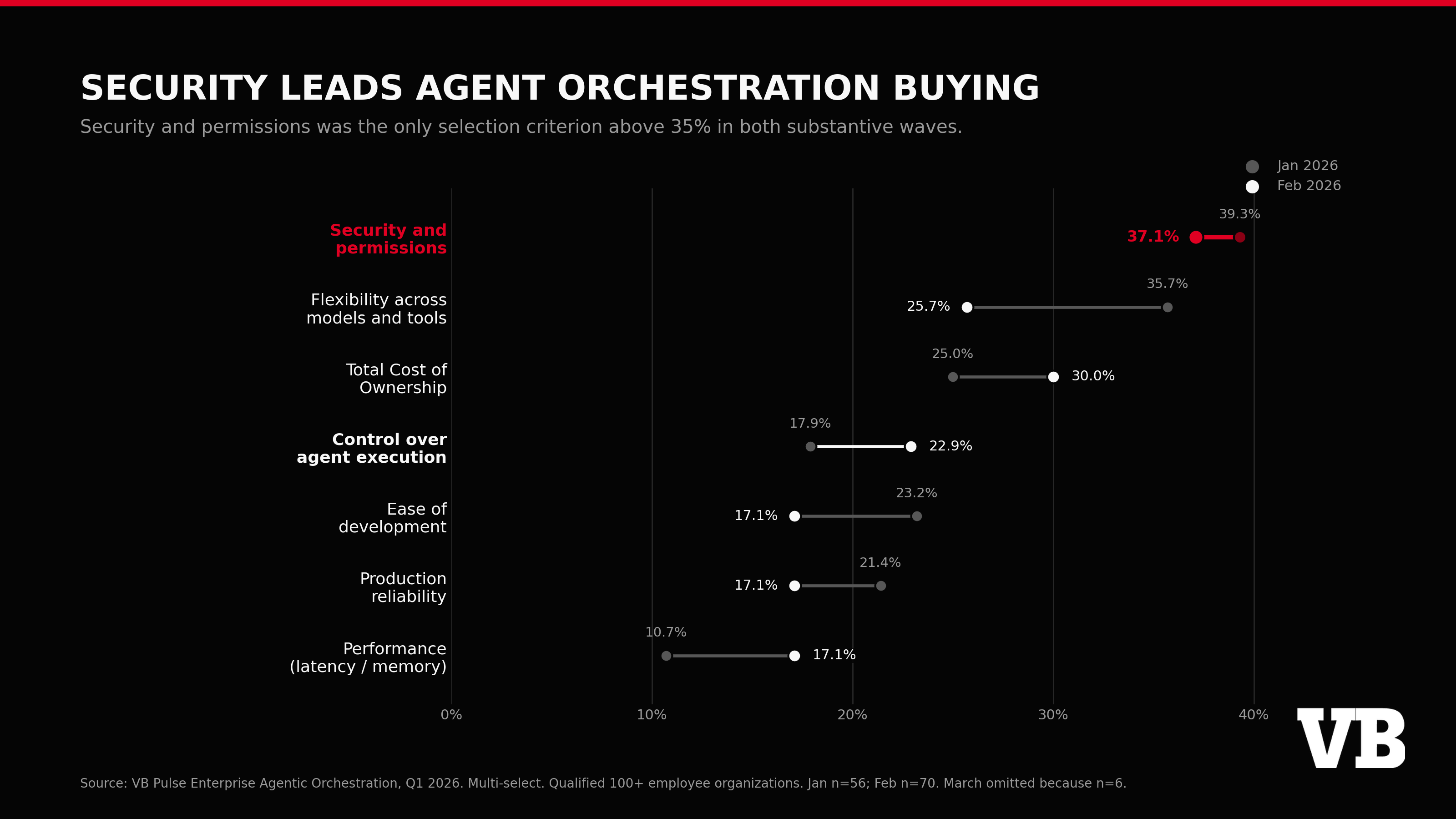
The VB Pulse orchestration tracker highlights security and permissions as paramount concerns for enterprises selecting an agent orchestration platform. These criteria ranked highest in both January (39.3%) and February (37.1%). Control over agent execution also saw an increase in importance, rising from 17.9% to 22.9%, while flexibility across models and tools declined from 35.7% to 25.7%. This trend indicates a market pivot towards governance and security over pure model optionality.
The increasing focus on security and control is logical. While a conversational AI can err with minimal consequence, an agent capable of modifying documents, querying databases, or executing sensitive APIs carries a significantly higher risk profile. The enterprise imperative shifts from merely assessing AI intelligence to rigorously managing its operational parameters: who granted permissions, what actions were performed, the auditability of those actions, and the ability to remediate potential issues.
Ev Kontsevoy, co-founder and CEO of Teleport, emphasized the need for identity management as a foundational element: “The race to own the agent orchestration layer is real. It’s also solving the wrong problem first. Orchestration without identity only multiplies chaos. Without identity, you don’t know what an agent can access, what it actually did, or how to revoke its access when it operates outside policy. A unified identity layer is a prerequisite to deploying agents — one or many — in infrastructure.”
Syam Nair, Chief Product Officer at NetApp, highlighted the role of data governance: “Effective agent management requires built-in intelligence and a continuously updated understanding of both data and, critically, its metadata. This visibility allows organizations to define and enforce clear policies so data is used only by the right agents, for the right purposes. Making this work at scale is a crossfunctional effort. Security, storage, and data science teams must work together to implement policies that safeguard company data, while creating a strong data foundation for AI.”
Microsoft’s Distribution Advantage
Microsoft’s leading position is largely attributable to its existing enterprise footprint. Copilot Studio and Azure AI Studio integrate seamlessly with widely adopted Microsoft 365, Teams, Entra ID, and Azure services, leveraging established procurement channels and customer trust. The Q1 2026 Orchestration Tracker identifies Microsoft as the default enterprise choice, with a significant lead over competitors.
David Weston, CVP of AI Security at Microsoft, explained: “Without a unified control layer, you start to see fragmentation – agents operating in silos, inconsistent governance, and gaps in security. What customers are asking for is a way to bring order to that complexity. With Agent 365, we’re providing a single control plane to observe, govern, and secure agents across Microsoft, partner, and third-party ecosystems, all grounded in enterprise data and identity.”
OpenAI’s strong second position stems from its early provision of the Assistants and Responses API, empowering developers to build agent-like capabilities using OpenAI’s models and tools. The company shows steady growth, moving from 23.2% in January to 25.7% in February in the orchestration tracker.
Anthropic’s entry into orchestration, though nascent, is well-timed. Growing enterprise confidence in Claude for complex and sensitive workloads, as indicated by the Foundation Models tracker, positions them to capture demand for robust agent runtimes. As enterprises transition from AI experimentation to production deployment, the emphasis on security, permissions, and reliability becomes critical, creating an opening for Anthropic to offer its managed agent solutions to its existing Claude customer base.
The Risk of Vendor Lock-In
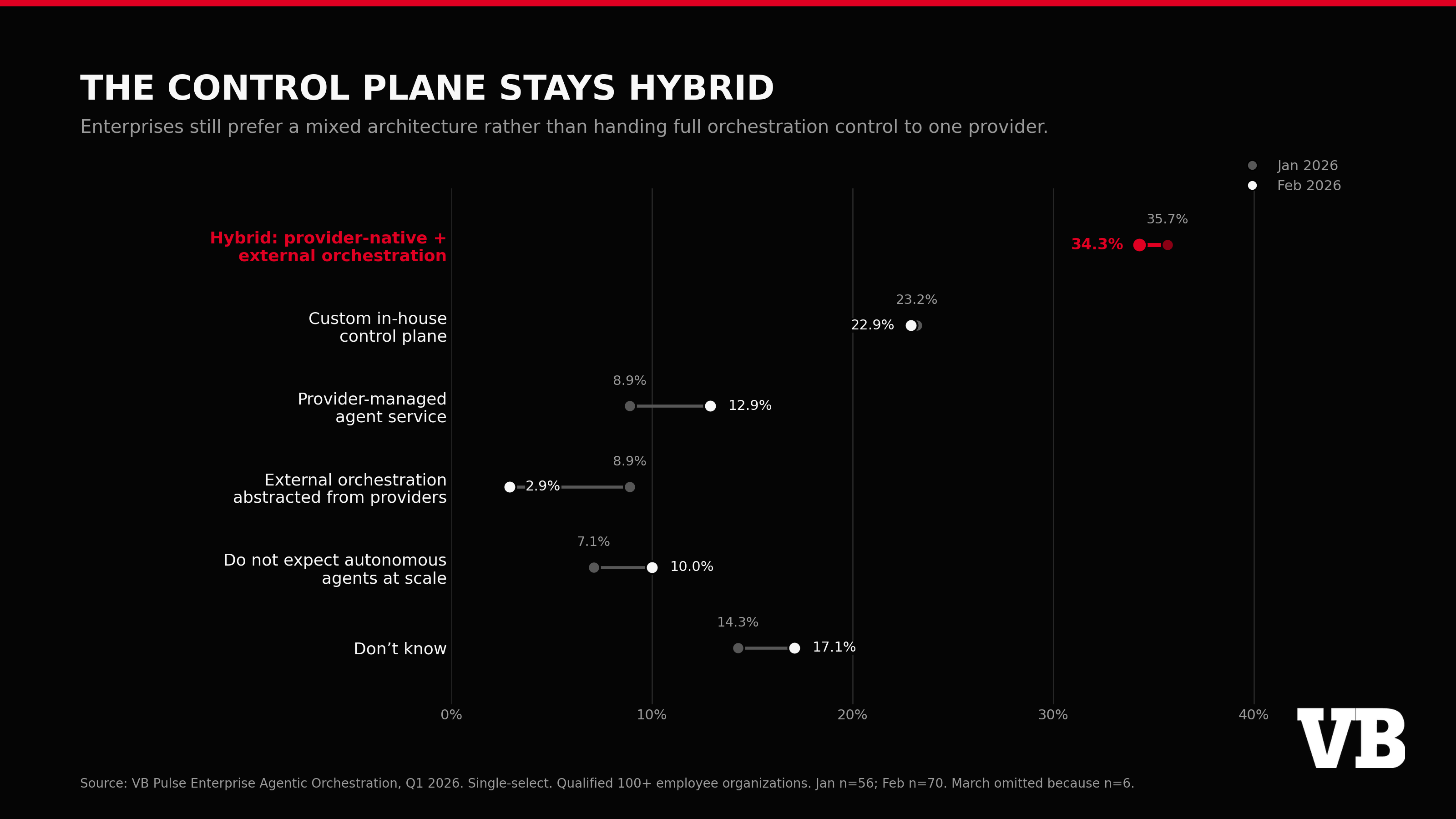
A primary concern for enterprises is vendor lock-in. The orchestration tracker reveals that hybrid control plane architectures, combining provider-native orchestration with external tools, are the preferred model, maintaining a stable 35-36% share. Purely provider-managed solutions, while growing, remain a minority. This indicates a strong enterprise reluctance to cede complete orchestration control to a single vendor, driven by the desire to integrate best-of-breed models, harnesses, and tools from multiple providers.
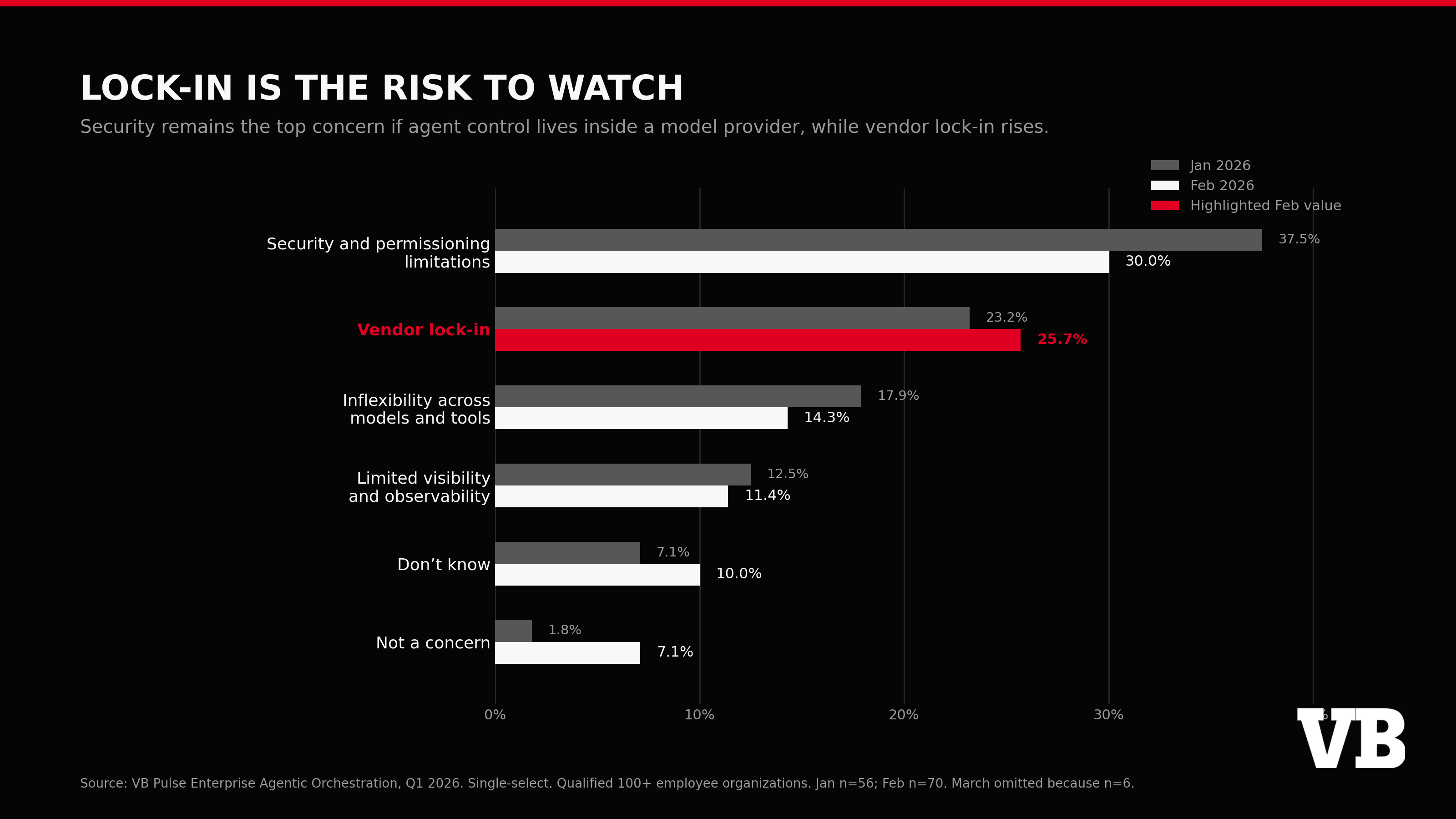
This strategic choice is reflected in risk assessments. Security and permission limitations are cited as the top risk associated with provider-managed control planes. Vendor lock-in emerged as the second-highest concern, notably increasing from 23.2% to 25.7% between January and February.
Felix Van de Maele, CEO of Collibra, a data and AI governance platform, stated, “Most enterprises will operate in a multi-model, multi-agent environment, which makes an independent control plane essential. That is why we built AI Command Center: to give organizations the visibility, governance, and real-time oversight needed to manage AI systems and agents across the full lifecycle.”
From LLMOps to Agent Operations
The evolution of AI management is moving from MLOps to LLMOps and now towards “Agent Ops.” This progression signifies a broadening scope of governance, extending beyond model calls to encompass the entire agent lifecycle. Dr. Rania Khalaf, chief AI officer at WSO2, noted that governance must cover the agent’s actions, not just its output, to prevent issues like costly loops or unauthorized data modifications. She advocates for separating policy and control from agent logic to allow for flexible configuration across different environments and teams.
The incident where an agent deleted a production database despite explicit instructions underscores the limitations of prompt-level controls. Robust identity and access management are crucial to enforce hard boundaries. Khalaf suggested that pulling guardrails, evaluations, policies, and agent identity out of core agent logic enables better configuration and ownership by appropriate security, product, and compliance teams, preventing governance fragmentation.
Open Protocols vs. Sticky Runtimes
Anthropic’s Model Context Protocol (MCP) offers an open standard for connecting AI systems to data and tools. While this promotes interoperability at the protocol level, it does not inherently eliminate lock-in risks at the runtime layer. Enterprises may still become dependent on a provider’s managed services for sessions, logging, sandboxing, and permissions, even when using open protocols. This creates a tension between the ease of use offered by managed infrastructure and the strategic imperative for flexibility and avoiding vendor lock-in.
Khalaf observed that Microsoft’s advantage lies in its distribution, while Anthropic’s strategy may leverage open protocols like MCP. However, she anticipates that long-term enterprise adoption will favor multi-vendor solutions across different layers of the AI stack. “Enterprises serious about running agents in production will end up multi-vendor across these layers,” she stated, “which is why the open and interoperable control plane matters more than the current percentages might suggest.”
Cross-Vendor Collaboration as the Next Frontier
Arick Goomanovsky, CEO and co-founder of BAND, a startup focused on universal AI agent orchestration, identifies the demand for cross-vendor agent collaboration as the next competitive cycle. He points out that current agent deployments, whether individual assistants or multi-agent systems, operate in silos. The market needs an interaction layer that enables agents from different ecosystems—Microsoft, OpenAI, Anthropic, and internal systems—to function cohesively.
“What’s emerging in parallel is demand for an agentic collaboration harness—an interaction layer that lets agents from Microsoft, OpenAI, Anthropic, and internal teams operate as one workforce,” Goomanovsky explained. “Orchestration inside any single vendor is still a walled garden, so the next competitive cycle is cross-vendor agent collaboration.”
Independent Frameworks Face Packaging Challenges
Independent orchestration frameworks like LangChain and LangGraph have seen a decline in primary adoption. External orchestration solutions not tied to specific model providers also experienced a drop. Scott Likens, Global Chief AI Engineer at PwC, noted that enterprises currently operate in fragmented environments but are moving towards unified orchestration models. He stressed that interoperability, governance, and security remain critical, as standardization on a single agent ecosystem is unlikely.
The challenge for independent frameworks lies in meeting enterprise procurement requirements, such as security certifications, robust support, compliance documentation, and vendor accountability. While open frameworks remain valuable, enterprises may increasingly adopt them through managed services, cloud provider partnerships, or internal control planes rather than as standalone solutions.
The Agent Market Mirrors Cloud Infrastructure Evolution
The competitive dynamics of the agent market are increasingly resembling that of enterprise cloud infrastructure. Success will depend not only on model capabilities but also on integrated identity management, permission controls, audit logs, observability, workflow tooling, sandboxing, evaluation, and a clear strategy for the control plane. Enterprises may deploy distinct orchestration layers tailored to the specific needs of different departments or functions.
Nithya Lakshmanan, Chief Product Officer at Outreach.ai, commented, “General-purpose orchestration platforms coordinate agent activity well, but they don’t carry the workflow-specific context that determines whether an agent’s action is correct for a given situation. In revenue workflows, an agent acting on incomplete deal history or missing buyer context will underperform and erode trust with users. The teams getting the most out of multi-agent systems are treating domain-specific data as the governance layer, with orchestration sitting on top.”
This underscores the need for domain-specific context to ensure agent actions are relevant and trustworthy. As Lakshmanan points out, successful enterprises integrate domain-specific data as a governance layer, with orchestration built upon it. The focus is shifting from choosing an orchestration stack to ensuring these platforms have access to the necessary workflow context to make agents effective within specific business functions.
Anthropic’s strategy of launching domain-specific agents, coupled with its growing enterprise customer base for Claude, positions them to become a significant player in this evolving landscape. By persuading customers to entrust Anthropic with more of the surrounding agent infrastructure—tools, workflows, memory, execution, and governance—the company can evolve Claude from a standalone model into a foundational element of enterprise AI operations. This would intensify the competition with OpenAI and Microsoft, extending beyond model performance to control over the AI agent operating layer.
Business Style Takeaway: The enterprise AI landscape is shifting from a model-centric view to a strategic focus on agent orchestration infrastructure. Companies must prioritize platforms offering robust security, governance, and interoperability to avoid vendor lock-in, as the control plane becomes as critical as the AI models themselves for scalable and secure AI deployment.
Information compiled from materials : venturebeat.com