


AI’s Evolving Role in Cybersecurity: Unearthing Deep-Seated Vulnerabilities
The advent of highly sophisticated AI models is fundamentally reshaping the landscape of software security. Anthropic’s recent unveiling of its Mythos model demonstrated an unprecedented capability to identify software vulnerabilities, flagging thousands of high-severity bugs requiring remediation before public release.
Empirical Validation from the Front Lines
Security researchers at Mozilla’s Firefox browser division are now offering practical insights into the deployment of such advanced AI, underscoring the profound implications for the broader software security ecosystem. In a recent publication, Mozilla detailed how Mythos has been instrumental in uncovering a significant number of critical vulnerabilities, including some that had remained undetected for over a decade.
This represents a substantial leap forward from the performance of AI security tools just six months prior. Previously, AI-driven bug detection was hampered by a high rate of low-quality reports and false positives, overwhelming security teams. However, Mozilla’s experience indicates a turning point, largely attributed to the integration of agentic systems capable of self-assessment and filtering of erroneous results.
“The dynamic shifted dramatically for us in a very short period,” researchers noted. “This was driven by both a significant increase in model capability and a refinement of our methodologies for leveraging these advanced systems.”
Quantifiable Impact and Advanced Exploit Discovery
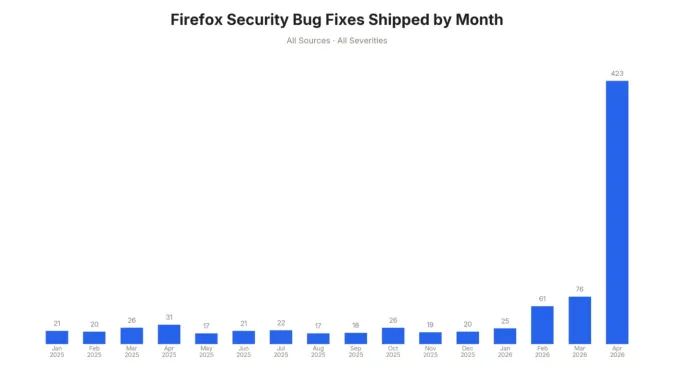
The results are demonstrably significant: Firefox implemented 423 bug fixes in April 2026, a stark contrast to the 31 fixes from the same period the previous year. Mozilla has also publicly detailed 12 of these discovered vulnerabilities, ranging from novel sandbox exploits to a long-standing defect in HTML element parsing dating back 15 years.
“These capabilities have become remarkably effective very rapidly,” stated Brian Grinstead, a distinguished engineer at Mozilla. “We observe this across our internal scanning, external bug reports, and various industry indicators.”
The AI’s success in identifying vulnerabilities within Firefox’s sandbox system is particularly noteworthy, given the complexity required to exploit such mechanisms. Successfully finding sandbox flaws necessitates the AI generating a compromised code patch and then executing an attack on the most protected segment of the software. This multi-stage process demands both inventive problem-solving and meticulous execution.
To provide context, Mozilla’s bug bounty program offers up to $20,000 for discovering sandbox vulnerabilities, the highest reward available. Despite this lucrative incentive, Grinstead noted that Mythos is identifying sandbox issues at a volume previously unattainable by human researchers. “While we do receive such reports,” he commented, “the frequency is incomparable to what this AI technique enables.”
Human Oversight Remains Crucial in Remediation
Interestingly, the Firefox team continues to rely on human engineers for bug resolution, even with the advanced AI capabilities. While the AI can generate proposed code patches for identified bugs, these often require significant modification and review by human developers before deployment. “For the specific bugs discussed, every patch was authored and reviewed by human engineers,” Grinstead clarified. “Full automation of this process has not yet proven feasible.”
The long-term ramifications of AI’s growing proficiency on the cybersecurity balance of power remain a subject of ongoing analysis. With Mythos having been available for only a month, the full extent of its impact is still unfolding, as many discovered bugs await patching. While Anthropic adheres to responsible disclosure protocols, the potential for malicious actors to employ similar, albeit potentially less sophisticated, AI techniques is a persistent concern.
Anthropic CEO Dario Amodei expressed optimism regarding the potential for these tools to ultimately benefit defenders, suggesting that proactively fixing vulnerabilities could lead to a more secure digital environment. However, Grinstead offers a more pragmatic outlook: “These tools are valuable for both offensive and defensive operations, but their availability currently provides a marginal advantage to defenders. The ultimate equilibrium is yet to be determined.”
Business Style Takeaway: The integration of advanced AI like Anthropic’s Mythos marks a significant paradigm shift in cybersecurity, moving beyond basic vulnerability scanning to deep-code analysis. Businesses must recognize this evolution and consider how these powerful AI tools could be leveraged to bolster their own defenses or, conversely, what new threats they might enable for adversaries, necessitating a strategic reassessment of security investments and talent development.
Original article : techcrunch.com