


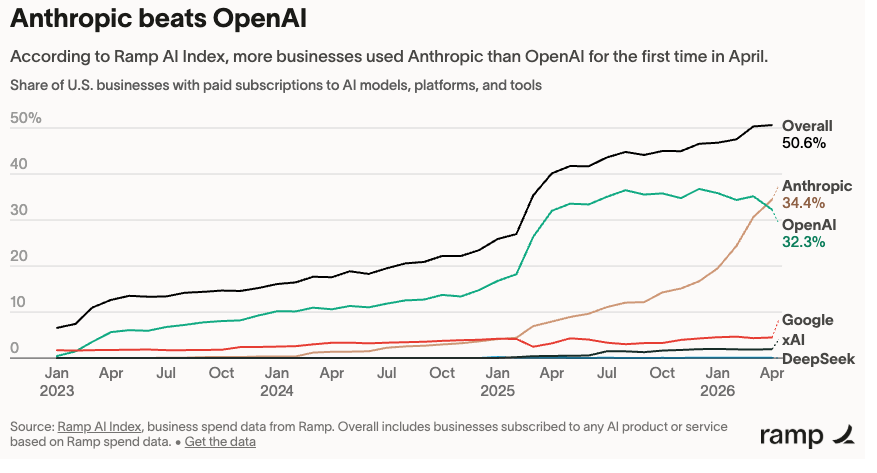
For the first time since the AI arms race intensified, American businesses are demonstrating a greater preference for Anthropic’s Claude over OpenAI’s ChatGPT, according to recent spending data.
In April, Anthropic’s adoption rate climbed to 34.4% of businesses, an increase of 3.8%, while OpenAI’s adoption saw a 2.9% decline, settling at 32.3%. Overall AI adoption across businesses experienced a modest rise of 0.2 percentage points, reaching 50.6%.
This pivotal shift, detailed in the May 2026 release of the Ramp AI Index compiled by corporate card and finance automation platform Ramp, signifies the culmination of Anthropic’s year-long ascent—a trajectory few in the tech industry anticipated. Over the past twelve months, Anthropic has quadrupled its business adoption, contrasting sharply with OpenAI’s marginal 0.3% growth in the same period.
However, the same report that heralds Anthropic’s new market leadership also cautiously points to potential vulnerabilities. These include escalating operational costs, compute resource limitations, and the very token-based pricing model that has been instrumental in driving the company’s remarkable revenue expansion.
Anthropic’s Meteoric Rise to Prominence in Corporate America
To fully grasp the significance of this market shift, it’s crucial to consider the positions of both companies a year prior. In April 2025, OpenAI held a commanding lead in business AI adoption, accounting for approximately 32% of the market according to Ramp’s data, while Anthropic lagged behind at under 8%. OpenAI had established an early, dominant presence as the default choice for consumers, with ChatGPT serving as most individuals’ initial encounter with AI, a momentum that seamlessly translated into corporate purchasing decisions.
Anthropic’s trajectory followed a distinct path. Initially favored by early adopters—such as engineers, AI evangelists, and the technical vanguard within organizations—Anthropic successfully transitioned to the mainstream. As noted by Ara Kharazian, lead economist at Ramp, in the March 2026 edition of the index, Anthropic leveraged this early-adopter base to achieve broader market penetration. By February of this year, Anthropic was securing approximately 70% of head-to-head competitions against OpenAI among businesses making their first AI service purchases, a complete reversal of the trends observed in 2025.
This remarkable growth is clearly illustrated in Ramp’s granular data. The company’s adoption figures reveal Anthropic’s surge from just 0.03% of businesses in June 2023 to 7.94% by April 2025, and then a dramatic acceleration to 34.44% by April 2026.
Conversely, OpenAI’s market share peaked near 36.5% in mid-2025 and has been on a gradual decline since. A primary driver of Anthropic’s expansion is its Claude Code product, an AI-powered coding assistant that has become the fastest-growing offering in the company’s history. Recent analyses indicate that Claude Code is now responsible for an estimated 4% of all public code commits on GitHub globally, doubling the figure from just one month prior.
Business Insider had foreshadowed this development in April, reporting that the crossover was imminent. A Ramp spokesperson commented to the publication that “at the current pace, Anthropic is on track to surpass OpenAI within the next two months,” adding that Anthropic already held a lead “among early adopters, including VC-backed companies, and in key sectors like software, finance, and professional services.” This prediction proved remarkably accurate.
AI Adoption Reaches a Workplace Tipping Point, But Productivity Revolution Is Yet to Materialize
The insights from Ramp’s business spending data are complemented by a separate workforce survey that highlights the pervasive integration of AI into the American economy. For the first time since Gallup began tracking this metric, half of all employed American adults report using AI in their roles at least a few times annually, up from 46% in the previous quarter. The frequency of use is also increasing, with 13% of employees now indicating daily AI usage and 28% reporting usage several times a week or more.
However, the Gallup data, derived from a February 2026 survey of 23,717 U.S. employees, also suggests that the benefits of AI are largely confined to enhancing individual tasks rather than driving organizational transformation. Only about 10% of employees within AI-adopting organizations strongly agree that artificial intelligence has fundamentally changed their work processes. This finding aligns with firm-level studies across the U.S., U.K., Germany, and Australia, which show chief executives reporting minimal widespread productivity gains from AI over the past three years—a notable divergence between the enthusiastic market discourse and the tangible operational outcomes.
Ramp’s methodology captures a distinct yet related perspective. While Gallup queries employees on their AI usage, Ramp measures whether their employers are actively investing in these technologies. The index tracks corporate card and invoice-based transactions, identifying firms as AI adopters if they record a positive transaction for an AI product or service in a given month. Ramp’s methodology documentation acknowledges that its findings likely underestimate actual adoption, as many employees utilize free AI tools or personal accounts for professional tasks. Taken together, these datasets present a nuanced picture: AI is ubiquitous in the American workplace, yet its potential to fundamentally reshape organizational operations has yet to be fully realized.
Anthropic’s Success May Be Its Greatest Vulnerability
Perhaps the most compelling aspect of Ramp’s analysis is its cautious stance on declaring a definitive market victor. Kharazian has identified three critical risks facing Anthropic, even as it ascends to market leadership. The most significant of these arises from an inherent structural tension within the company’s business model.
Anthropic’s revenue model incentivizes higher token consumption, thereby encouraging the use of more resource-intensive models even when less demanding ones would suffice. This dynamic is already presenting significant budgetary challenges for major enterprises. For instance, Uber’s CTO disclosed that the company depleted its entire 2026 AI budget within just four months, primarily due to substantial expenditures on Claude Code and Cursor. Engineers reported monthly API costs ranging from $500 to $2,000 per individual. Engineer adoption of these tools skyrocketed from 32% to 84% within months, and approximately 70% of Uber’s code commits are now AI-generated. The Uber scenario serves as a microcosm of a broader issue: Claude Code is highly effective—perhaps too effective. When a productivity tool becomes so indispensable that a company’s $3.4 billion R&D division struggles to maintain operational capacity, the subsequent cost scrutiny could compel organizations to seek more economical alternatives.
Concurrently, quality and reliability have been strained under the immense demand. In recent weeks, users have reported frequent service outages, stringent rate limitations, and a decline in the quality of Claude’s outputs. Anthropic has responded by adjusting usage limits and securing a substantial compute deal with SpaceX, granting access to over 300 megawatts of new capacity at the Colossus 1 data center in Memphis. CEO Dario Amodei stated that the company experienced “80x growth per year in revenue and usage” for Q1 2026, far exceeding its initial projections of 10x. Furthermore, Ramp economist Rafael Hajjar observed that Anthropic’s latest model update would triple token costs for any prompt involving image processing—a decision that appears incongruous with the company’s existing cost and compute challenges.
Open-Source Alternatives and OpenAI’s Codex Pose Significant Threats to Anthropic’s Lead
The Ramp report also highlights competitive pressures that could rapidly alter the market landscape. Among the fastest-growing vendors on Ramp’s platform in April were providers of AI inference services offering access to cost-effective, open-source models. These platforms enable enterprises to utilize “good enough” AI solutions at a significantly reduced cost, particularly for routine tasks that do not necessitate the capabilities of frontier models.
OpenAI’s Codex presents an even more direct competitive challenge. By most performance metrics, Codex is a robust product capable of handling many of the same tasks as Claude Code, but at a lower price point. The cost associated with switching between these models is also minimal. Uber, for example, is actively evaluating Codex as a strategic hedge, a move that could signal a broader trend among enterprise technology choices. OpenAI also maintains significant structural advantages. Its ChatGPT platform boasted 900 million weekly active users by March 2026, substantially exceeding Claude’s consumer reach. Enterprise revenue now constitutes over 40% of OpenAI’s total revenue and is projected to equal consumer revenue by the close of 2026. Moreover, OpenAI’s recent $122 billion funding round, completed in March at an $852 billion valuation, provides ample resources for competing aggressively on pricing, capacity, and product development.
Anthropic is actively pursuing strategies to broaden its distribution channels. AWS recently launched the Claude Platform on AWS, offering enterprises direct integration with Anthropic’s native platform through existing AWS credentials, billing, and access controls—a move designed to reduce procurement friction. Additionally, Anthropic has secured multi-billion dollar compute agreements with major cloud providers and technology firms including Amazon, Google, Microsoft, and Nvidia, although much of this capacity is not slated for deployment until late 2026 or 2027. Reports also suggest Anthropic is in discussions to secure an additional $50 billion in funding at a valuation approaching $900 billion.
The Unforeseen Factor Driving Business Choices for Claude
Beyond the raw spending data and market share charts lies a more profound question: What compels businesses to select Anthropic’s Claude over demonstrably cheaper alternatives that offer comparable performance?
Kharazian delved into this question in his March analysis. Claude Code and OpenAI’s Codex are largely comparable offerings; Codex even shows superior performance on certain benchmarks and is more affordable. Yet, Anthropic is constrained by its inability to meet current demand. All available plans incorporate usage limitations and rate caps, leading the company to forgo potential revenue due to compute resource constraints.
Kharazian posited that cultural factors may play a significant role. Earlier this year, Anthropic declined to meet the Pentagon’s terms of use for Claude, resulting in a blacklisting by the Department of Defense. OpenAI subsequently stepped in to offer its services. This incident appeared to galvanize user support for Anthropic, temporarily propelling Claude above ChatGPT on the App Store. Kharazian suggested that the selection of an AI model might be evolving from a standard enterprise procurement decision into something akin to the “green bubble vs. blue bubble” dynamic in iMessage—a signal of identity as much as a technological choice.
While this notion may seem unconventional for enterprise software procurement, Ramp’s data points towards an explanation that pure economic principles cannot fully address. In a market characterized by similar product performance, where a cheaper alternative exhibits superior benchmark results, and where switching costs are negligible, factors beyond simple spreadsheet logic are driving the most significant AI market share shift observed since the industry’s inception. As Kharazian highlighted in his report: “We have never seen a software industry as dynamic, where newcomers can disrupt market leaders in a matter of months, and where the pace of development overrides the typical forces of vendor stickiness.”
This inherent dynamism is a double-edged sword. The same forces that propelled a company from 8% to 34% market share within a year could just as easily reverse the trend. Anthropic’s current two-point lead was established in the most volatile software market in modern history, a market where the distance between market leadership and irrelevance has never been shorter.
Business Style Takeaway: The AI market is experiencing a rapid leadership shift, with Anthropic’s Claude overtaking OpenAI’s ChatGPT in U.S. business adoption. This highlights the critical importance of developer tools like Claude Code, but also underscores the inherent risks of rapid growth outpacing compute capacity and potentially unsustainable pricing models, demanding strategic foresight for long-term market stability.
Information compiled from materials : venturebeat.com