

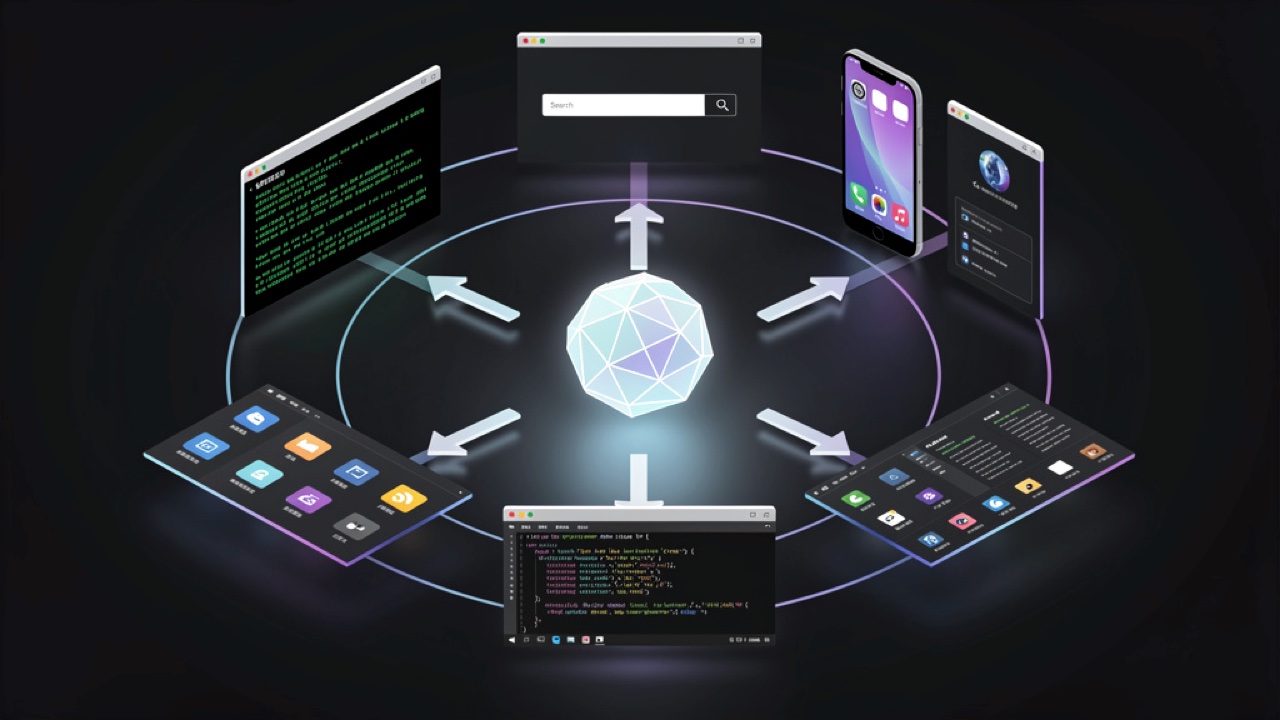
Alibaba’s AI division, the Qwen team, has unveiled Qwen-AgentWorld, a suite of two models designed not to operate within agent environments, but to accurately predict their outcomes. This innovative release encompasses seven distinct domains—MCP, Search, Terminal, Software Engineering, Android, Web, and OS—all unified under a single architectural framework.
This development marks an escalation of Alibaba’s commitment to advancing autonomous agents. It follows the recent May release of Qwen3.7-Max, a model boasting a 35-hour autonomous execution capability.
The strategic shift addresses a critical limitation encountered by teams scaling agent training. Conventional search engines present existing results without the ability to simulate controlled conditions. Similarly, live terminal environments do not permit the on-demand simulation of low-disk-space scenarios. Agent training has historically been constrained by the realities of production environments, lacking a systematic method to expose the edge cases that agents must handle but rarely encounter in typical training.
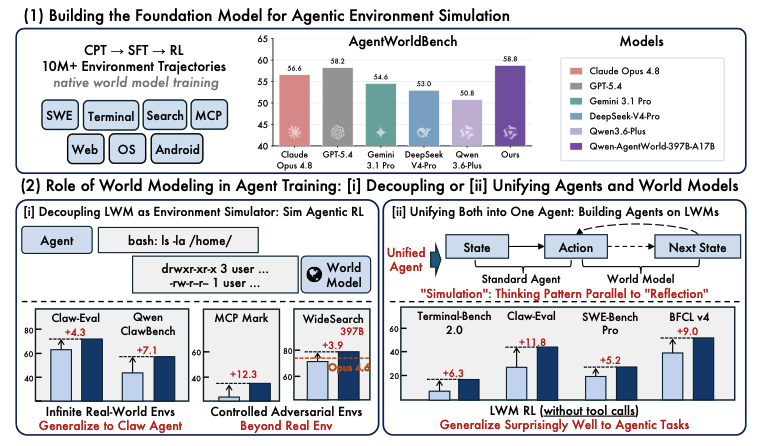
The research team’s experiments involved training agents within the generated simulator, yielding performance improvements that surpassed those achieved through training solely in real-world environments. In a parallel evaluation, employing “world model” training as a preparatory phase before agent fine-tuning led to enhanced performance across seven benchmarks, including three the model had never encountered during its initial training.
The accompanying research paper highlights a significant gap in existing agent research, stating, “We argue that world modeling is a crucial missing piece in the path to general agents.”
Qwen-AgentWorld Focuses on Environmental Response Prediction
Most existing agent models are trained to answer a single question: given the current environmental observation, what action should be taken next? In contrast, Qwen-AgentWorld is trained to predict the inverse: after a specific agent action, what will the subsequent environmental state be?
This fundamental reversal is the essence of what the paper terms a “language world model.” Instead of optimizing for action selection, the model learns to forecast the next environment state across all seven domains using a unified training objective. Previous efforts were more specialized; WebWorld, an earlier Qwen project from February, focused exclusively on web environments. Similarly, Snowflake’s Agent World Model, published in the same month, generates code-driven, SQL-backed environments rather than training a model to predict states. Qwen-AgentWorld distinguishes itself as the first to integrate environment modeling from the earliest pretraining stages across seven diverse domains within a single model.
Alibaba developed both models through a three-stage process, utilizing over 10 million interaction trajectories derived from actual agent executions. The initial stage trains the model on fundamental environmental behaviors—such as file system operations, terminal states, browser DOM modifications, and API responses. The second stage focuses on developing the model’s reasoning capabilities to anticipate future states before predicting them. The final stage employs reinforcement learning to refine predictions through rule-based validation and open-ended quality assessments.
Both models adopt a Mixture-of-Experts (MoE) architecture, ensuring that only a fraction of the model’s parameters are activated per token. The 35 billion parameter model utilizes 3 billion active parameters, while the 397 billion parameter model activates 17 billion. Both models support extensive 256K context windows. For graphical user interface (GUI) domains like Android, Web, and OS, the models process information from textual accessibility trees and UI view hierarchies, bypassing the need for image-based analysis.
The weights for the 35B model and the AgentWorldBench are publicly accessible under the Apache 2.0 license. The weights for the 397B model have not been released.
Impact of Training Method Outweighs Benchmark Scores
While the benchmark scores quantify the models’ accuracy in predicting environmental responses, the true significance lies in the training results—demonstrating the practical value of this predictive capability for agent development.
Researchers reported that agents trained within this controlled simulation environment outperformed those trained solely in real-world scenarios. The strategic injection of targeted perturbations, including partial responses that necessitate additional agent steps and edge cases rarely encountered in production, elevated the MCPMark score from 24.6 to 33.8. In the Search domain, agents trained entirely in simulated, fictional worlds demonstrated strong transferability to real search tasks, improving the WideSearch F1 Item metric from 34.02 to 50.31 when using the open 35B model. A separate “warm-up” test revealed that preliminary world model pretraining enhanced performance on the BFCL v4 benchmark from 62.29 to 71.25 and on Claw-Eval from 53.60 to 64.88, without any agent-specific fine-tuning.
Researchers Raise Concerns on Benchmarking and Overfitting Risks
The release of Qwen-AgentWorld has prompted significant discussion among AI researchers on platforms like X, with several raising pertinent questions regarding the methodology and potential implications for agent development.
One AI/ML researcher, @drawais_ai, noted the fundamental shift in the training objective: “Every other ‘agent’ model has been trained to act in environments. Qwen flipped the question. They trained the model to predict the environment itself… That predictive knowledge then transfers to agent tasks even without any agent-specific fine-tuning.” This researcher highlighted the Controllable Sim RL results as crucial evidence supporting the efficacy of synthetic training for large-scale agent development, particularly emphasizing the out-of-domain transfer observed in three of the seven benchmarks.
The benchmark metrics themselves have also faced scrutiny. @TheSignal_Desk, known for their analyses of AI research, pointed out that “AgentWorldBench is a benchmark Alibaba built and published in the same paper. They wrote the test, then topped it by 0.46.” This observation raises questions about potential bias in the evaluation framework.
Furthermore, practitioners are advised to critically examine the simulated Reinforcement Learning (Sim-RL) methodology. @limalemonnn, an AI agent developer, cautioned, “Sim-trained agents traditionally overfit to the simulator’s quirks. If the world model is too clean, the agent learns the model, not the task.” They suggested that the paper’s holdout split section warrants careful review before drawing definitive conclusions from the reported numbers.
The concern regarding overfitting is partially addressed within the research itself. The significant difference between uncontrolled Sim RL (MCPMark 24.6) and controlled Sim RL (MCPMark 33.8) suggests that the performance gains are substantially linked to the controllability mechanism, rather than solely to simulation fidelity. The strong transferability of agents trained in fictional worlds to real search tasks provides compelling evidence against pervasive overfitting.
Implications for Teams Developing Agentic Pipelines
For AI engineering teams focused on building and scaling agentic pipelines, this research signals a notable evolution in agent capability development. Organizations now have a viable third option alongside real-environment RL and static benchmarks: controlled simulation designed to incorporate edge cases that production environments typically do not surface.
Synthetic Environments as a Foundational Training Layer: Controlled simulation, capable of injecting conditions absent in real-world environments, should be viewed as a complementary training layer rather than a complete substitute for real-environment RL.
Prioritizing Foundational Learning: The findings underscore the critical importance of what a model learns prior to agent-specific training. The “warm-up” results, demonstrating performance improvements on unseen benchmarks without dedicated agent fine-tuning, indicate that grounding agents in their environmental context should occur earlier in the development lifecycle than is currently standard practice.
Business Style Takeaway: Alibaba’s Qwen-AgentWorld introduces a paradigm shift in AI agent training by simulating environmental responses, enabling more robust agent performance and handling of edge cases. This approach offers businesses a powerful tool to enhance AI agent reliability and efficiency, potentially reducing real-world testing costs and accelerating development cycles.
Learn more at : venturebeat.com