

Presented by Solidigm
As artificial intelligence applications shift from simple, single-turn interactions to sophisticated, multi-step agentic systems, the primary constraint in AI deployment is no longer GPU availability, but rather the management of context, according to Jeff Harthorn, AI applied research lead at Solidigm.
Harthorn posits that by 2026, the critical bottleneck for AI inference will be context management, superseding concerns about GPU availability or even compute efficiency. He notes that while the cost per floating-point operation (FLOP) for GPUs has decreased significantly, and model architectures and inference engines have become substantially more efficient, the volume of data required for context has grown at an even faster rate. This growth is particularly pronounced in persistent, multi-session AI agent systems where maintaining state between interactions has become paramount.
This trend is fueled by two converging factors: the dramatic expansion of context windows in AI models, which allows for far larger individual inputs, and the architectural evolution towards agentic AI systems. These systems often chain dozens or even hundreds of model calls together, each generating and requiring the tracking of specific states. Furthermore, enterprises are increasingly demanding that this inference state persist across sessions for purposes of audit, governance, and future reuse. The confluence of these demands is pushing context data volumes to levels that existing memory architectures were not designed to handle.
"All three of these trends are occurring simultaneously, collectively driving context data and context memory requirements into unprecedented territories," explains Ace Stryker, director of AI and ecosystem marketing at Solidigm.
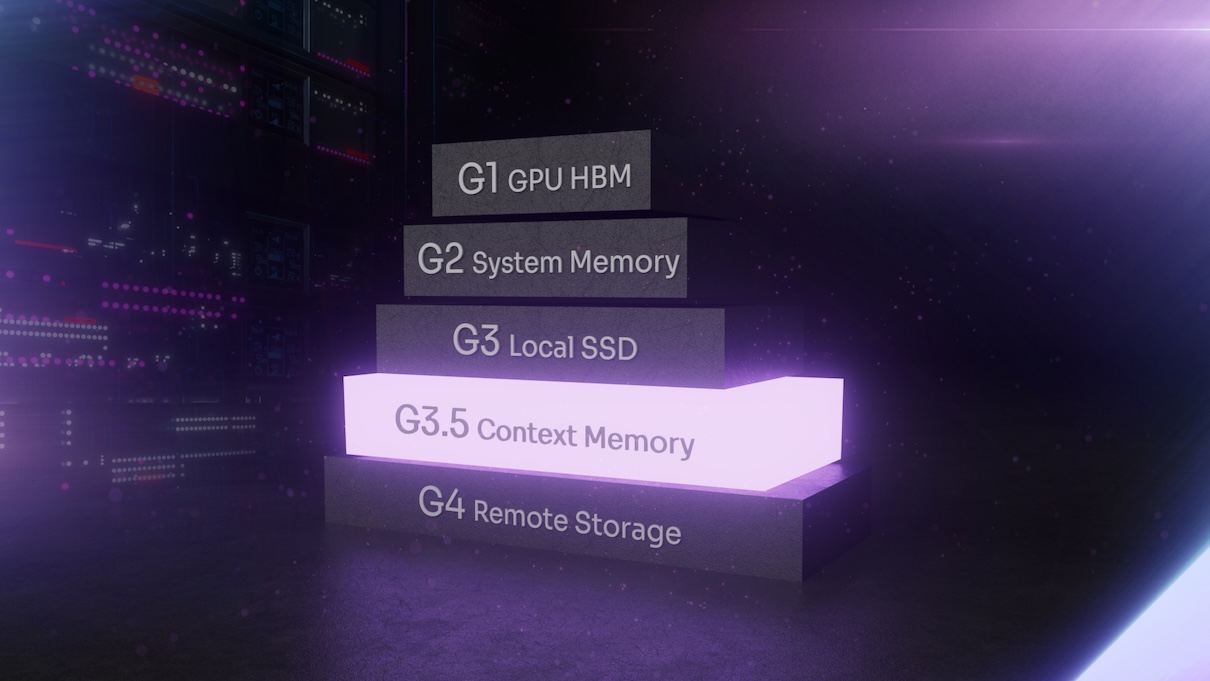
The industry’s proposed solution is the emergence of a dedicated context tier, positioned architecturally between high-speed GPU memory and bulk network storage. This layer is envisioned as high-performance, high-density flash storage, specifically engineered to efficiently store and serve the Key-Value (KV) cache—the crucial inference data that enables AI models to retain and utilize context—as well as retrieval data, all at inference speeds. Nvidia has begun to formalize this architectural concept under the term CMX (Context Management and Serving), with storage manufacturers like Solidigm actively developing SSD products optimized for these demanding workloads.
"Historically, storage hasn’t been the primary focus for organizations planning their enterprise infrastructure buildouts," Stryker observes. "In many respects, it represented a comparatively minor cost compared to compute, often treated as a commodity where procurement was driven solely by the lowest cost per gigabyte. However, in the current landscape, any deficiency in storage performance directly impacts an organization’s return on investment and its bottom line."
Why AI Inference Demands a Distinct Storage Architecture from Training
The storage architectures currently employed by AI systems largely stem from the requirements of training workflows. AI training is characterized by sequential processing and a write-heavy I/O pattern, involving the transfer of large data blocks between computational resources and bulk object storage. The established tiered structure—comprising high-bandwidth memory on GPUs, fast NVMe storage within servers, and bulk storage accessible over the network—generally suffices for this use case.
In contrast, AI inference presents a fundamentally different set of demands. Its input/output (I/O) signature is fine-grained, highly sensitive to latency, and increasingly stateful. Both KV cache data and retrieval data exhibit distinct access patterns but require rapid delivery and frequent reuse across interactions. Neither data type is optimally suited for GPU high-bandwidth memory, which is both expensive and physically limited in capacity, nor for conventional bulk storage, which was never engineered to support the real-time demands of active inference workloads.
"The most compelling architectural challenge today isn’t at the very top or bottom of the stack, but rather in the middle," Harthorn remarks. "A significant portion of the infrastructure situated below GPU High Bandwidth Memory is being tasked with functions it was not originally designed for, making this area the focus of considerable current systems development."
A prominent manifestation of this architectural gap is the phenomenon of recomputation. During the inference process, a critical initial step known as “pre-fill” involves processing all relevant context for a given session before token generation can commence. When KV cache state is not readily available in a fast, accessible storage tier, the system is forced to recompute this state. This process consumes valuable GPU cycles that yield no new output, representing a significant inefficiency.
"A substantial proportion of GPU compute time can be consumed by re-pre-filling operations," Harthorn explains. "During this period of context calculation, compute resources are effectively being used to reproduce existing state rather than generate novel work. When viewed from this perspective, GPU utilization issues can be seen as partially stemming from storage-related bottlenecks."
This revised perspective is invigorating interest in a performance metric adopted from the networking field: “goodput,” which measures useful tokens delivered per unit of cost, as opposed to raw token throughput per dollar.
The AI Context Memory Tier and Its Operational Mechanics
The industry’s response to these challenges is coalescing into a distinct architectural layer. This emerging tier, situated between GPU memory and conventional network storage, is purpose-built for holding and serving inference context. It functions distinctly from drives within GPU servers (often referred to as G3) and the storage servers connected via the network (G4), and is engineered to supply context data to accelerators with exceptional speed.
"If an organization is building a data center that will become operational in the latter half of this year or early next year, it’s no longer feasible to consider storage as residing in only two locations," Stryker asserts. "Storage infrastructure must now encompass at least three tiers to accommodate the context memory layer, and this approach is poised to become a permanent fixture in future data center designs."
This development parallels the emergence of object storage as a distinct category, which arose organically once a critical mass of workloads necessitated its specific capabilities. Object storage subsequently developed its own set of primitives, service-level agreements (SLAs), cost models, and a robust vendor ecosystem.
"The context tier appears to be following a similar evolutionary trajectory," Harthorn suggests. "The sheer volume of data is driving the formation of this category, rather than being dictated by the product roadmap of any single vendor."
For infrastructure leaders, this necessitates proactive planning for this new tier, moving beyond a perception of it as an optional component. By strategically deploying additional NAND flash in this layer, organizations can reduce their reliance on Dynamic Random-Access Memory (DRAM). DRAM is significantly more expensive per gigabyte, and its deployment is often constrained by availability and thermal limitations.
"From an investment efficiency standpoint, adopting the SSD layer, as recommended and prescribed by Nvidia for numerous use cases, represents a more cost-effective approach," Stryker concludes.
Essential Flash Requirements for Supporting AI Inference
To effectively participate in the AI inference stack, SSD technology must meet several new performance criteria. Predictable tail latency—the worst-case performance scenario for a drive—is paramount, outweighing average-case speed. Orchestration systems that allocate GPU resources based on anticipated storage response times cannot tolerate unexpected multi-second delays. Consistent, observable performance is therefore more critical than peak throughput.
Beyond latency, storage density emerges as a significant factor, particularly for hyperscale deployments. In data centers where power consumption, rather than raw cost, is the primary limiting resource, “watts per petabyte” becomes the key performance indicator. Floating gate NAND technology, the manufacturing approach underpinning Solidigm’s products, is particularly well-suited for optimizing this metric. Furthermore, seamless network integration through technologies like NVMe over Fabrics, RDMA, and the forthcoming support for CXL (Compute Express Link) is essential, given the stringent latency requirements of active AI inference pipelines.
"Beyond raw throughput and the ability to transfer data rapidly, as was the primary need for training, these drives must now deliver highly consistent performance characteristics," Harthon emphasizes. "The focus has shifted to enabling operations that are highly predictable and easily observable by the personnel managing and orchestrating these complex systems."
Guidance for Enterprise AI Leaders on Planning for the Context Tier
The standards, software primitives, and best practices currently being established will shape the operational landscape of AI inference infrastructure for years to come. Solidigm is actively contributing to this formative process through participation in standards bodies, collaborative efforts in partner labs, and the dissemination of research findings, underscoring the critical nature of their involvement as this category continues to mature.
"The pivotal question for the next few years isn’t whether AI infrastructure requires more compute power," Harthorn concludes. "It’s whether existing compute resources can be utilized more efficiently. A significant part of the answer to that question lies within the emerging context tier, which is being architected and deployed today."
Business Style Takeaway: The escalating demands of AI inference, particularly the explosion of context data in agentic systems, necessitate a new storage tier optimized for rapid KV cache and retrieval data serving. Businesses must shift their infrastructure planning to include this specialized context tier to avoid compute inefficiencies and maximize AI ROI, moving beyond traditional storage paradigms.
Original article : venturebeat.com