

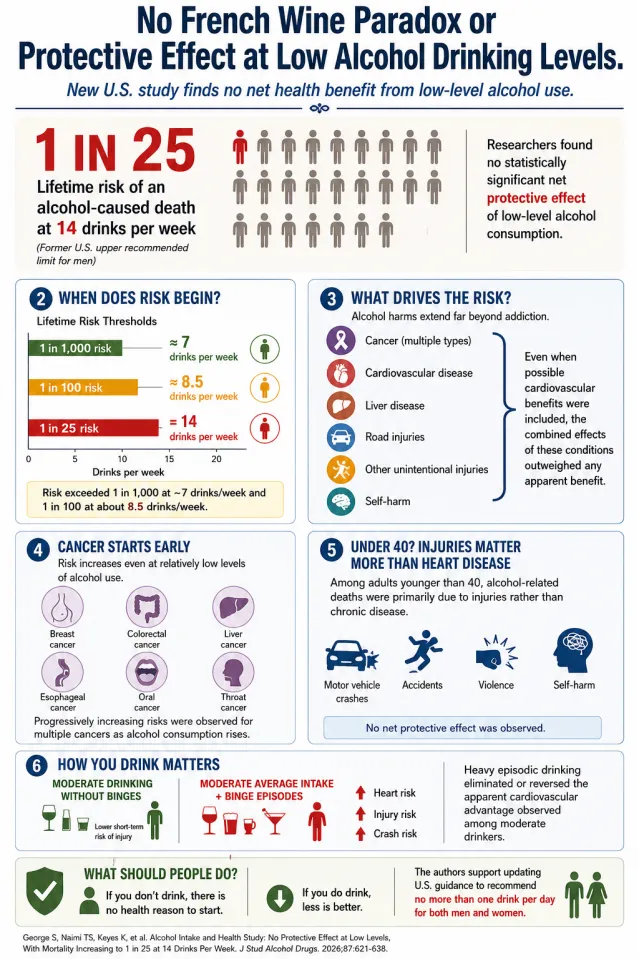
A significant new study by Sinead George and colleagues from the Centre for Addiction and Mental Health has delivered a stark reassessment of alcohol consumption, finding no discernible net health benefits even at low levels. The research posits that for individuals consuming 14 drinks per week, the lifetime risk of alcohol-attributable death is approximately 1 in 25. This challenges the long-held notion that moderate alcohol intake confers health advantages, with current evidence increasingly highlighting risks like cancer, cardiovascular issues, and injuries that may overshadow any perceived benefits.
Previous discussions had begun to question the “French wine paradox,” the idea that moderate drinking was beneficial. This recent analysis by George et al. concludes that low-level drinking offers zero net health benefits.
The study meticulously estimated the lifetime risk of alcohol-attributable mortality and morbidity in the United States, correlating these risks with average lifetime alcohol consumption and specific drinking patterns.
This research emerges alongside a growing body of evidence linking alcohol to a range of adverse health outcomes, including cancer, cardiac arrhythmias, liver disease, injuries, and addiction, even in individuals not classified as having alcohol use disorder. Alcohol remains a leading preventable cause of death in the U.S., accounting for over 170,000 deaths annually and millions of lost potential life years.
Rather than focusing on comparative longevity between drinkers and non-drinkers, the Alcohol Intake and Health Study’s investigators quantified the specific risks posed by alcohol consumption itself.
The study’s findings are particularly relevant for addiction specialists and the broader public. Consuming 14 drinks per week, a threshold previously considered the upper limit for men in U.S. guidelines, was associated with an estimated 1 in 25 lifetime risk of death from alcohol-related causes.
Women generally face heightened health risks from alcohol compared to men at equivalent consumption levels. This is due to physiological differences, such as body composition and metabolism, leading to higher blood alcohol concentrations. Consequently, women are more prone to developing alcohol-related liver disease, cardiomyopathy, neurotoxicity, and certain alcohol-associated cancers with lower cumulative exposure and shorter drinking durations. While some women may exhibit higher alcohol tolerance, the long-term health implications are significant.
Understanding the Implications
For decades, the perception of alcohol as a health aid was bolstered by studies indicating that moderate drinkers exhibited better health outcomes than abstainers. However, many of these foundational studies were hampered by methodological flaws, including the misclassification of former drinkers as abstainers and insufficient control for confounding lifestyle factors. The current analysis, by contrast, modeled diseases and injuries with well-established causal links to alcohol, such as various cancers, liver disease, cardiovascular conditions, infections, and injuries.
While some earlier research suggested minor cardiovascular benefits at very low consumption levels, these apparent advantages were negated when alcohol-induced cancers, liver disease, infections, injuries, suicides, and other mortality causes were comprehensively factored in. This holistic assessment is paramount.
The critical question shifts from whether alcohol offers marginal benefits for a single condition to whether it enhances overall health when all associated risks are considered. According to this study, the answer is no.
The Growing Link to Cancer
To many, alcohol consumption conjures images of cirrhosis, alcoholism, or impaired driving. However, contemporary research increasingly points to cancer as a primary public health consequence. The International Agency for Research on Cancer classifies alcohol as a Group 1 carcinogen, based on conclusive evidence of its causal role in human cancers. The incidence of breast, colorectal, esophageal, oral, liver, and other cancers escalates with alcohol intake. Notably, these increased risks are not confined to heavy drinkers.
The public’s slow adoption of this message may stem from the insidious nature of cancer development. Unlike a hangover, alcohol-induced DNA damage or hormonal alterations promoting carcinogenesis occur without immediate, noticeable symptoms. Individuals may feel well while unknowingly increasing their long-term cancer risk through drinking, a reality that is becoming increasingly difficult to overlook.
The study estimated that lifetime alcohol-attributable mortality surpassed 1 in 1,000 at approximately one drink daily and exceeded 1 in 100 at around eight to nine drinks weekly. At a consumption level of 14 drinks per week, the estimated risk of dying from an alcohol-related condition rose to approximately 4 percent, or 1 in 25.
Public health officials commonly employ lifetime risk thresholds when assessing hazards like environmental toxins and occupational exposures. A consumer product presenting a 1 in 25 lifetime mortality risk would likely trigger significant public concern. For adults under 40, the study found no net protective effect from alcohol; in this demographic, alcohol-related mortality is primarily driven by injuries, accidents, violence, and self-harm, rather than cardiovascular disease. The risks are immediate and tangible, rendering any potential cardiovascular benefits distant, uncertain, and largely irrelevant.
Another consistent finding in alcohol research is that average consumption is an incomplete measure. Seven drinks spread across a week are not equivalent to seven drinks consumed in a single occasion.
The study reviewed evidence indicating that binge drinking can nullify any apparent cardiovascular advantages associated with moderate average intake. Heavy episodic drinking was linked to a marked increase in the risk of cardiovascular events, injuries, suicide attempts, and motor vehicle accidents.
Intervention Beyond Alcohol Use Disorder
From an addiction physician’s perspective, the data offers valuable insights for early intervention, even before the onset of alcohol use disorder.
A recurring theme in clinical practice is the importance of intervening proactively rather than waiting for individuals to reach a crisis point. Just as hypertension and prediabetes are managed before severe complications arise, early intervention for alcohol-related harms is crucial, as prevention strategies are effective.
The adverse effects of alcohol are not exclusive to individuals with severe alcohol use disorder; many harms manifest among those who perceive themselves as moderate drinkers. Increased cancer risk, injury, and cardiovascular complications do not necessitate a diagnosis of alcoholism.
The traditional demarcation between “problem drinkers” and others is becoming scientifically untenable.
The Conclusive Evidence
Perhaps the most compelling implication of this study is the absence of any credible medical rationale for advising non-drinkers to commence alcohol consumption for health benefits—a notion that, while perhaps surprising, was once part of medical advice.
The Alcohol Intake and Health Study does not advocate for the immediate cessation of drinking for all individuals, nor does it suggest that occasional moderate drinkers are inevitably destined for poor health outcomes.
However, it critically undermines the long-standing narrative that moderate drinking is beneficial for health.
Extensive international analyses corroborate these findings. When cancer and injury risks are considered alongside cardiovascular outcomes, the level of alcohol consumption associated with minimal overall health risk approaches zero.
The most straightforward conclusion is remarkably simple: If you do not drink, there is no medical imperative to start. If you do drink, reducing consumption is generally advisable. For those prioritizing health and longevity, the evidence increasingly points toward a clear conclusion: The risks associated with alcohol substantially outweigh any potential benefits.
Business Style Takeaway: Understanding that alcohol consumption offers no net health benefits, even at moderate levels, reframes risk assessment for leaders. This knowledge can inform corporate wellness initiatives, employee assistance programs, and personal decision-making, prioritizing evidence-based approaches over outdated assumptions to foster a healthier, more productive workforce.
Source: : www.psychologytoday.com