

Consider a controlled scenario: two individuals are presented with an identical task—crafting four concise sentences about a negative future outcome. The critical difference lies in the nature of the threat posed. One is asked to contemplate climate change, the other, a personal risk of contracting a serious illness. While the cognitive demand is uniform, the emotional and linguistic responses diverge significantly.
The Nuances of Threat and Cognitive Response
The individual tasked with reflecting on climate change tends to produce prose characterized by longer, logically connected sentences, reflecting a step-by-step analytical process. Conversely, the text generated in response to the illness threat is typically shorter, more emotionally charged, and laden with first-person pronouns and expressions of fear, while exhibiting fewer connective phrases that typically structure coherent arguments.
This distinction is not merely anecdotal; it emerged as a consistent pattern in a recent study involving 2,708 participants, published in *Applied Cognitive Psychology*. The findings challenge a long-standing tenet within psychological research.
Historically, the prevailing narrative suggested that perceived threats invariably accelerate cognitive processing while diminishing its precision. The established view posits that deliberate, analytical reasoning is supplanted by rapid, instinctual reactions when individuals feel endangered.
Re-evaluating Previous Frameworks on Threat and Cognition
Empirical support for this perspective exists. Studies linking reminders of mortality, exposure to terrorism concerns, and the experience of scarcity have indeed correlated with a decline in cognitive rigor. For instance, research by Mani et al. (2013) indicated that financial anxieties deplete cognitive resources essential for addressing other challenges, reinforcing the notion that threat impairs thinking capacity.
However, the collective body of research has not presented a wholly consistent picture.
Terror Management Theory, for example, posits that mortality salience prompts individuals to reinforce their existing belief systems (Greenberg et al., 1990). Another viewpoint suggests that threats generally induce more conservative attitudes across the populace (Jost et al., 2003). A third perspective argues that the impact is contingent on individual disposition, with liberals exhibiting more conservative-like thinking under duress (Nail et al., 2009).
Furthermore, certain observations defy these established models. Following the 2008 Mumbai attacks, attitudes towards immigration in Western Europe remained stable (Finseraas & Listhaug, 2013). Intriguingly, the 2011 attacks in Norway were met with an increase in favorable sentiments towards immigrants (Jakobsson & Blom, 2014). This divergence presents a significant challenge to a field that often speaks with certainty about “the effect of threat.”
A compelling hypothesis offers a potential resolution: Eadeh and Chang (2020) proposed that threats are not monolithic. Threats perceived as belonging to a particular political ideology can lead to ideological reinforcement. For example, environmental warnings might skew political leanings leftward rather than rightward.
If this premise holds, the issue may not lie with the data but with the conceptualization. The term “threat” has been treated as a singular entity, whereas its manifestations are demonstrably diverse.
Dissecting Threat-Specific Linguistic Styles
This proposition formed the basis of our investigation. Collaborating with Mehmet Harma, Fırat Şeker, and Burak Doğruyol, we designed a preregistered experiment to systematically compare the effects of 11 distinct threats—including climate change, financial hardship, illness, warfare, relationship dissolution, and terrorism—under identical experimental conditions. This methodology allowed for direct comparative analysis.
Our initial phase involved administering reasoning tasks, the very metrics conventionally employed to gauge the cognitive impairment associated with threat. The outcome was unambiguous and surprising: none of the 11 threats resulted in a statistically significant decrease in performance scores. By this conventional standard, no measurable cognitive degradation occurred.
However, this reasoning assessment proved to be an insufficient indicator. Prior to engaging with these tasks, participants had articulated their thoughts on the assigned threat through written statements. An analysis of this written output revealed a clear differentiation among the 11 threats.
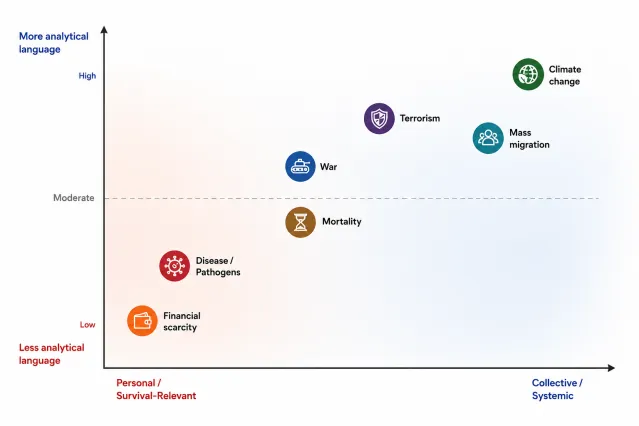
Threats such as climate change and mass migration elicited more analytical and structured linguistic patterns. In contrast, concerns about disease and financial instability prompted language that was less structured and more emotionally resonant. The impact of threat, therefore, was not a blanket cognitive deterioration but a nuanced reorganization of thought processes, the specific direction of which was dictated by the nature of the perceived danger.
This outcome aligns with a more sophisticated understanding: threat does not operate uniformly. A large-scale, distal threat like climate change invites proactive planning and discursive engagement, thereby fostering analytical reasoning. Conversely, an immediate, personal threat, such as a health crisis or impending financial default, necessitates a more visceral, urgent response, drawing cognitive resources towards emotional processing.
The experimental setup remained constant across all conditions. The variability in the threat itself was the crucial factor shaping the divergent responses.
A paramount takeaway from this research concerns the methodologies used to assess cognitive function. The subtleties of threat perception and its influence were largely invisible in standard performance metrics but vividly apparent in the linguistic output.
While a test score offers a singular numerical value, the richness of an individual’s written expression provides a far more granular insight. The construction of sentences, the degree of emotional expression, and the choice of pronouns—all these elements illuminate the intricate ways a threat is being processed.
Interestingly, one consistent element emerged across nearly all threat conditions: language related to social connection, community, and belonging remained prominent. Regardless of the specific danger, individuals’ expression tended to reach outward toward others.
Consequently, when confronted with a world perceived as threatening, the more pertinent inquiry shifts from a simple “Am I stressed?” to “What specific nature does this threat possess, and how is it influencing my cognitive orientation?” Financial anxieties, for instance, can constrict focus to the immediate, thereby narrowing decision-making horizons. A more abstract, long-term concern, however, might paradoxically create the cognitive space for more deliberate and reasoned consideration.
The generalized term “stress” obscures these vital distinctions. An individual’s own articulated thoughts, however, offer a more precise diagnosis. Close attention to one’s own language can reveal the true nature of the challenge being faced.
Business Style Takeaway: Understanding how different types of threats (e.g., long-term strategic risks versus immediate operational crises) influence cognitive processing and communication is crucial for effective leadership. Leaders can leverage this insight to tailor their messaging and decision-making processes, fostering analytical rigor for distant threats and providing empathetic support for immediate crises.
Original article : www.psychologytoday.com