

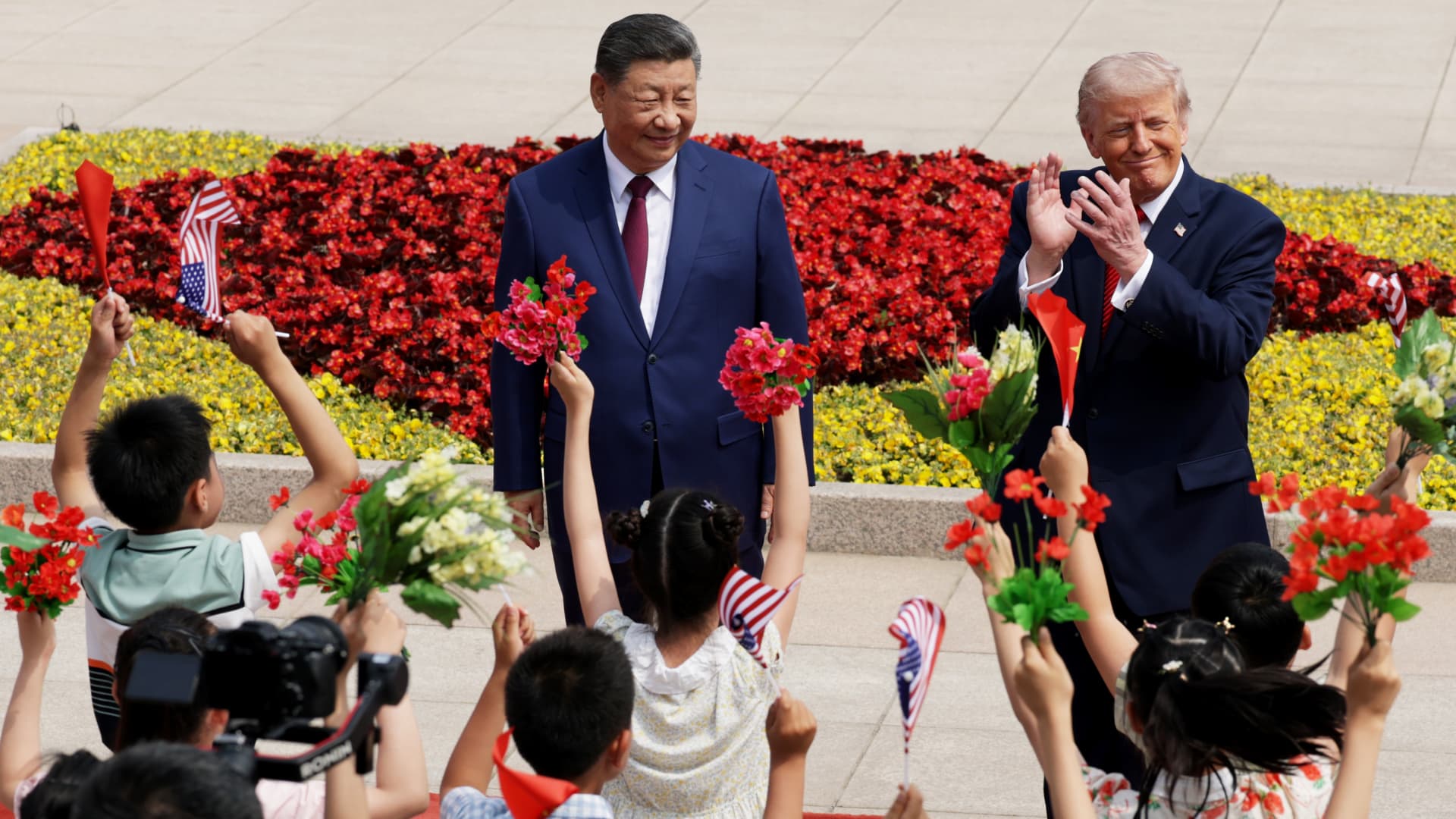
The recent high-level summit between U.S. President Donald Trump and Chinese President Xi Jinping has significantly reinforced the existing trade détente between the two global economic titans, injecting a measure of stability into an often-turbulent bilateral relationship.
Originally slated for an earlier date, the two-day engagement concluded Friday, yielding commitments for a follow-up meeting in the autumn. This development follows a period marked by shifts in geopolitical alignment and an effort to de-escalate trade tensions.
Geopolitical Landscape Re-evaluated
Initial discussions were reportedly overshadowed by President Xi’s pointed remarks regarding Taiwan, which, according to state media, posed a substantial risk to the U.S.-China relationship. Concurrently, statements made by President Trump suggesting China’s agreement to purchase American oil and assist in Iran negotiations contributed to a temporary uptick in oil prices. However, concrete details regarding the timing and volume of these potential oil transactions remain unconfirmed by Beijing, and Washington has offered no official statements on the Taiwan issue.
Yue Su, Principal Economist for China at the Economist Intelligence Unit, commented that while substantive dialogue on Taiwan was absent, the shared focus on Iran underscored areas of mutual interest. She added, “The fact that both sides want to describe the meeting as a win shows goodwill, at least. There are limits to what China can realistically do, as the Iranian regime is operating in survival mode and will prioritize its own interests and agenda above all else.”
Trade Truce Reaffirmed
Specifics of any trade agreements have yet to be formally disclosed. However, President Xi’s acceptance of an invitation to visit the United States on September 24th provides a critical window for continued dialogue before the expiration of the current one-year trade truce in October 2025. This existing agreement has already facilitated tariff reductions and the reversal of restrictions on rare earth materials, stemming from earlier escalations in bilateral friction.
State media reports indicate that both nations have agreed upon a three-year framework for constructive “strategic stability.” Jack Lee, an analyst at China Macro Group, observed, “Strategically, Beijing appears to be trying to turn Trump’s transactional willingness to stabilize ties into a longer-term operating framework for U.S.-China relations,” suggesting this framework could influence future U.S. presidential administrations’ approaches to China.
Business and Investment Implications
President Trump announced that China intends to place an order for 200 Boeing aircraft, a figure exceeding the company’s prior expectations, though falling short of earlier industry projections. Furthermore, reports indicate that Nvidia has received U.S. approval to supply its H200 chips to major Chinese corporations, a development that spurred an upward movement in technology stocks.
The U.S. business delegation accompanying President Trump included prominent figures such as Boeing CEO Kelly Ortberg and Nvidia CEO Jensen Huang, alongside other industry leaders including Apple CEO Tim Cook and Tesla’s Elon Musk. These executives participated in a meeting with Chinese Premier Li Qiang, where the primary takeaway was China’s commitment to gradually opening its market to foreign enterprises, a trend observed over recent decades.
The scale of the U.S. business delegation was notably smaller than those that have accompanied presidential trips in the past. Gary Dvorchak, Managing Director at Blueshirt Group, opined, “I don’t think the purpose was to have every CEO sign a deal. I think the purpose was just to kind of flex America’s muscles and just show from an economic standpoint what a powerhouse we are. It also shows a high level of unity amongst the American government and private sectors.”
Business Style Takeaway: The recent U.S.-China summit has underscored a pragmatic approach to managing bilateral economic and geopolitical risks, reinforcing a tentative trade truce and signaling potential areas for collaboration. Investors and businesses should monitor the implementation of agreed-upon frameworks for strategic stability and market access, as these could shape the contours of international trade and technological development for the foreseeable future.
According to the portal: www.cnbc.com