

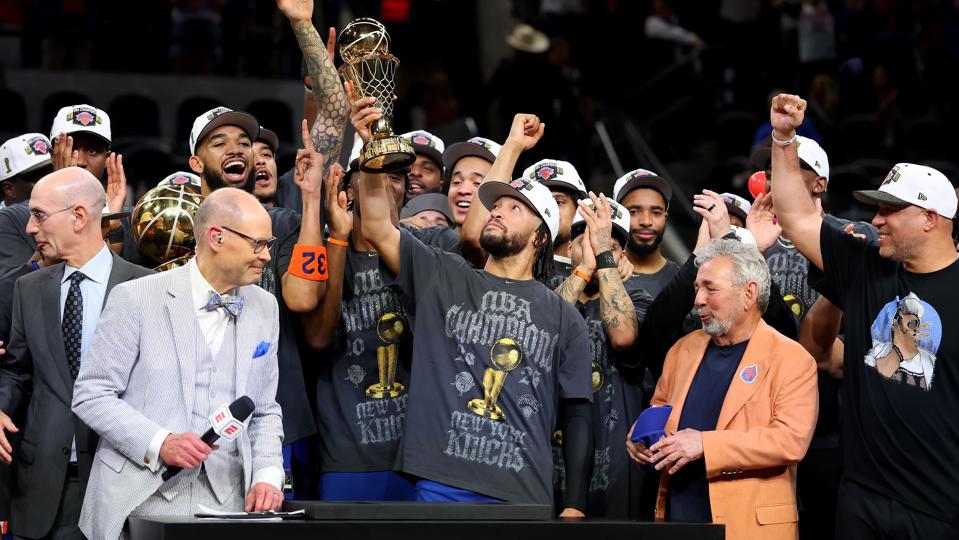
Jalen Brunson, the 29-year-old point guard for the New York Knicks, has been named the NBA Finals MVP following the team’s victory, securing their first championship in 53 years. This historic win for the Knicks was made possible by strategic team-building that commenced after Brunson opted for a less lucrative contract two years prior.
Key Details
In 2022, Brunson inked a deal with the Knicks valued at $104 million. This contract represented a significant value for a future Finals MVP, especially when compared to deals signed by other prominent players, such as Nikola Jokic, whose contracts reached up to $276 million.
Furthermore, in the summer of 2024, Brunson agreed to a contract extension totaling $156.6 million. This deal was structured to provide him with less immediate compensation than he could have secured by waiting for unrestricted free agency.
It is reported that had Brunson delayed his negotiation until reaching free agency, he would have been eligible for a contract worth approximately $269 million over five years. By choosing the Knicks’ offer, he effectively deferred an estimated $113 million, thereby providing the team with crucial salary cap flexibility to assemble a championship-caliber roster around him.
Leveraging this newly available cap space, the Knicks successfully acquired key players for their championship-winning 2026 roster, including Karl-Anthony Towns and Mikal Bridges, Brunson’s former teammate from Villanova.
Crucial Insight
“He understands what winning is about,” Knicks head coach Mike Brown stated in a recent interview following Saturday’s game. “He took a pay cut that I wouldn’t take. Every time they would throw that number in front of me, I would say no, and I feel like I’m a great guy. He set the bar. That set the standard.”
Counterpoint
In a February profile for Vanity Fair, Brunson elaborated on his decision, characterizing the choice for a lesser contract as a personal one. “I’ve seen players wait and then get hurt, and then they’re at the mercy of the organization,” Brunson explained, emphasizing his belief that he performs best when his mind is free from financial anxieties. He added, “A lot of people say I sacrificed for the team. One hundred percent I sacrificed for the team. But most importantly, I made sure my family and I are taken care of.”
Future Outlook
Brunson is slated to become eligible for a new five-year contract in 2028, potentially valued at up to $417.8 million, according to a 2024 report from The Athletic. At that point, Brunson will be 32 years old. Reflecting on his situation in February, Brunson told Vanity Fair, “Obviously we’d love for them to do right by me. I think anyone would. I feel like I sacrificed.”
Key Background
Brunson distinguished himself as a McDonald’s All-American in high school and emerged as a star player for Villanova, contributing to their NCAA men’s basketball championships in 2016 and 2018. Drafted by the Dallas Mavericks as the 33rd overall pick in the 2018 NBA draft, he eventually sought free agency after declining a reported $55 million contract extension in 2022, which led him to sign with the Knicks. Over the past few years, Brunson has once again become the pivotal player for the resurgent Knicks, spearheading their remarkable postseason run to the franchise’s first championship since 1973. In the decisive Game 5 on Saturday night, Brunson scored 45 points, shooting 14-of-27 from the field and 13-of-15 from the free-throw line.
Further Reading
Business Style Takeaway: Jalen Brunson’s championship-clinching MVP performance underscores a strategic gamble on team building over individual maximum compensation. His willingness to sacrifice significant personal earnings facilitated the acquisition of complementary talent, proving that prioritizing collective success can yield the ultimate reward, and potentially greater long-term financial gain through future performance-based contracts.
According to the portal: www.forbes.com