

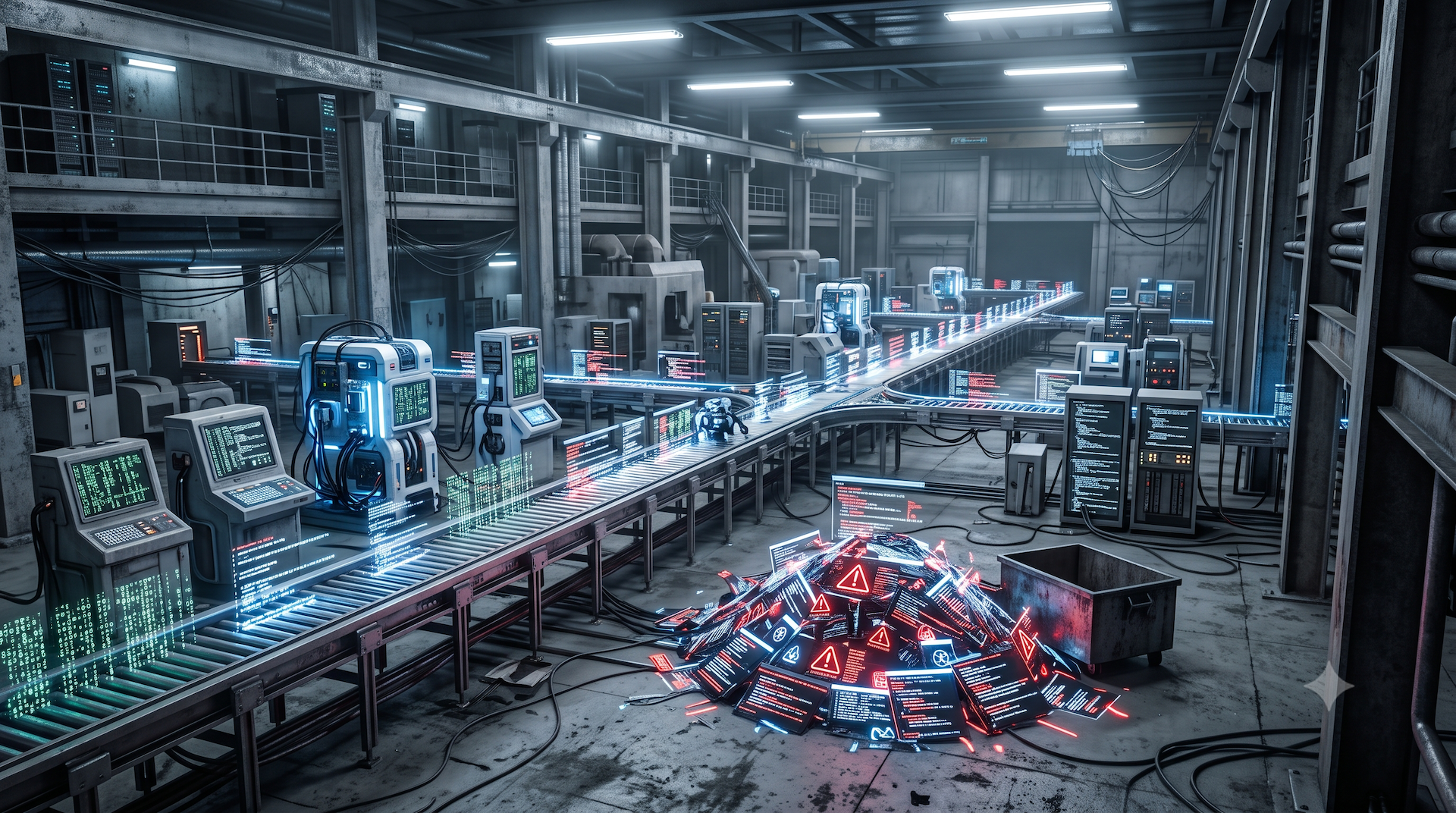
The advent of industrialized manufacturing fundamentally reshaped global production, enabling unprecedented output, cost efficiencies, and speed. A comparable transformation is now underway in the realm of software development.
The proliferation of Large Language Models (LLMs) has significantly reduced the effort required to write code, amplified individual developer productivity, and prompted organizations to rethink software engineering as a production pipeline. This shift challenges the efficacy of traditional software development lifecycles and continuous integration/continuous delivery (CI/CD) practices that have been standard for decades. The concept of a “software factory” emerges as a solution, but like its physical counterparts, its success hinges on more than just velocity.
The notion of a “software factory” has gained considerable traction over the past year. Luca Rossi’s influential piece, “The Era of the Software Factory,” compellingly argued that AI is not merely accelerating code generation; it is fundamentally altering the entire software production ecosystem.
While the term can encompass various elements—such as a suite of AI coding agents and reusable skill sets, expedited CI/CD pipelines, enhanced code review mechanisms, or broader automation in software delivery—it is more productively viewed as a set of guiding principles rather than a distinct category of tools. A true software factory cannot be a haphazard assembly of prompts, agents, and plugins. It necessitates a robust platform that governs the flow of work, dictates how code is generated, reviewed, tested, traced, deployed, and rectified when issues arise.
Without such a structured approach, organizations risk merely creating isolated, inefficient operations and mislabeling them as a factory.
The Convergence of Forces Driving the Software Factory Model
Several concurrent factors are propelling the adoption of this new paradigm:
Businesses have perpetually faced a demand for software exceeding the capacity of available engineering talent. This gap has historically been filled by tools like spreadsheets, which often serve as pragmatic solutions for applications that companies would otherwise develop.
AI has demonstrably lowered the barrier to code creation, a point frequently highlighted. While coding is now more accessible, it is not invariably cheaper or superior, as evidenced by substantial AI expenditure reported by major corporations. The threshold for producing functional code has, in effect, diminished.
More critically, individual engineers can now generate significantly more code than was feasible just a few years ago. This shifts the primary bottleneck away from “How quickly can someone write this?” or even “Does someone possess the coding proficiency?” The crucial question now becomes: “Should this be written at all?”
Furthermore, can we genuinely produce end products that are both robust and reliable, without simply accumulating technical debt? Or are we merely accelerating the creation of low-quality, AI-generated output? This is the core risk to address.
The Perils of the Contemporary Software Factory
The prospect of increased output and efficiency is undeniably attractive. Historically, factories streamlined production, making goods more accessible and affordable.
However, as with many engineering endeavors, advancements often involve trade-offs, and the software factory model introduces novel risks.
When technology—digital or otherwise—amplifies an individual’s output, it concurrently magnifies the potential for errors, whether attributable to the human operator or the technology itself. The current velocity of code deployment is on an industrial scale. Even smaller organizations can now see their codebases expand to magnitudes comparable to those of major tech firms a decade prior.
Emerging data already indicates a correlation between increased AI adoption and potential instability. Faros AI reported that while developer task throughput increased by 33.7% and the pull request (PR) merge rate rose by 16.2%, the ratio of incidents to PRs surged by an alarming 242.7%, and bugs per developer escalated by 54%. Similarly, Google’s DORA research indicated that higher AI integration was associated with decreased delivery stability.
In my capacity as a fractional Head of Data, I have been engaged to resolve precisely these types of challenges. Within the past year, I have encountered two projects where AI-generated data infrastructure incrementally evolved over time, leading to significant complications.
The combined effect of multiple engineers striving for rapid progress and a lack of standardized practices resulted in unmanageable codebases. While codebases naturally evolve, the confluence of disparate coding styles, often influenced by LLMs, led to rapid, unintended code mutations. Within months, codebases exhibited five to six distinct coding styles—a phenomenon that previously took years to develop. Consequently, engineers gradually lost a clear understanding of the underlying system.
This pattern is reminiscent of the early days of self-service tooling a decade ago, where initial productivity gains masked escalating downstream complexity.
This underscores why the software factory concept must transcend a sole focus on speed.
Hallmarks of an Effective Software Factory
Several core principles are essential for constructing a functional software factory:
Platform-Centric Approach Over Disparate Tools: Many teams are incrementally integrating AI into their coding workflows through peripheral additions—such as a PR review agent or a set of code snippets within repositories. However, establishing a genuine software factory demands a unified platform, not merely a collection of isolated tools. A platform provides a cohesive foundation where tools are interconnected, sharing data and collaborating as a single, integrated system, thereby unifying standards, processes, and the development work itself.
Rerunability and Traceability: An effective platform must enable the retrospective analysis of any execution, identification of failures, and seamless reruns. This is why standalone agents are insufficient for a factory model. The system must support the retrieval of a serial ID, its lookup, and the precise tracing of its journey to the final output. Consequently, state machines offer a more logical structure for AI workflows than simple loops, facilitating easier process reruns and step-by-step comprehension.
Robust Safety Mechanisms and Guardrails: Industrial factories are inherently complex environments, and a software factory is no exception. As more developers engage with these platforms, the implementation of advanced guardrails and safety measures becomes paramount. Integrating testing and quality control early in the development lifecycle is crucial; identifying defects at the earliest possible stage dramatically reduces remediation costs and limits their potential impact.
Emphasis on Standardization: At the enterprise level, each codebase possesses a unique character. Introducing code assistants without established standards can result in an unmanageable amalgamation of coding styles. Standardization must be an intrinsic component of the development process from its inception.
Integrated Quality Control: Traditional manufacturing models often relegated quality control to the end of the production line, involving inspection and subsequent defect correction. Toyota’s revolutionary approach, however, embedded quality into the process itself, empowering workers to halt production upon detecting an issue. The objective was not merely to identify defects post-production but to prevent their propagation downstream.
This philosophy is directly applicable to the software factory. Quality control must be interwoven throughout the entire workflow, commencing with the initial specification phase. This entails incorporating static code analysis tools to flag apparent errors and providing structured templates to LLMs to guide code generation according to predefined architectures. Without these measures, the final review stage becomes the bottleneck, or teams risk disseminating suboptimal AI-generated code.
Achieving True Productivity: Speed with Accountability
Enhancing code output velocity does not equate to genuine productivity if downstream issues remain unaddressed. A company is not more productive simply because it manufactures millions of vehicles that subsequently prove unreliable. Nor is it productive if it exclusively produces an endless stream of proofs-of-concept that never reach production.
True productivity lies in the software factory’s ability to transform transient ideas into enduring, functional outputs. While quantifying lines of code and team velocity is straightforward, it obscures the broader picture.
The ultimately successful software factory will not be defined by the sheer volume of code it generates, but by the minimization of downstream defects.
Business Style Takeaway: The push toward “software factories” driven by AI presents a critical inflection point for businesses; focusing solely on increased output velocity without robust platform governance, quality control, and standardization risks accelerating technical debt and operational failures. True productivity lies in building reliable, maintainable software systems, not just generating more code faster.
Source: : venturebeat.com