

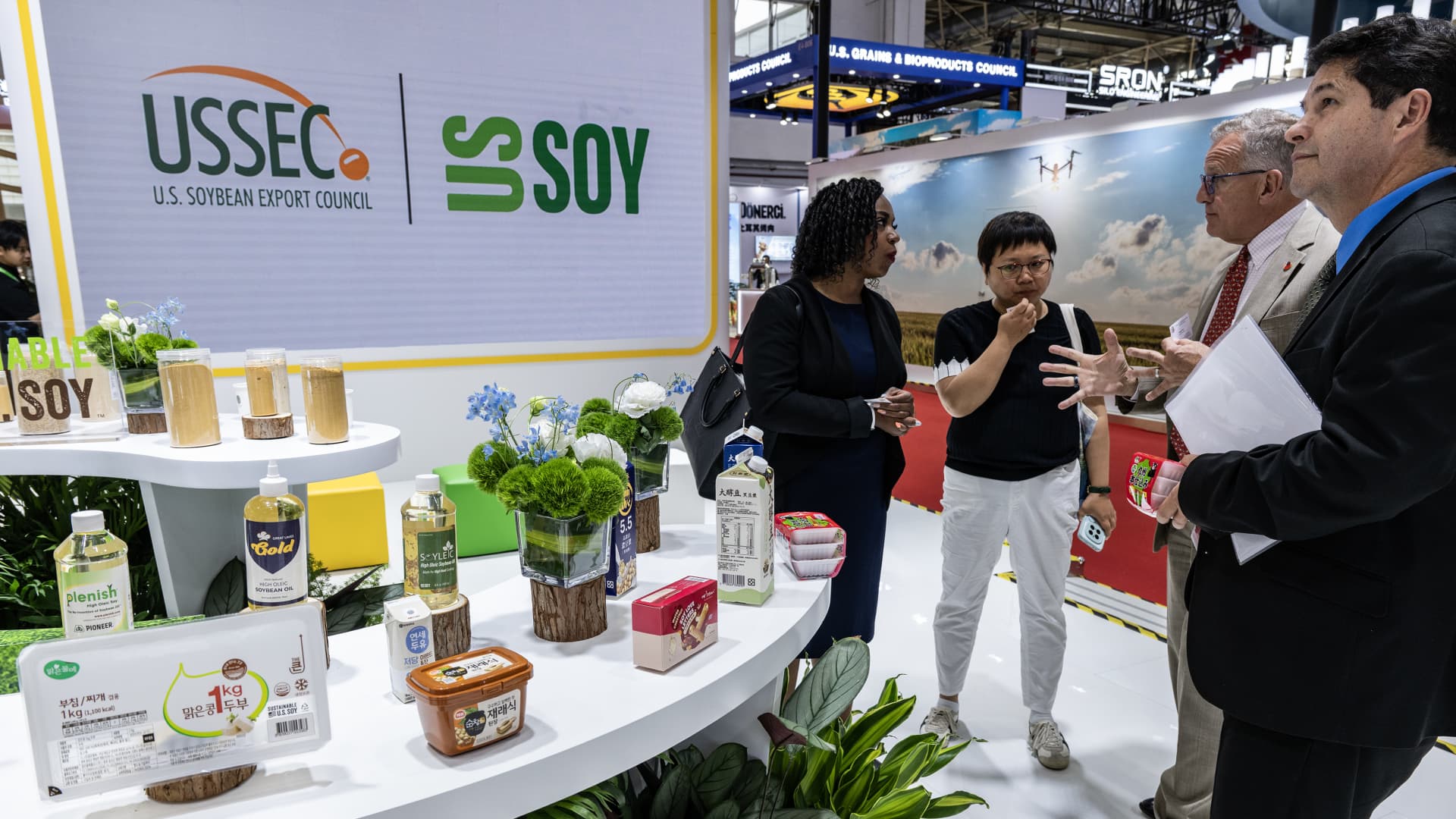
Amidst a shifting global agricultural trade landscape, the United States is strategically reasserting its position in the Chinese soybean market, historically a cornerstone of its agricultural exports. Facing increased competition from Brazil, which has significantly expanded its market share, U.S. soybean producers are now emphasizing the superior quality and distinct cultivation advantages of their crops as a key differentiator.
Executives from the U.S. Soybean Export Council highlighted the fundamental differences in growing conditions between North and South America. A comparative analysis of weather patterns, particularly rainfall in the critical pre-harvest period, underscored how South American production, exemplified by Brazil, can lead to variations in crop condition and, consequently, quality, as opposed to the more controlled environment typically experienced in U.S. growing regions like Illinois.
This strategic pivot was a central theme at a recent supply chain expo in Beijing, co-organized by the U.S. Soybean Export Council and the China Council for the Promotion of International Trade. The initiative aimed to foster dialogue on advancing a sustainable and resilient U.S.-China soybean supply chain. Industry leaders urged Chinese buyers to delve deeper into quality metrics and nutritional profiles, particularly those relevant to animal feed, to make more informed sourcing decisions.
 China’s 'K-shaped' economy deepens as consumption stays subdued: Economist
Market Dynamics and Shifting Trade Flows
The dynamics of U.S.-China agricultural trade have been significantly influenced by broader geopolitical and trade policy shifts. China, as the world’s largest importer of soybeans, has actively diversified its supply sources to bolster national food security, a strategy that has notably benefited Brazil and Argentina. A decade ago, the U.S. and Brazil were near-equal suppliers to China, each accounting for approximately 40% of imports. However, following the imposition of U.S. tariffs on Chinese goods in 2018, Brazil’s share began to dramatically increase.
Data from the first five months of 2026 indicates a substantial alteration in this balance, with Brazil supplying over 60% of China’s soybean imports, the U.S. providing 23%, and Argentina contributing 10%. This shift is reflected in U.S. export figures, which saw a precipitous 76% decline in soybean exports to China last year, down from a peak of $17.9 billion in 2022. Despite this contraction, U.S. soybeans remain the largest agricultural export category to China, valued at $3.1 billion.
Rebuilding Confidence and Future Projections
Efforts to regain market share are gaining momentum, underscored by recent bilateral agreements. Following a meeting between U.S. President Donald Trump and Chinese President Xi Jinping, China committed to purchasing a minimum of $17 billion in U.S. agricultural products annually through 2028, in addition to prior soybean purchase commitments. Specifically, an earlier agreement stipulated the purchase of at least 25 million metric tons of American soybeans annually for three years.
Industry stakeholders report that China has fulfilled its initial purchase obligations for the current marketing year and has begun acquiring the larger volumes stipulated in the subsequent agreement. Recent U.S. Department of Agriculture data also points to significant soybean sales to China, with some of these transactions potentially being routed through “unknown destinations,” a common practice that often ultimately benefits Chinese buyers.
Market participants express cautious optimism regarding a modest recovery in U.S. soybean exports. Projections suggest that volumes may stabilize between 25 million and 30 million metric tons in the near term, with potential for growth to approximately 40 million metric tons in subsequent years. These developments signal a gradual rebuilding of trust and trade relationships, though the market remains sensitive to broader economic and political factors.
Producer delegations have also been active on the ground in China, engaging in agricultural roundtables to explore avenues for renewed cooperation. While acknowledging the current trade volumes are below the peak levels seen in 2019, these interactions aim to re-establish the robust agricultural ties that previously characterized the bilateral relationship.
Business Style Takeaway: The U.S. soybean industry’s strategy to regain market share in China by emphasizing quality over volume reflects a broader trend of supply chain diversification and risk management by major importing nations. This highlights the imperative for global commodity producers to adapt to shifting geopolitical landscapes and demonstrate clear value propositions beyond mere price competitiveness.
Source: : www.cnbc.com