

Mistral AI has unveiled OCR 4, its latest document intelligence model, which significantly advances beyond simple text extraction. This new iteration provides a structured representation of entire documents, incorporating precise bounding boxes for elements, classification of content blocks, and granular confidence scores for individual words. This marks Mistral’s fourth generation of optical character recognition technology in just over a year, arriving at a critical juncture where the company’s emphasis on European AI sovereignty is gaining considerable commercial traction.
The model demonstrates robust multilingual capabilities, supporting 170 languages across 10 distinct language groups. It is compatible with a wide range of document formats, including PDF, DOC, PPT, and OpenDocument. Notably, OCR 4 can be deployed as a self-contained container within an organization’s own infrastructure. This capability is particularly attractive to enterprises in highly regulated sectors that must maintain strict control over sensitive documents and cannot risk routing them through cloud APIs subject to U.S. jurisdiction.
“Mistral OCR 4 extracts and structures content from a wide range of documents,” the company stated in its announcement. “Where previous generations focused on converting a page into clean text and tables, OCR 4 returns a structured representation of the document.”
OCR 4 is immediately accessible via the Mistral API, Document AI within Mistral Studio, Amazon SageMaker, and Microsoft Foundry. Support for Snowflake Parse Document is expected soon. Pricing begins at $4 per 1,000 pages, with volume discounts reducing the cost to $2 per 1,000 pages through a batch API.
OCR 4: A Semantic Map for Documents, Not Just Text
The core engineering innovation in OCR 4 lies in its structural understanding. Departing from the decades-old paradigm of outputting a flat stream of extracted text, the model now delivers a layered representation. Each identified block is precisely located with a bounding box, categorized by its type (such as title, table, equation, or signature), and assigned confidence scores at both the page and word levels.
Mistral reports that the demand for bounding box information was its most frequently requested feature. The rationale is straightforward: without location data, downstream systems struggle to trace extracted information back to its precise source on a specific page. This traceability gap has historically posed a significant challenge for enterprises building Retrieval-Augmented Generation (RAG) pipelines, compliance workflows, or any application requiring auditable answers to questions like “Where did this figure originate?”.
The block classification feature addresses a related challenge. By tagging a paragraph as a “title,” for instance, documents can be segmented into hierarchical chunks suitable for semantic search. Content identified as a “table” can be directed to a structured data processing pipeline instead of a text summarization tool. Similarly, a “signature” block can trigger automated redaction workflows within compliance systems.
While these capabilities are not entirely new in isolation, their integration as first-class outputs of the OCR model itself—eliminating the need for a separate layout analysis stage—significantly simplifies integration for enterprise teams, saving them from the burden of building and maintaining complex custom solutions.
Confidence scores offer a dual benefit. At scale, they enable organizations to programmatically route regions with low confidence to human reviewers while automatically approving high-confidence extractions. This facilitates the implementation of “human-in-the-loop” verification without requiring manual review of every page. In production environments, OCR is typically the initial step in a broader pipeline, rather than the final objective.
Developers engaged in building RAG systems, agentic workflows, or document automation solutions often find themselves dedicating substantial effort to reconstructing document layout and structure, sometimes even more than to the core AI logic. OCR 4 aims to eliminate this reconstruction phase, promising not only cost savings in OCR processing but also significant reductions in engineering hours across the entire document processing workflow.
Human Evaluations Favor Mistral’s Output, Though Benchmarks Present Nuances
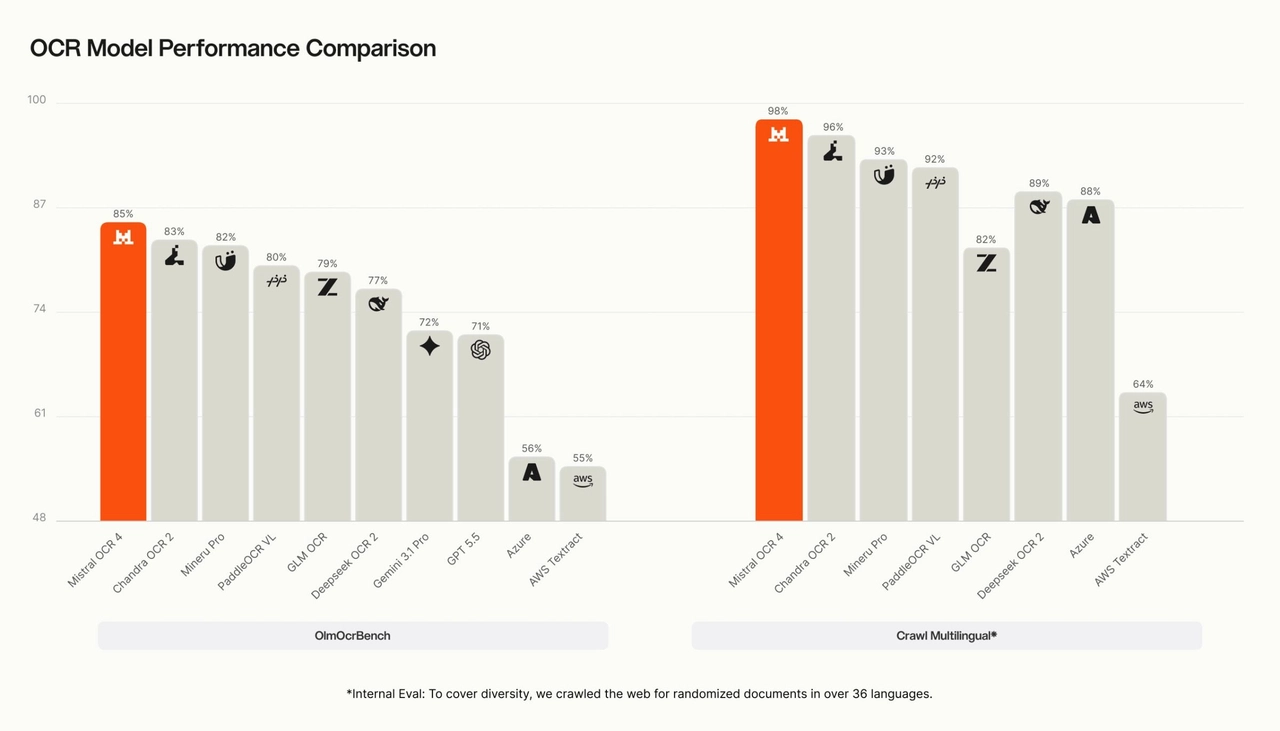
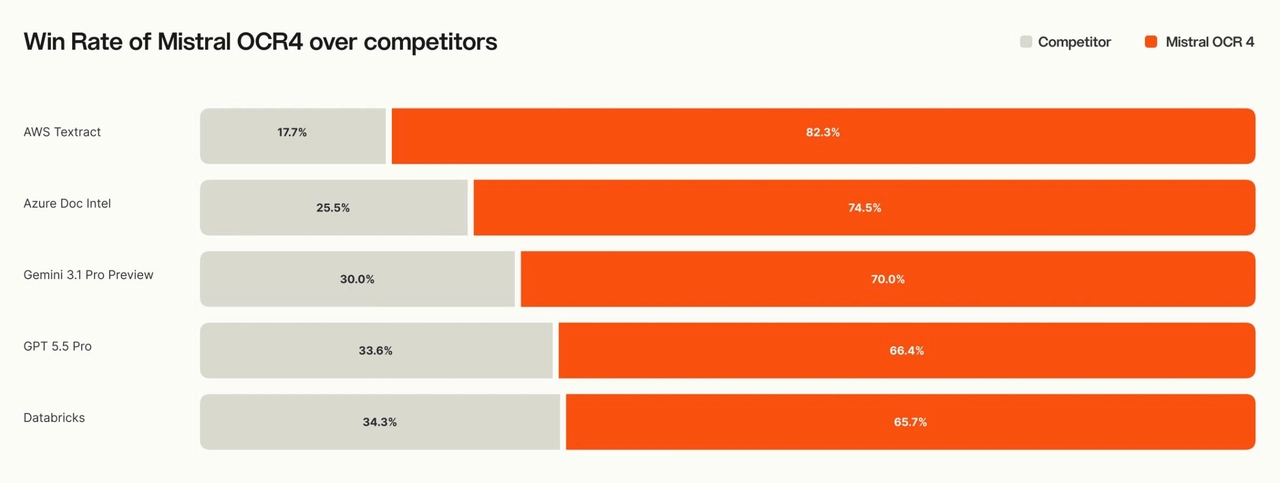
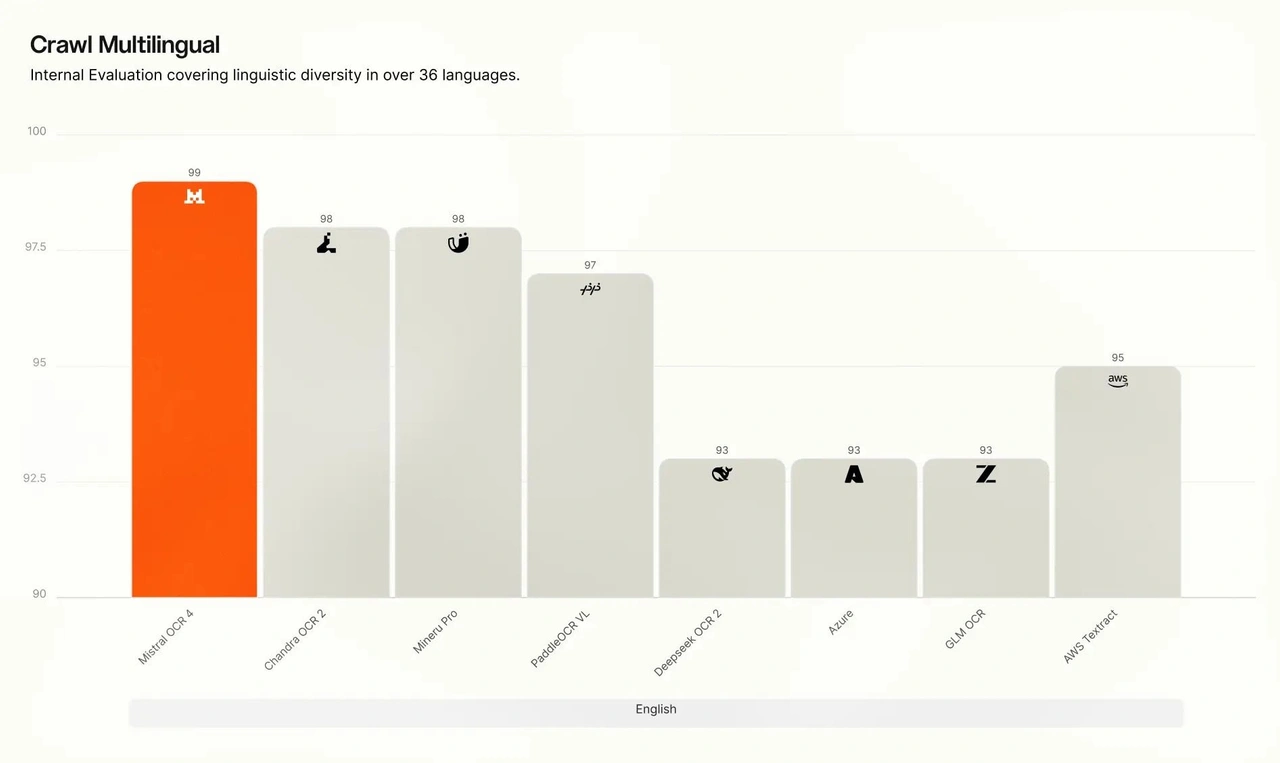
Mistral reports that OCR 4 achieved an average win rate of 72% in head-to-head human evaluations against leading competitors. These evaluations, conducted by independent annotators across more than 600 real-world documents in over 12 languages, highlight strong performance. The model also secured the top overall score on the OlmOCRBench at 85.20 and achieved 93.07 on OmniDocBench.
However, Mistral itself advises caution in interpreting these benchmark figures. In a notable display of transparency, the company publicly disclosed specific scoring anomalies identified, including ground-truth errors in reference annotations, mismatches due to equivalent LaTeX notation, assumptions in column reading order, and issues with header/footer attribution. “We therefore treat the aggregate score as directional rather than definitive,” the company stated—an unusually candid approach for a product announcement.
This transparency is strategically timed. On the public OlmOCRBench leaderboard, some observers have noted that OCR 4 currently ranks third, behind open-weight models such as Chandra OCR 2. Furthermore, certain open-weight models, like PaddleOCR-VL-1.6, self-report higher OmniDocBench composite scores (claiming 96.33), although these results have not yet been independently verified on the public leaderboard.
Despite benchmark complexities, early enterprise feedback has been positive. Aidan Donohue, an AI engineer at the financial AI firm Rogo, reported that OCR 4 achieved equivalent accuracy to leading agentic document parsers on a chart-dense financial question-answering dataset, but at “roughly 8x lower cost and 17x lower latency.” Similarly, Ivan Mihailov, an AI engineer at intellectual property management firm Anaqua, noted that OCR 4 is “roughly 4x faster per page than our incumbent provider.”
Ultimately, enterprise buyers are advised to conduct their own evaluations. The critical factor is not which model achieves the highest score on a benchmark, but which model delivers the fewest errors on specific document types and languages, at a cost and latency that align with the organization’s operational needs.
The Anthropic Export Ban Amplifies Mistral’s Sovereignty Narrative
Mistral’s release is strategically timed against a backdrop of significant geopolitical developments impacting the AI landscape. The U.S. Commerce Department’s recent intervention on June 12, which forced Anthropic to disable access to its advanced Fable 5 and Mythos 5 models for foreign nationals, serves as a potent validation of Mistral’s core argument for European AI autonomy.
This export control action abruptly disrupted critical AI services for enterprise clients across finance, healthcare, SaaS, and infrastructure sectors, highlighting the vulnerability of relying on U.S.-controlled AI technologies. The models remain offline, with uncertain prospects for restoration, intensifying concerns about supply chain security in the AI domain.
This situation starkly underscores a warning issued by Mistral CEO Arthur Mensch over a year ago. Mensch cautioned at London Tech Week in June 2025 about the risks of U.S. AI companies holding “the keys” to their models, stating that European companies were “giving leverage to their providers” and emphasizing the need for independent control over AI capabilities.
Mensch has consistently advocated for European AI infrastructure development. In late May, he told CNBC that Europe “is lagging behind when it comes to [the] buildout of infrastructure, and so we are investing to close that gap.” He also countered calls for AI disarmament, arguing that Europe must maintain its own advanced AI capabilities to remain competitive globally, particularly in light of AI’s adoption by other nations.
The self-hosted, single-container deployment option for OCR 4 is the tangible product manifestation of this sovereignty strategy. While U.S. providers might offer EU data residency, documents processed remain subject to U.S. law. In contrast, Mistral, a French-incorporated company operating under EU jurisdiction, offers on-premise deployment, ensuring that sensitive documents never leave the customer’s control. With the EU AI Act’s stringent enforcement provisions taking effect on August 2, the imperative for European enterprises to prioritize data sovereignty in their AI vendor selection is more pressing than ever.
Contrast with Baidu’s Open-Weight Release Highlights Strategic Divergence
Mistral’s launch of OCR 4 closely followed the release of Baidu’s Unlimited-OCR on June 22. This open-weight, 3-billion-parameter model, distributed under an MIT license, addresses a persistent challenge in document AI: processing entire PDFs and multi-page scans in a single pass without disruptive chunking or complex output stitching.
Baidu’s model employs Reference Sliding Window Attention (R-SWA), a technique that allows the AI to maintain full attention on the original document while limiting its generated text memory to a focused, moving window. This approach ensures a consistent KV cache size and enables transcription of over 40 pages in a single processing step. The model quickly garnered significant attention, achieving 1,800 GitHub stars within its first 24 hours and widespread discussion on platforms like Hacker News.
These two concurrent releases frame a developing split in the document AI market: one path focuses on self-hosted, long-horizon document parsing with open-weight models, while the other offers structured, managed extraction services with enterprise-grade features. Baidu’s model, being free and runnable on standard GPU hardware without dedicated support or SLAs, is ideal for research teams or individual projects. In contrast, Mistral’s OCR 4 is a commercial product designed for enterprise procurement, featuring per-page pricing, advanced structuring capabilities, multi-platform distribution, and on-premise deployment options, catering to organizations requiring Service Level Agreements (SLAs), data processing agreements, and compliance audits.
The competitive landscape for OCR also includes major players like Google Document AI, Amazon Textract, Azure Document Intelligence, ABBYY Vantage, and a growing array of open-weight alternatives.
Reflecting on the state of OCR technology, practitioners on platforms like Hacker News have offered candid assessments. One user commented, “OCR still sucks in 2026,” while another reported remarkable success using Claude for transcribing hundreds of handwritten pages with zero corrections, even noting a continuity error in the source material. These anecdotal reports highlight the critical variability in OCR performance based on specific document types, languages, and the quality of the input material.
The Strategic Imperative: Document Intelligence as an Entry Point to Enterprise AI Stacks
Viewed from a broader perspective, Mistral’s OCR 4 release is less about optical character recognition itself and more about a strategic play for the enterprise AI market. This is particularly relevant given the global intelligent document processing market, projected by Grand View Research to grow at a 33.1% compound annual growth rate through 2030, representing a substantial opportunity.
For Mistral, OCR 4 serves as a crucial entry point into enterprise AI budgets. The model integrates seamlessly with Mistral’s Search Toolkit, an open-source framework for composable search solutions. Within this architecture, OCR 4 acts as the foundational ingestion layer for RAG and enterprise search pipelines, transforming raw documents into structured, citation-ready data. This positioning naturally leads enterprises to explore Mistral’s wider suite of offerings, including its Medium 3.5 model for reasoning and the Vibe agentic platform for task execution.
This strategic positioning is crucial for understanding Mistral’s ambitious fundraising goals. Reports indicate the company is in early discussions to raise approximately €3 billion ($3.5 billion) at a valuation nearing €20 billion, a substantial increase from its September Series C round. While Mistral has raised about $4 billion to date, significantly less than its major U.S. competitors, the development of OCR 4 and its associated enterprise revenue stream are key components in justifying this higher valuation. Mistral has set aggressive revenue targets, aiming for €1 billion in 2026, up from €200 million in 2025.
With approximately 1,000 employees, Mistral aims to compete with AI labs that have secured vastly larger capital investments. Its strategy centers on differentiating itself through a specialized enterprise stack focused on sovereignty, advanced document intelligence, and agentic workflows. This approach is designed to capture the growing segment of European enterprise budgets that are increasingly wary of dependency on U.S. technology providers.
The pricing model further supports this strategy. At $2 per 1,000 pages for batch processing, the cost of digitizing a large corporate archive becomes significantly more manageable, potentially making large-scale digitization projects economically viable where token-based pricing for vision-language models might have been prohibitive.
The ultimate success of Mistral’s strategy hinges on its ability to execute at scale, facing competition from established giants like Google, Amazon, and Microsoft, as well as a rapidly evolving open-source ecosystem. However, the ongoing uncertainties surrounding U.S. export controls, tightening European data sovereignty regulations, and the prospect of a substantial funding round create a favorable environment for Mistral’s vision. The company is scheduled to host a production webinar for OCR 4 on July 7.
Just two weeks ago, the imperative to build AI infrastructure resilient to geopolitical influences like U.S. export controls was largely theoretical. The recent U.S. government action against Anthropic’s models, however, demonstrated the real-world implications, rendering advanced AI inaccessible to non-U.S. entities overnight. While Mistral did not instigate this crisis, its development of OCR 4 positions it as a key beneficiary, offering a compelling solution for organizations prioritizing data sovereignty and operational control.
Business Style Takeaway: Mistral AI’s OCR 4 release emphasizes structured document intelligence and self-hosted deployment, directly addressing enterprise concerns around data sovereignty and regulatory compliance, particularly in Europe. This strategic focus positions the company not just as an AI provider but as a critical enabler for businesses seeking to leverage sensitive data securely while building independent AI stacks, potentially influencing future investment in AI infrastructure with a focus on geographical and regulatory independence.
According to the portal: venturebeat.com