

In a recent season of a prominent Indian music program, a young vocalist from the northern state of Bihar delivered a poignant, century-old folk song. The melody spoke of separation, the enduring impact of colonialism, and a deep sense of longing.
The narrative unfolds from the perspective of a woman observing her husband depart for a distant conflict under British rule. Her lament captures his absence, her resentment towards the empire that claimed him, and a powerful imagined act of defiance.
This rendition, by Bihar folk singer Utpal Udit in collaboration with the esteemed Rekha Bhardwaj, rapidly garnered millions of views. It emerged as one of the standout successes of “Coke Studio Bharat,” the Indian iteration of a celebrated music franchise dedicated to introducing regional and folk traditions to wider audiences across South Asia.
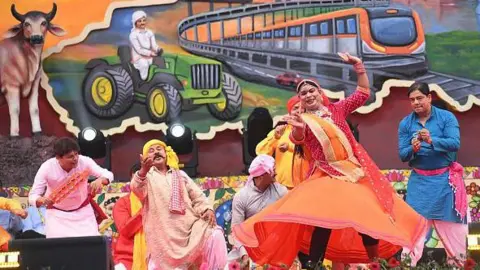
While the performance propelled Udit into national prominence, it also unexpectedly reignited interest in the Bhojpuri language. Bhojpuri, despite its rich literary and cultural heritage spanning centuries, is frequently relegated to being associated with migrant laborers and rudimentary entertainment.
Spoken by tens of millions across Northern India and a diaspora that extends from the Caribbean to the Pacific, Bhojpuri stands as one of South Asia’s most prevalent languages, boasting an extensive legacy of folk songs, poetry, oral storytelling, and theatre.
However, this nuanced cultural depth is often overshadowed in contemporary perception.
For many, Bhojpuri has become synonymous with a highly popular music industry characterized by lyrics laden with sexual innuendo, misogyny, and double entendres. On screen, characters and accents associated with Bihar are frequently reduced to caricatured sidekicks, laborers, or provincial outsiders.
Despite the decades-long efforts by regional artists to preserve the authentic folk traditions of Bhojpuri, these are often eclipsed by the language’s more visible—and more stereotyped—persona.
Now, musicians like Udit are actively striving to present a more comprehensive portrayal.
“It’s disheartening when you have a profound connection to the music of your heritage, yet it’s perceived negatively by others,” Udit shared. “My aspiration is to fundamentally alter that perception.”
 Getty Images
Udit, a native of the Saharsa district, spent his formative years moving throughout Bihar due to his father’s profession, absorbing the region’s diverse folk traditions along the way.
He recalls that initially, the melodies captivated him more than their deeper meanings. Later, a burgeoning curiosity led him to explore the works of Bhikhari Thakur and Mahendra Misir, seminal poets and playwrights who profoundly shaped Bihar’s folk narrative.
Many of these narratives center on migration—a recurring and defining theme in both Bhojpuri folk music and the historical experience of Bihar itself.
As one of India’s economically challenged states, Bihar’s trajectory has long been influenced by its residents seeking opportunities elsewhere. This exodus began under colonial labor systems and continued into the industrial and urban expansion of modern India, a journey that has resonated through its music for generations.
A song Udit frequently performs, “Jani Ja Bideswa Ke Or,” from Bhikhari Thakur’s seminal play “Bidesiya,” vividly portrays a woman imploring her husband not to leave their home in search of work, lamenting the emptiness his departure will bring and the suffering her soul will endure.
Composed over a century ago, this song emerged from a period of widespread migration, yet its themes retain a striking contemporary relevance.
Udit emphasizes that preserving this vital connection between the past and the present has become a cornerstone of his artistic endeavors.
“I want people to recognize that Bhojpuri and Bihari music possess a depth far exceeding the prevailing stereotypes,” he stated. “My aim is for them to truly hear the stories embedded within this music.”
On social media platforms, Udit frequently augments his performances with detailed annotations on their historical and cultural significance. A concise rendition of a folk tune might be accompanied by reflections on migration, colonialism, or the contributions of a specific playwright.
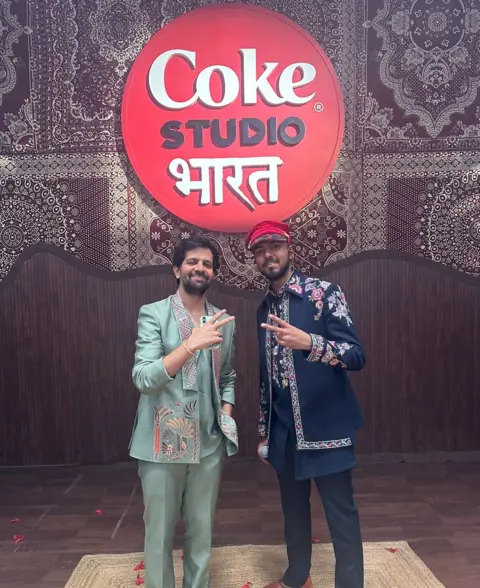
This dedication to contextualization was precisely what attracted Khwaab, the producer of “Kachaudi Gali,” to Udit’s artistic world.
Approximately a year prior, Khwaab encountered an Instagram video of Udit performing the song in his village. The visual performance itself was compelling, but it was the accompanying caption that truly captured his attention.
“Utpal is undeniably a gifted singer,” Khwaab remarked. “However, upon reading his explanation of the song’s historical background, I was profoundly struck. It was at that moment I knew something significant needed to emerge from this.”
 Coke Studio Bharat
He was also struck by the sense that an entire archive of cultural expression had been obscured by prevailing stereotypes.
This realization led Khwaab and Udit to embark on a project to reimagine “Kachaudi Gali” for a contemporary audience.
For the Coke Studio rendition, Khwaab’s vision was to imbue the production with a modern sensibility while remaining steadfastly loyal to the song’s roots. Traditional instruments, including the shehnai, tabla, dholak, harmonium, and dotara, were recorded live, and the arrangement was crafted to possess the scope and polish of mainstream popular music.
The challenge, he explained, lay not merely in preserving folk music but in effectively translating its essence for listeners unfamiliar with its rich tradition.
“It’s about safeguarding elements that risk being lost, while simultaneously creating something novel. I wanted others to understand that folk music, too, can possess a contemporary appeal.”
However, not all artists dedicated to reshaping perceptions of Bhojpuri approach the task by solely looking to the past.
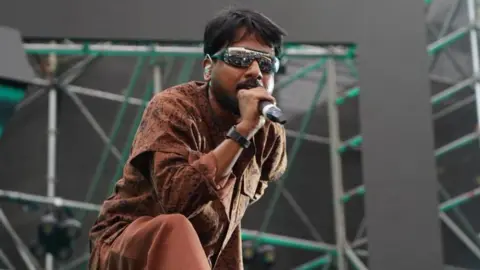
A few hundred kilometers away, rapper Sanket Shikriwal has arrived at a similar objective, albeit from a distinctly different artistic direction.
Over the past few years, Shikriwal has emerged as a distinctive voice within India’s independent music scene, recognized for his rap performances that challenge preconceived notions of what Bhojpuri music can encompass.
If Udit’s work is characterized by a spirit of recovery and preservation, Shikriwal’s artistry thrives on a dynamic collision of genres and influences.
In his music, Bhojpuri seamlessly integrates with elements of jazz, spoken word, and hip-hop. Evocations of rural life coexist with references to literary figures like Franz Kafka and musical icons such as John Coltrane. The landscape of Bihar is juxtaposed with Mumbai; themes of migration intermingle with the nuances of internet culture. His compositions feel less like a revival of folk traditions and more like an ongoing dialogue between past and present, village and city, belonging and the desire for escape.
The musical output can also be confrontational. It incorporates colloquial language and profanity, complicating any simplistic attempt to position him as a sanitized alternative to the excesses often associated with commercial Bhojpuri music.
 Shikriwal
However, Shikriwal disputes the notion that profanity itself is the primary issue.
“I do not employ profanity merely to project a tough persona,” he stated. “It serves as my chosen medium for expressing deep-seated agitation.”
He argues that this distinction is critical because Bhojpuri often faces a level of scrutiny not applied to other musical genres.
Historically, hip-hop has frequently utilized profanity as a vehicle for conveying anger, social critique, and personal expression. Closer to home, Punjabi music, despite facing criticism for its portrayal of violence and hypermasculinity, has evolved into one of India’s most successful cultural exports. Artists such as Diljit Dosanjh and the late Sidhu Moosewala have successfully transformed regional identity into a powerful source of pride and aspiration.
Shikriwal contends that Bhojpuri has rarely been afforded such a latitude of interpretation.
“The pertinent question is not whether Bhojpuri can be elevated to respectability,” he asserted. “It is why speakers of Bhojpuri are perpetually expected to justify their cultural standing.”
His aspiration is not for a sanitized rendition of Bhojpuri culture, but rather for a more self-assured expression—one that is confident enough to define itself on its own terms.
“I desire for people to look upon Bihar and recognize its legacy of philosophers once more,” he stated.
“We refer to it as the Land of Buddha, yet we subject its people to such profound disrespect.”
Udit believes that this fundamental shift in perception may already be in motion.
The overwhelmingly positive response to “Kachaudi Gali,” he notes, offered a compelling glimpse into what that future could entail.
“It served as a potent reminder,” he concluded, “that one of India’s most widely spoken languages is still awaiting the opportunity to be heard and understood on its own authentic terms.”
Business Style Takeaway: The resurgence and redefinition of Bhojpuri culture through music highlight the potent influence of cultural narratives on brand perception and market engagement. For global businesses, understanding these evolving cultural landscapes is crucial for authentic connection and avoiding outdated stereotypes, enabling more resonant and respectful brand positioning.
Source: : www.bbc.com