

As enterprise AI agents are increasingly tasked with executing complex, long-horizon objectives, their effectiveness is frequently constrained by the “harness”—the software framework that integrates a core Large Language Model (LLM) with its operational environment. Typically, these harnesses are static and manually developed, requiring tedious, manual updates. They do not possess the capability to automatically refine their code based on the execution data they gather.
To overcome this engineering impediment, researchers at Xiaomi have introduced HarnessX, a novel framework designed to treat the AI harness as a composable entity that can autonomously improve its own code. This automated adaptation allows AI systems to dynamically adjust to application-specific demands in real-world enterprise scenarios. Empirical testing has demonstrated that HarnessX delivers substantial performance enhancements across diverse fields, including software engineering and web interaction.
These findings underscore that scaling foundation models is not the sole pathway to more capable AI; for smaller models, it may not even be the optimal route. HarnessX’s harness evolution process has achieved an average performance improvement of +14.5% across 15 distinct model-benchmark combinations. Notably, for the open-weight Qwen3.5-9B model, performance gains reached as high as +44% on embodied planning tasks.
The Engineering Challenges of AI Harnesses
In the realm of AI applications, the overall capability of a foundation model is significantly influenced by its surrounding harness. This harness functions as the operational layer, translating raw model outputs into structured, executable agent behaviors. It encompasses the crucial elements such as prompts, integrations with external tools, memory management systems, and control flows that govern how an AI system perceives its environment, reasons through a problem, and executes actions.
As enterprise agents are assigned increasingly intricate, long-term workflows, the engineering of their harnesses has emerged as a fundamental aspect of AI development. Despite its critical importance, harness development has yet to mature into a standardized engineering discipline and faces three principal challenges:
-
Static and Manual Development: Harnesses are presently static and handcrafted. Any alteration in the underlying foundation model, the integration of new tools, or a shift to a different operational domain necessitates custom, manual code modifications. Existing harnesses lack the inherent mechanisms to autonomously learn and improve from prior execution experiences.
-
Architectural Entanglement: Many current harnesses suffer from tightly coupled code paths, where prompt templates, tool wrappers, retry policies, and memory management are deeply intertwined. This entanglement means that modifications to one component can inadvertently disrupt others. Consequently, reusing a harness across different business domains often results in extensive code duplication rather than clean, modular composition.
-
Isolated Optimization: The harness and the foundation model are typically optimized independently. When engineers conduct tests to refine the harness, the resulting execution traces are usually discarded instead of being utilized as training data to enhance the model. This disconnect prevents harness improvements from naturally following model upgrades, creating a bottleneck that limits the full value extraction from an agent’s operational data.
HarnessX: An Autonomous Foundry for AI Agents
HarnessX addresses the engineering bottlenecks associated with manual harness development by introducing what its creators term a “unified harness foundry.” The core innovation lies in treating the harness as a “first-class object.” In software engineering parlance, this means the harness is a independently serializable, modular, and interchangeable component. By decoupling the model configuration (i.e., the specific AI model being used) from the harness configuration, engineers can seamlessly swap, adapt, and evolve the scaffolding without altering the underlying model.
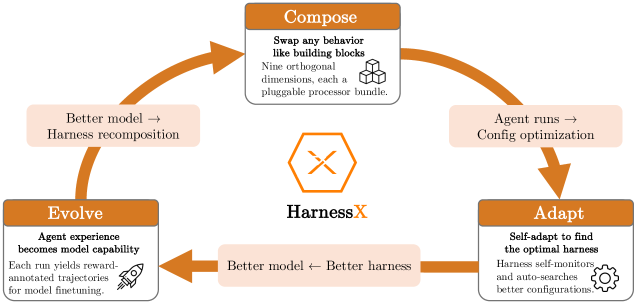
HarnessX deconstructs agent behavior into distinct modules, including context assembly, memory management, tool ecosystems, control flow, and observability. Each specific behavior is implemented as a “processor” that connects to precise lifecycle hooks within the harness. This modular architecture facilitates the seamless swapping, addition, or removal of these processors without disrupting the overall pipeline.
To automate the optimization of this modular structure, HarnessX incorporates AEGIS, a trace-driven evolution engine. AEGIS frames harness adaptation as a reinforcement learning (RL) problem, operating on the symbolic components of the harness. The approach to optimizing harnesses as an RL problem necessitated explicit engineering to mitigate three potential issues:
-
Reward Hacking: The risk that the system might discover shortcuts to achieve rewards without genuinely solving the underlying task.
-
Catastrophic Forgetting: The possibility that an modification intended to resolve a failure pattern in one context might unintentionally degrade performance in another previously solved workflow.
-
Under-Exploration: The tendency for the system to focus on minor prompt adjustments rather than exploring fundamentally superior structural configurations for tools.
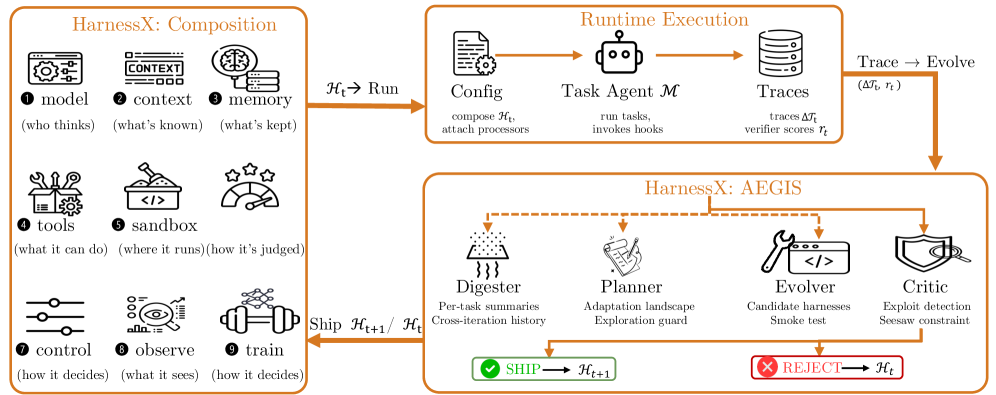
To circumvent these challenges, AEGIS employs a four-stage pipeline coupled with comprehensive trace observability:
-
Digester: This stage compresses execution traces into structured summaries, pinpointing the exact points of agent failure.
-
Planner: It analyzes these summaries to enable the system to explore structural modifications, moving beyond mere incremental prompt adjustments.
-
Evolver: This component generates code-level harness edits and conducts tests to ensure their correct functionality prior to deployment.
-
Critic and Gate: A Critic module evaluates the generated edits to detect instances of reward hacking, while a deterministic gate mechanism rejects any update that causes a regression in a previously solved task, thereby preventing catastrophic forgetting.
HarnessX enters a burgeoning field of research focused on self-improving harnesses, distinguishing itself through its emphasis on harness-model co-evolution. The researchers posit that optimizing either the harness or the model in isolation eventually leads to diminishing returns. Evolving solely the harness reaches a ceiling if the underlying model lacks the reasoning capacity to leverage new tools. Conversely, training only the model hits a training-signal ceiling if the harness fails to prompt the model to utilize its advanced capabilities.
HarnessX facilitates this co-evolution by interleaving harness evolution with model training. The execution traces generated as the harness adapts to tasks are converted into reinforcement learning signals for the foundation model. This ensures that as the harness refines its strategies, the model simultaneously learns to exploit these new strategies more effectively, breaking through the capability ceilings inherent in traditional AI agent development.
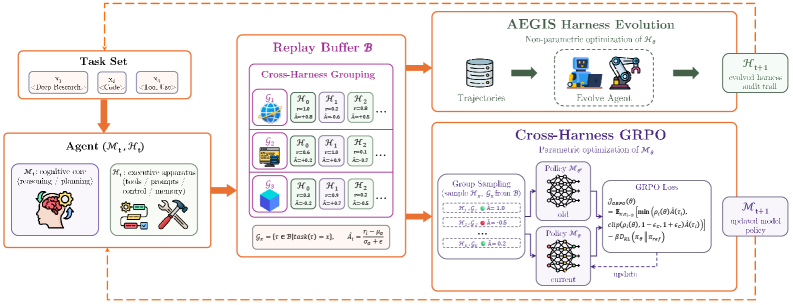
HarnessX enables this co-evolutionary process through cross-harness GRPO (Group Relative Policy Optimization), a popular RL algorithm utilized for training reasoning models like DeepSeek-R1. During model fine-tuning, cross-harness GRPO aggregates execution trajectories from an agent performing the same task across disparate versions of the application’s harnesses. This aggregated data allows the underlying model to internalize significant strategic shifts, such as adopting a new API endpoint or managing execution budgets, rather than merely learning superficial prompt variations.
HarnessX Performance on Industry Benchmarks
To assess the practical efficacy of HarnessX, the researchers conducted tests across five distinct benchmarks: software engineering, multi-turn customer service dialogues, web navigation, open-ended multi-step reasoning, and embodied planning. The AI architecture was divided into two roles: the “meta-agent,” powered by Claude Opus 4.6, responsible for analyzing logs and generating harness code; and the “task agents,” which executed the actual workflows. To demonstrate the framework’s model-agnostic nature, the system was tested with three different worker models: Claude Sonnet 4.6, GPT-5.4, and the open-weight Qwen3.5-9B.
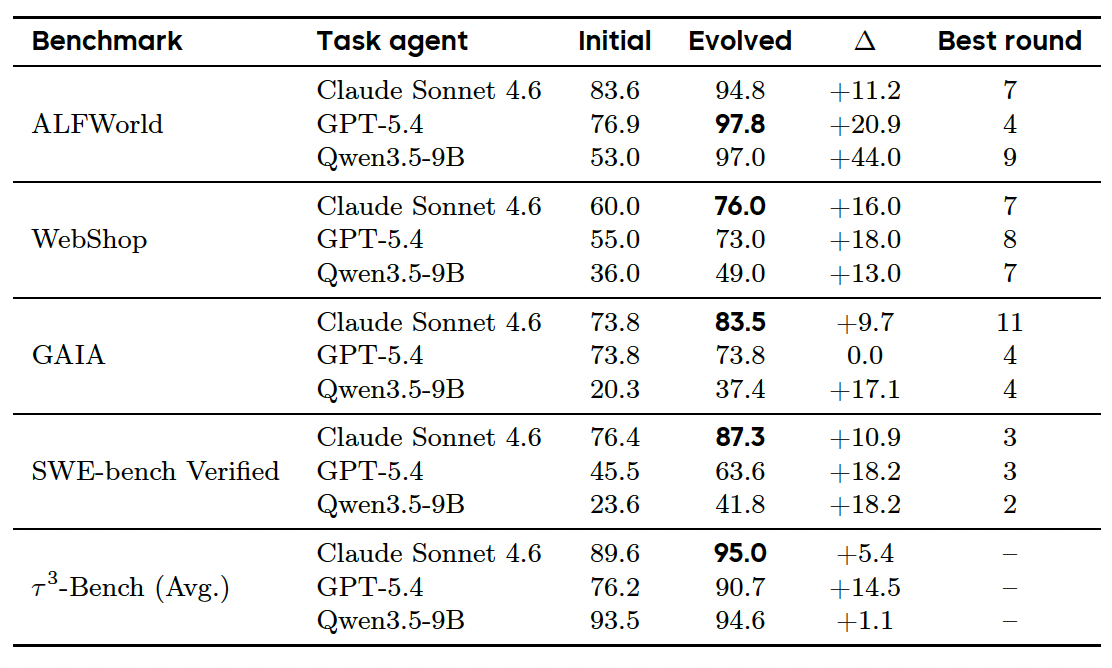
HarnessX was benchmarked against two primary reference points: a static harness, representative of current enterprise AI deployments using handcrafted, fixed configurations with benchmark-specific prompts and tools; and the Claude Code SDK, serving as a baseline to evaluate the performance of a single-agent evolution process versus the more complex, multi-stage AEGIS pipeline. The dynamic evolution of the harness yielded substantial performance enhancements on the same base models. HarnessX demonstrated improved performance in 14 out of 15 model-benchmark configurations, achieving an average absolute performance gain of +14.5% across all tests.
The most pronounced benefits were observed with less capable models. The open-weight Qwen3.5-9B model experienced a +44.0% performance increase on the ALFWorld embodied planning benchmark and an +18.2% improvement on SWE-bench Verified for software engineering tasks. Co-evolution also proved highly effective; when the foundation model was trained using data generated during harness evolution, an additional +4.7% average performance boost was recorded. This gain, applicable to open-weight models, highlights the synergistic benefits of simultaneously improving the harness and the model. The co-evolutionary gains are specifically observed with open-weight models.
Empirical evidence from the experiments illustrates how HarnessX effectively resolves common challenges encountered when developing agent harnesses for real-world applications. For instance, on the GAIA multi-step reasoning benchmark, the task agent frequently failed because its Wikipedia scraping tool, a headless browser, timed out on the site’s JavaScript-intensive interface. HarnessX analyzed the execution traces, identified the error, and generated a new tool that queried the MediaWiki API directly for plain text, bypassing the browser entirely. This optimized tool was integrated into the harness, immediately resolving the failing tasks.
During e-commerce simulations on WebShop, the AI agent often became trapped in pagination loops, repeatedly clicking “next page” and refining searches without finalizing a product purchase. Instead of merely adjusting prompts, HarnessX implemented an advisory processor that detected repetitive navigation actions. This processor injected a warning into the agent’s context, prompting a decision and breaking the looping behavior, thereby improving overall performance.
Limitations of Automated Harness Engineering
A significant consideration is that the current system relies on highly capable LLMs to function as the meta-agent responsible for rewriting harness code. In their experimental setup, the researchers utilized state-of-the-art closed models like Claude Opus. While open-weight models are rapidly advancing, their efficacy as meta-agents in this context remains to be fully explored.
Another limitation pertains to the inherent capabilities of the task-execution models themselves. If a foundation model fundamentally lacks the capacity to execute the complex workflows proposed by an evolved harness, HarnessX cannot unilaterally enhance the agent’s overall performance. This was observed with the Qwen3.5-9B model in SWE-bench coding tests.
Notwithstanding these constraints, HarnessX makes a compelling case that harness engineering, rather than solely relying on model scaling, offers a practical avenue for improvement available to practitioners today. For organizations utilizing smaller open-weight models for complex workflows, the demonstrated gains may warrant evaluating harness evolution as a primary optimization strategy before investing in more costly frontier models. The researchers intend to release the codebase in a forthcoming update.
Business Style Takeaway: The introduction of HarnessX signifies a paradigm shift, moving AI agent development from static, manual configurations to dynamic, self-improving systems, unlocking significant performance gains particularly for smaller models. This approach democratizes advanced AI capabilities by providing a cost-effective method to boost performance without necessarily requiring access to the largest, most expensive foundation models.
Based on materials from : venturebeat.com