

While developing proprietary, state-of-the-art AI models remains within reach for only a select few organizations, customizing the ‘harness’—the system that controls and directs AI models—presents a more accessible and crucial opportunity for most enterprises.
However, current methods for tuning these agent harnesses often rely on manual, intuitive debugging, which struggles to keep pace with the rapid advancements in large language models (LLMs). To address this limitation, researchers at the Shanghai Artificial Intelligence Laboratory have introduced “Self-Harness,” a novel approach where an LLM-based agent autonomously refines its operational rules. By analyzing its own execution logs, the system replaces guesswork with empirical data, enabling the development of robust custom agents that continuously adapt to their specific model’s weaknesses.
The Complexity of Harness Engineering
An AI agent’s efficacy is determined not only by its underlying model but also by its harness, which provides context and facilitates interaction with its environment. This harness encompasses critical components such as system prompts, tool integrations, memory management, verification protocols, runtime policies, orchestration logic, and error recovery mechanisms.
The harness is vital because many common agent failures originate from its configuration rather than the core model. For instance, an agent might report task completion without validating the model’s output (e.g., confirming code execution success) or repeatedly attempt failed actions. The harness also plays a crucial role in preventing performance degradation due to context window limitations or information overload as interaction history grows. Prominent examples of existing harnesses include SWE-agent, Claude Code, Codex, and OpenHands.
Harness engineering, despite its importance, remains a complex undertaking. According to Hangfan Zhang, the lead author of the Self-Harness paper, “in many cases, an experienced engineer with deep domain knowledge can still propose better changes than an LLM can today.”
The primary bottleneck, however, lies not in human capability but in the reliance on ad hoc debugging over systematic, verifiable feedback loops. Zhang elaborated, “The deeper issue is that the current harness-engineering paradigm often lacks a systematic feedback loop. Many edits are made based on intuition, a few observed failures, or ad hoc debugging.” As new models emerge frequently, relying on human intuition to fine-tune model-specific harnesses becomes increasingly inefficient and unsustainable. Some existing methods leverage more powerful models to enhance weaker target agents’ harnesses, but this dependency introduces challenges like cost, accessibility, or misalignment with the target model’s specific failure modes.
Introducing Self-Harness Methodology
The Self-Harness paradigm empowers LLM-based agents to enhance their own harnesses without requiring human intervention or external, more capable models. This continuous self-improvement cycle operates through a three-stage iterative process that translates observed behavior into harness enhancements:
-
Weakness Identification: Beginning with an initial harness configuration, the agent executes a series of tasks, generating execution logs with verifiable outcomes. It then categorizes failed executions and identifies patterns indicative of model-specific weaknesses.
-
Harness Modification Proposal: Based on the identified failure patterns, a “proposer” component within the agent generates a set of targeted and minimal harness modifications. Each proposed change is directly linked to a specific failure mechanism, preventing overly broad or generic adjustments.
-
Modification Validation: Candidate modifications are rigorously evaluated through regression testing. An edit is incorporated into the harness only if it demonstrably improves performance on failing tasks without causing significant degradation on unrelated tasks. If multiple modifications pass validation, they are merged into the next harness iteration.
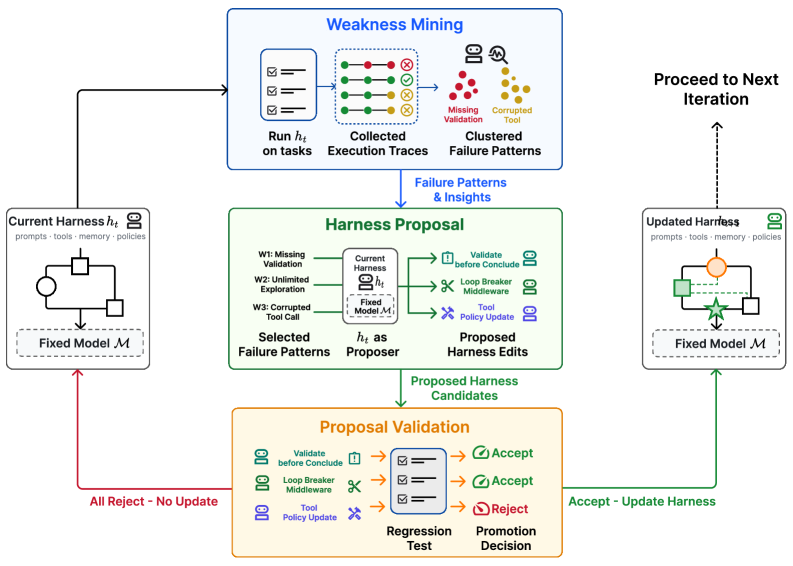
Consider an automated agent designed to fix software issues by reading documentation, writing code patches, and submitting pull requests. If a company updates its documentation standards, the agent might falter, misinterpreting context or generating flawed code. Self-Harness transforms such ambiguous failures into actionable insights. “The failure traces expose where the agent is misusing the new documentation format; the proposer can generate a targeted harness edit… and the evaluator can decide whether that edit improves the failing cases without regressing other cases,” Zhang explained.
Demonstrating Self-Harness Effectiveness
The researchers validated Self-Harness using Terminal-Bench-2.0, a benchmark designed to assess general tool-based execution capabilities, including artifact management, command utilization, verification logic, and error recovery. The system was tested with three distinct LLMs: MiniMax M2.5, Qwen3.5-35B-A3B, and GLM-5.
To isolate the impact of the self-evolving harness, a minimal harness was established using the DeepAgent SDK, comprising only the system prompt, default file system tools, and shell utilities. The LLM backend, toolset, benchmark environment, and evaluation criteria remained constant, with only the harness undergoing automated refinement.
Quantitative results revealed significant performance enhancements through automated harness modifications. Across the tested models, performance on held-out tasks improved by a remarkable 33% to 60% relative increase.
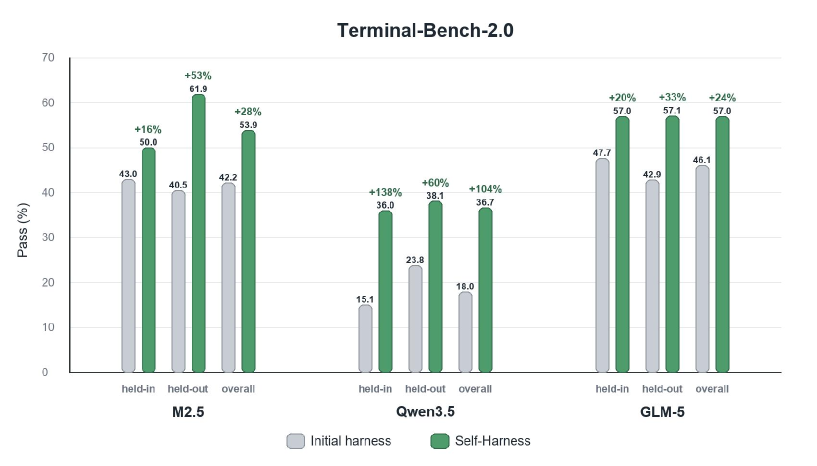
Crucially, an explicit acceptance criterion ensures that only modifications improving performance without introducing regressions are implemented. Self-Harness’s value for enterprise applications lies in its ability to generate targeted improvements that address specific model failures, rather than simply elongating prompts or adding generic instructions. For example, MiniMax M2.5, under a baseline harness, would repeatedly explore dataset configurations until a timeout occurred. Self-Harness identified this issue and introduced a “loop breaker” in its runtime policy, limiting tool calls and redirecting the agent’s approach. It also added a rule to proactively create necessary artifacts. Qwen-3.5, prone to file overwrite errors and subsequent retries, was corrected by implementing a strict command-retry discipline and a mechanism to recreate missing artifacts. GLM-5, which struggled with preserving environment changes and validating task completion, benefited from harness rules that persisted PATH variables, limited external computations, and enforced sanity checks before task finalization.
Considerations for Automated Harnesses
While Self-Harness automates the complex process of identifying and rectifying model-specific failures, organizations must carefully consider the associated trade-offs. Automating harness refinement involves significant computational overhead.
“Self-Harness replaces part of the human engineering burden with repeated proposal generation, parallel candidate evaluation, and regression testing,” Zhang noted. “That can mean more API tokens, more latency during optimization, and more infrastructure for running evaluation tasks.”
Furthermore, the effectiveness of this system hinges on the accuracy of its evaluation pipeline. The researchers utilized deterministic verifiers to ensure the validity of automated edits. Without robust ground truth, automated systems risk propagating suboptimal changes. “The evaluation system is not an optional component; it is what lets us trade human intuition for empirical evidence,” Zhang emphasized.
This reliance on strict verifiers also defines the optimal deployment environments for Self-Harness. “The best deployment targets today are environments where failures can be measured and where trial-and-error is relatively safe,” Zhang stated, highlighting coding, internal workflow automation, and DevOps data pipelines as prime use cases. Conversely, its application in high-stakes or subjective domains like medical decision-making, safety-critical infrastructure, or legal judgments is inadvisable due to the challenges in objective, timely, and non-deterministic evaluation.
Evolving Engineering Roles: From Prompt Tweakers to Feedback Architects
The advent of self-improving agents does not signify the obsolescence of human involvement in coding or enterprise workflows. The quality of human-AI collaboration remains paramount and often surpasses automated benchmarks.
Instead, engineering roles are evolving towards higher levels of abstraction. “The role of enterprise engineers will shift from manually patching individual prompts or tool calls toward designing the feedback systems that make agent improvement possible,” Zhang predicted. Consequently, “the engineer becomes less of a prompt tweaker and more of a feedback architect.” As foundational models advance, they will inherently incorporate capabilities currently demanding manual harness engineering. “But once that happens, the harness will not disappear; its scope will move outward to connect the model to richer external environments,” Zhang concluded. “Until that boundary moves beyond what humans can evaluate, humans will remain critical providers of feedback.”
Business Style Takeaway: The development of Self-Harness signifies a pivotal shift towards autonomous AI system optimization, enabling businesses to create more robust and adaptable AI agents without constant manual intervention. This innovation is crucial for enterprises looking to maximize the ROI on their AI investments by ensuring custom-built solutions continuously improve performance and address model-specific weaknesses, ultimately driving operational efficiency and competitive advantage.
Source: : venturebeat.com