

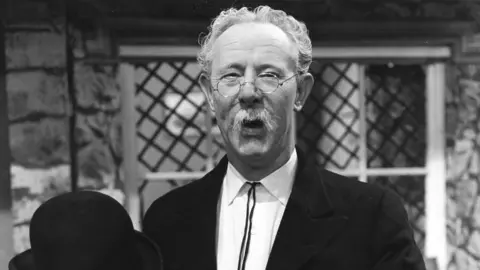
Richard Hearne, a luminary of early British television, once commanded a national audience for two decades. His alter ego, Mr Pastry, achieved iconic status in the UK during the 1950s and 60s, even gaining significant traction in the United States through the same television platform that later introduced the Beatles to American shores. Yet, today, both Hearne and his beloved character are largely fading from public memory, even in his birthplace of Norwich.
 BBC
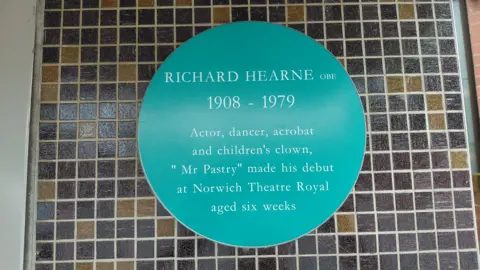
BBCA modest plaque affixed to the Theatre Royal in Norwich serves as the sole public marker of his stage debut as an infant in 1908. However, local historian Paul Dickson, known for his Norwich city walking tours, notes that few people today recognize the name of a star once of immense magnitude. In an episode of the ‘Secret Norfolk’ series on BBC Sounds, Dickson highlighted that even in Hearne’s hometown, his legacy is largely overlooked.
 Paul Hayes/BBC
Born into a theatrical family, Hearne and his relatives resided on Lady Lane, directly opposite the Norwich Theatre Royal. This very spot is now occupied by the city’s modern Forum building. His earliest theatrical appearance, as an infant requiring a role in a play, was facilitated by his mother, who was performing at the theatre.
“My mother said I didn’t cry at all, I was wonderful,” Hearne recalled in a 1968 interview for BBC Radio 4. “But the only thing is, every time I was turned my eyes were glued to the lime lights. So wherever I was turned, this head was fixed, staring at the lime lights.”
Hearne ultimately found significant acclaim on British television as Mr Pastry. This character, an endearing, doddering old man, provided a perfect vehicle for Hearne’s considerable talents in acrobatic slapstick. His appearances spanned variety shows, children’s programming, and even his own sitcoms. His prominence was such that he was selected to feature in the inaugural programme celebrating the opening of the new BBC Television Centre in 1960.
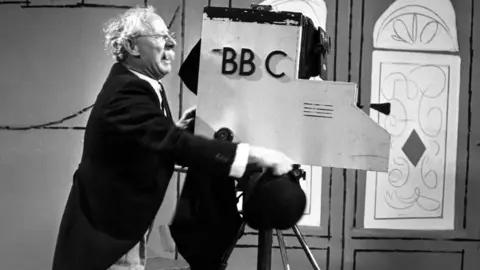
Hearne had been performing as an aged character since his twenties and first appeared on BBC Television in 1937. However, it was not until television resumed broadcasting after World War Two in the summer of 1946 that he formally named his signature character. “When television came back, they wanted me to go back to television,” he recounted to Radio 4 in 1968. “And I said ‘Well, if I’m going to play that old man again I’ll give him a name, so that I can keep my own identity.’ And I’d been playing in a musical comedy, and the name of the character was Mr Pastry.”
Mr Pastry’s appeal transcended the UK’s borders. According to Paul Dickson, Hearne became a frequent guest on the highly popular Ed Sullivan Show in the United States during the 1950s – the same program that would later propel the Beatles to international fame. “He performed 29 times on the Ed Sullivan Show,” Dickson stated. “Ed Sullivan really liked it.”
Following one of his appearances in 1954, the New York Daily News heralded Hearne as the “first foreign comedian to make a name for himself in American TV,” noting his “tremendous US fan following.”
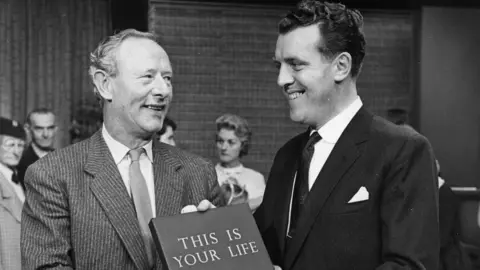
Beyond his entertainment career, Hearne leveraged his celebrity to fundraise for swimming pools for children with disabilities. Dickson noted that Hearne raised “well over half a million pounds in the 50s and 60s, which is a considerable amount of money,” an effort for which he was awarded an OBE for his charitable contributions.
Despite his significant achievements and philanthropic work, Hearne, who passed away in 1979, remains largely unremembered in his hometown of Norwich. Dickson observes that when he asks tour participants, particularly those under 60, if they recall Mr Pastry, the response is almost universally negative. “He’s a fascinating character, and obviously had a very, very successful career,” Dickson concluded.
Business Style Takeaway: The ephemeral nature of fame, even for prominent cultural figures, underscores the importance for brands and executives to continually reinforce their relevance and adapt their messaging to resonate with contemporary audiences. Understanding the dynamics of cultural legacy offers valuable insights into long-term brand building and maintaining market presence across generational shifts.
According to the portal: www.bbc.com