

The research dispels the notion that disparities in orgasm frequency between men and women during partnered intimacy are solely anatomical. It firmly establishes that male anatomy is not inherently more predisposed to orgasm than female anatomy, thereby underscoring that biological predisposition is not the root cause of the “orgasm gap.”
A pertinent consideration arising from this study is whether comparing solo versus partnered orgasms in women constitutes an “apples to oranges” scenario. While the data indicates a higher frequency of solo orgasms among women, an intriguing finding emerges when examining sexual satisfaction: only the frequency of partnered orgasms was a predictor of overall sexual satisfaction. This, coupled with the relationally motivated explanations women offered for their orgasm frequency across different contexts, strongly suggests that solo and partnered orgasms may serve distinct psychological and emotional functions for women. Solo orgasms might offer a dependable physiological release, facilitated by greater personal control and autonomy, free from external pressures or judgments. Conversely, partnered orgasms carry significant relational weight, serving as a conduit for deeper connection and intimacy. Considering the well-documented, reciprocal link between relationship quality and sexual satisfaction, it is logical that relationally oriented sexual experiences, such as partnered orgasms, would correlate positively with a woman’s overall sexual satisfaction.
Elevating Partnered Orgasm Frequency for Women
Encouragingly, for individuals seeking to enhance their partnered orgasm frequency, the findings affirm that anatomical limitations are not the barrier. Women largely attribute their partnered orgasm experiences to relational factors, which are amenable to change and improvement. Elements such as emotional intimacy, effective communication, a partner’s skill, diversity in sexual practices, body image confidence, and the perceived presence of expectations or judgment are all variables that can be addressed and overcome.
It is crucial, however, to contextualize the significance of orgasms within the broader spectrum of sexual satisfaction. In this particular study, orgasm frequency accounted for a modest 11 percent of the variance in women’s sexual satisfaction, leaving the predominant portion attributable to other contributing factors. This disconnect becomes apparent when juxtaposing orgasm frequency with overall satisfaction levels. A notable segment of women reporting high dissatisfaction with their sex lives still experienced regular orgasms—approximately 19.5 percent reported almost always or always reaching orgasm, and 34 percent did so more than half the time. Conversely, not all highly satisfied women experienced consistent orgasms; about 15 percent reached orgasm half the time or less. In essence, a couple’s sexual fulfillment is a multifaceted construct that extends well beyond the occurrence of orgasms alone.
Orgasm Essential Reads 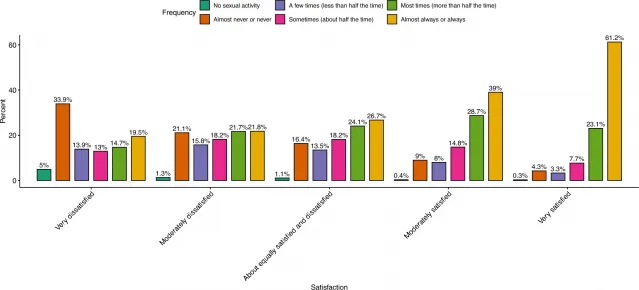
Business Style Takeaway: Understanding that satisfaction and performance in professional contexts, much like sexual satisfaction, are driven by a complex interplay of factors beyond a single metric (like orgasm frequency or a quarterly sales target) is critical for effective leadership. Focusing on relational elements such as communication, emotional connection, and skill development, rather than solely on measurable outputs, can significantly enhance overall team performance and individual well-being.
Information compiled from materials : www.psychologytoday.com