

The recent U.S.-Iran agreement to conclude the protracted conflict in the Middle East has garnered widespread international commendation, with several European nations indicating a readiness to suspend economic sanctions against Tehran. This potential lifting of sanctions is contingent upon Iran demonstrating concrete actions to curtail its nuclear ambitions.
Following over three months of hostilities, a landmark accord was reportedly finalized on Sunday between the United States and Iran, aiming for an immediate and lasting cessation of hostilities. This agreement, slated for formal signing in Switzerland this Friday, is anticipated to pave the way for an additional 60-day period of discussions focused on Iran’s nuclear program. The Prime Minister of Pakistan, Shehbaz Sharif, has been instrumental in facilitating these developments.
United States President Donald Trump has indicated his intention to authorize the immediate de-escalation of the U.S. naval blockade. Although the comprehensive details of the agreement remain undisclosed, reports from Iranian state media last Friday suggested a draft memorandum, spanning 14 pages, includes provisions for the U.S. to lift oil-related sanctions and for Iran to commit to the reopening of the Strait of Hormuz within a 30-day timeframe.
International Reaction and Sanctions Relief
In a unified declaration subsequent to the announcement of the pact, the United Kingdom, France, Germany, and Italy lauded the agreement as “a moment of opportunity to restore regional stability and stabilise the global economy.” These nations further articulated their preparedness to revoke pertinent sanctions, provided Iran undertakes “clear and verifiable steps regarding its nuclear program.”
The collective, referred to as the E4, underscored the imperative for the agreement to be “implemented rapidly and comprehensively.” Their statement emphasized that the “urgent reopening of the Strait of Hormuz with unconditional and unrestricted freedom of navigation is essential.”
The European signatories stressed their commitment to preventing Iran from acquiring nuclear weapons, affirming their readiness to collaborate with the U.S., Iran, and the International Atomic Energy Agency (IAEA) towards this objective, as reported by Reuters.
We strongly hope that this memorandum will be steadily implemented, that free and safe navigation in the Strait of Hormuz will be actually ensured.Sanae Takaichi, Japan Prime Minister
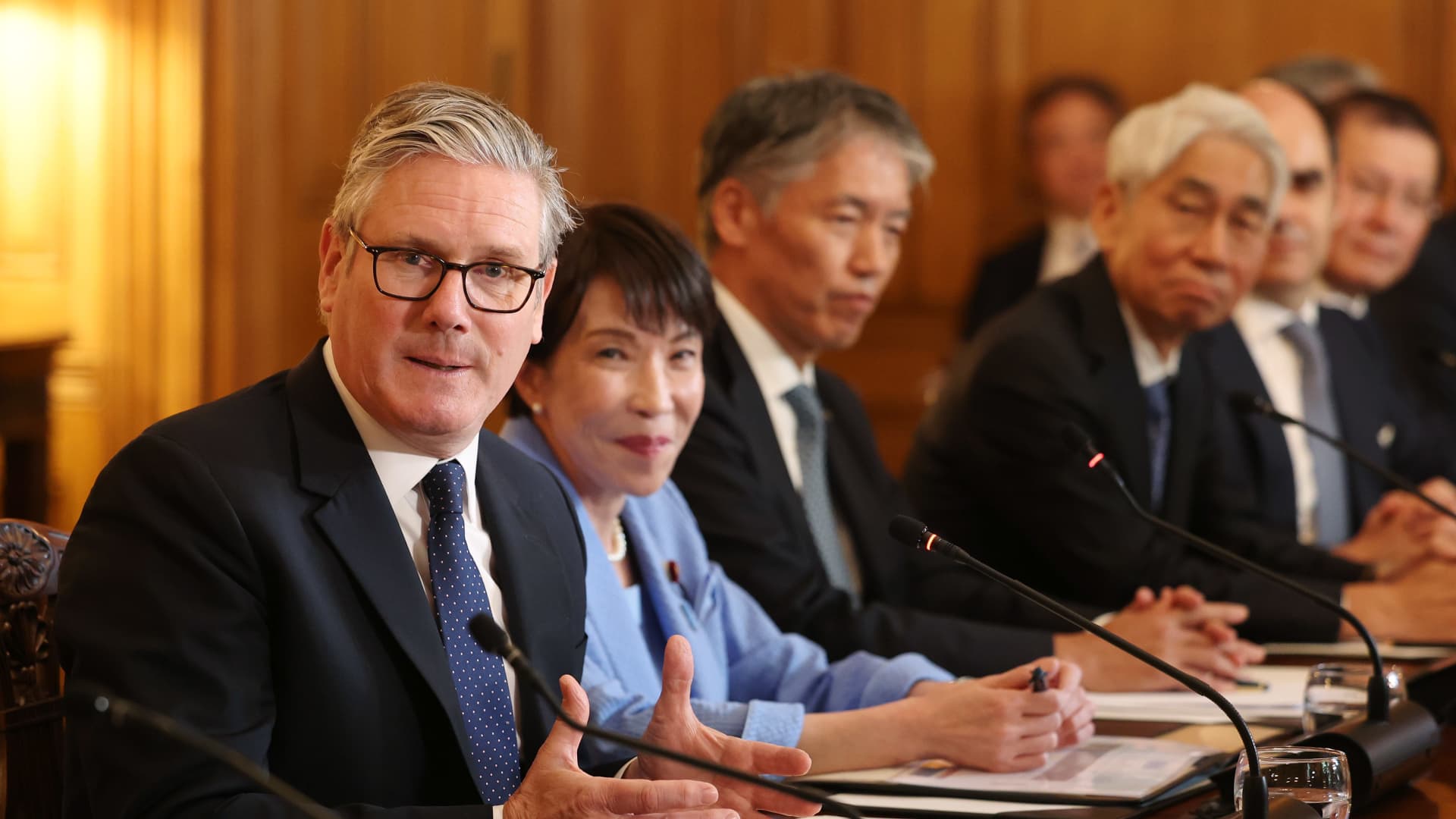
U.K. Prime Minister Keir Starmer characterized the deal as a “hugely important step forward in ending the war,” while concurrently highlighting the critical need for the Strait of Hormuz, a vital energy chokepoint that has been effectively impassable throughout the conflict, to remain “fully and permanently open.”
Japan’s Prime Minister Sanae Takaichi expressed the nation’s welcome for the agreement, describing it as “a major step toward resolution of the situation” in a translated statement posted on X. Takaichi articulated a strong hope for the memorandum’s consistent implementation, the actual assurance of unimpeded maritime passage through the Strait of Hormuz, and the swift finalization of an agreement pertaining to Iran’s nuclear dossier and other critical issues.
President Trump is scheduled to convene with leaders from the Group of Seven (G7) nations—Canada, France, Germany, Italy, Japan, and the U.K.—along with representatives from the European Union, at the upcoming G7 summit commencing Monday in France.
A critical step towards the peaceful settlement of the conflict.António Guterres, United Nations Secretary-General
United Nations Secretary-General António Guterres extended congratulations to the parties involved in the conflict for reaching this agreement, deeming it “a critical step towards the peaceful settlement of the conflict.” He also acknowledged and appreciated the supportive role played by Pakistan, Qatar, and other Middle Eastern countries in facilitating the negotiations.
Economic Implications and Market Response
The Australian government released a statement indicating that while a complete economic recovery will require time, the reopening of the Strait of Hormuz is “essential to easing pressure on energy prices.” Canberra has urged all parties to pursue a lasting peace through dialogue and diplomatic engagement, while also calling on Iran to address long-standing international concerns regarding its nuclear program and its implications for global security.
Qatar’s Ministry of Foreign Affairs also issued a statement commending the deal, describing it as “an important step towards consolidating sustainable peace and promoting economic growth regionally and internationally.”
This agreement emerges after months of intermittent negotiations and periods of heightened conflict in the region, which began in late February. These events have significantly impacted global energy markets and fueled apprehensions of a worldwide economic downturn.
The announcement of the deal on Sunday precipitated a decline in oil prices. Brent crude experienced a drop of approximately 4%, settling at $83 per barrel, while West Texas Intermediate (WTI) slid by 4.8% to $80.8 per barrel.
Christian Noyer, honorary governor of the Bank of France, commented on Monday that a finalized peace accord could “enormously” alleviate inflationary pressures, bolster consumer confidence, and provide global central banks with greater latitude in formulating monetary policy. He added, “We were very much hoping that this sort of event would come as soon as possible.”
Business Style Takeaway: The U.S.-Iran agreement to end hostilities and potentially reopen the Strait of Hormuz presents a significant inflection point for global energy markets and macroeconomic stability. Investors should closely monitor the verification of Iran’s nuclear program compliance and the subsequent lifting of sanctions, as these developments could alleviate inflationary pressures and create more favorable conditions for monetary policy adjustments worldwide.
Learn more at : www.cnbc.com