


The persistent issue of hallucinations in large language models (LLMs) poses a significant barrier to their widespread adoption in enterprise settings. Current methods for mitigating these factual inaccuracies often create a difficult trade-off: eliminating factual errors can suppress valid responses, thereby reducing the model’s overall utility.
Google researchers have introduced a novel concept called “faithful uncertainty,” a metacognitive approach designed to better align an AI’s response with its internal confidence levels. This technique enables models to offer appropriately hedged statements, such as “My best guess is,” rather than adhering to a rigid “answer or abstain” binary.
In practical agentic AI applications, this form of metacognitive awareness serves as a crucial control mechanism. It allows autonomous systems to accurately discern when their existing knowledge is sufficient and when they need to proactively engage external tools or search APIs to fill information gaps.
The ‘Utility Tax’ of Current Mitigation Strategies
Understanding why LLMs hallucinate requires differentiating between a model’s factual knowledge and its awareness of its own knowledge boundaries. Historically, improvements in AI factuality have primarily focused on expanding the breadth of knowledge, by embedding more facts into the model’s parameters through larger datasets and more extensive training.
However, this expansion of knowledge does not inherently enhance the model’s boundary awareness—its capacity to distinguish what is known from what is unknown and to recognize its own limitations.
Gal Yona, a Research Scientist at Google and co-author of the paper, explained to VentureBeat, “There are broadly two ways to improve LLM factuality. The first is continuing to teach the model more facts. But, Yona notes, ‘model capacity is finite, and the long tail of knowledge is effectively infinite.’”
Once models reach their capacity limits, the ideal scenario is that they recognize their knowledge gaps and refrain from answering. However, this is inherently challenging for LLMs.
“This is why most practical attempts to reduce hallucinations through various interventions don’t actually make it to deployment,” Yona elaborated. “They do reduce hallucinations, but they also hurt utility, because the model ends up refusing to answer questions it actually does know.”
This inability to reliably distinguish between known and unknown information results in what the paper’s authors term the “utility tax.” Enforcing a zero-hallucination standard often compels the model to abstain from answering even when it possesses substantial relevant knowledge, leading to the discarding of vast amounts of valid information. The researchers illustrate this by showing that reducing an initial 25% error rate to a strict 5% target necessitates discarding 52% of the model’s correct answers.
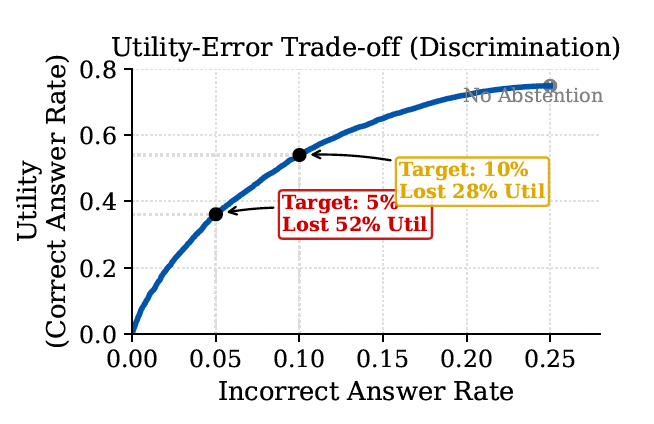
Requiring absolute factual accuracy forces enterprise systems into a dilemma between trustworthiness and helpfulness. Application developers are often reluctant to accept this substantial compromise, which renders their models less useful. As a result, systems tend to prioritize comprehensive output, leading models to operate in a mode where they continue to generate confident, yet inaccurate, statements.
VB Transform · July 14–15 · Menlo Park · Agentic orchestration
Intuit rebuilt its multi-agent system in 60 days. What did they change — and why?
At Transform, engineering leaders from Intuit, Target, and Instacart break down how they redesigned their orchestration architectures for reliability, scale, and real customers.
See the full agenda →
Reframing Hallucinations as Confident Errors
To overcome the “utility tax,” the researchers propose redefining hallucinations not as any factual error, but specifically as “confident errors”—incorrect information delivered with unwarranted authority and lacking appropriate qualification.
This subtle shift in perspective moves away from the strict “answer-or-abstain” binary, enabling the model to articulate its uncertainty.
Within this new paradigm, a factual mistake that is appropriately qualified (e.g., “I am not completely sure, but I believe…”) is no longer classified as a hallucination. Instead, it is presented as a hypothesis for user consideration. By communicating uncertainty, the AI preserves its utility—offering partial or probable knowledge—without compromising user trust.
However, an AI assistant that hedges every response with a disclaimer renders itself impractical, requiring constant user verification.
The proposed solution is “faithful uncertainty.” This approach synchronizes the model’s linguistic expression of doubt with its internal statistical confidence. Consequently, the model only hedges its responses when its internal state genuinely indicates conflicting or low-probability information.
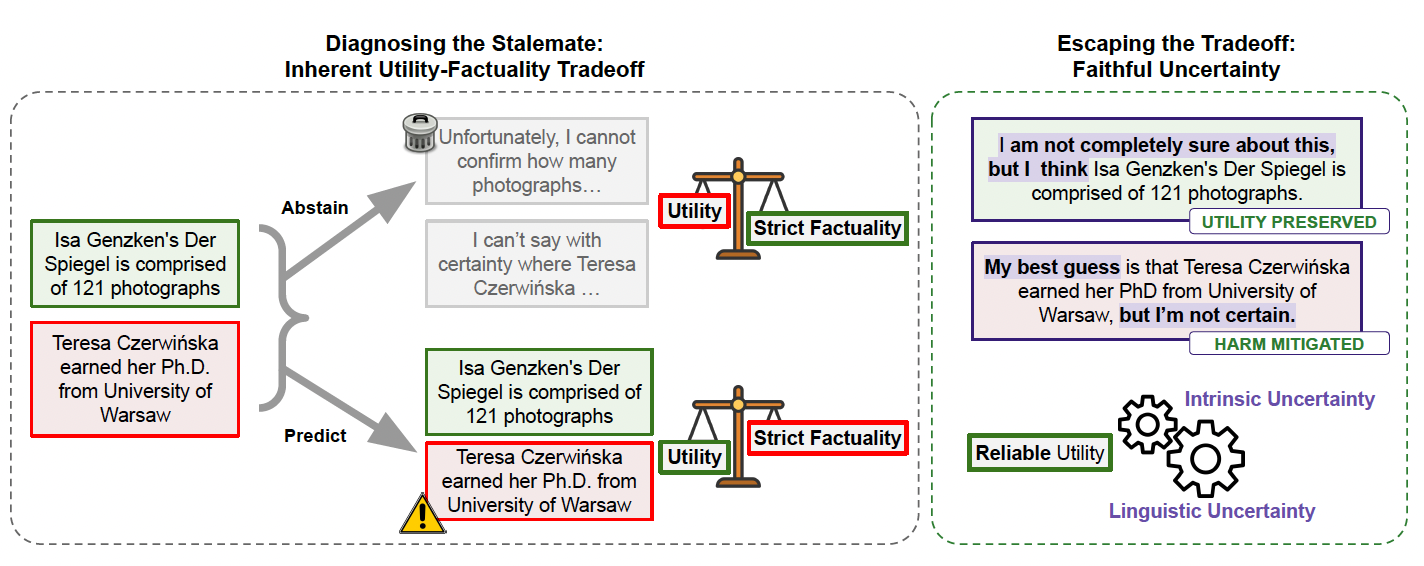
Faithful uncertainty is central to “metacognition,” enabling AI systems to recognize and act upon their own uncertainty. Analogous to human medical professionals, whose trustworthiness stems from their ability to differentiate between a confident diagnosis and an educated hypothesis, faithful uncertainty allows AI to provide nuanced responses. For example, an AI might state, “It might be a sprain, but let’s verify with additional data.”
Practical Implications for Enterprise AI
Under this revised framework, errors arising from genuine confidence but factual inaccuracy are classified as “honest mistakes.” This perspective positions knowledge expansion (through additional training data) and faithful uncertainty as complementary strategies. Knowledge expansion pushes the boundaries of what the AI knows, minimizing honest mistakes, while faithful uncertainty transparently communicates the current limits of that knowledge.
This approach has significant implications for agentic AI systems. While the move towards agentic AI might suggest that knowing what an AI doesn’t know is redundant due to external database access, this capability actually heightens the need for faithful uncertainty. In agentic systems, metacognition becomes the primary control layer governing overall operation.
External tools address the knowledge storage limitation, freeing models from encoding every piece of information. However, this introduces a new control challenge: determining when to retrieve information, verify facts, and orchestrate these external tools effectively. Without faithful uncertainty, an agent operates blindly, relying on static external heuristics or overly complex frameworks.
“The model might search for something it already knows confidently—wasting latency and cost for no gain. Or the opposite: it confidently answers from memory when it should have searched, producing a plausible but wrong output,” Yona stated. Current agent frameworks attempt to manage this externally using query classifiers or default search rules, but Yona describes these as “static and brittle.” By leveraging its intrinsic uncertainty to regulate its own behavior, an agent dynamically optimizes tool usage, invoking search functions only when its internal confidence is genuinely low.
Beyond managing tool invocation, faithful uncertainty is crucial for evaluating the results obtained from external tools. If a tool returns low-quality or unexpected information, a metacognitive agent will not blindly accept it. Instead, it uses its awareness of uncertainty to weigh the retrieved external data against its own internal knowledge base, preventing sycophantic behavior where the system might erroneously trust external sources that contradict its established knowledge.
The Bootstrapping Paradox: Teaching Uncertainty Effectively
For enterprise developers, achieving faithful uncertainty presents a challenge beyond simple implementation. It requires explicitly teaching models to express uncertainty through supervised fine-tuning (SFT). Since pre-trained models are typically exposed to authoritative texts, they must be trained to articulate phrases like, “I’m not entirely sure, but I believe VentureBeat was founded around…”
However, SFT introduces a “bootstrapping paradox.” Unlike standard training datasets where the correct answer is constant, the ground truth for uncertainty is dynamic and dependent on the model’s specific knowledge state at a given point in training.
“Here’s the catch: the ‘correct’ expression of uncertainty is inherently dynamic, because it depends on what this particular model knows or doesn’t know at this particular point in training,” Yona explained. “If you train on a label that says ‘I don’t know X’ but the model actually does know X, you’ve taught it to hallucinate uncertainty… The training data is static, but the target is a moving one, and that’s the fundamental tension teams need to grapple with.”
The Path Toward Self-Aware AI
For enterprises seeking to implement these capabilities without extensive retraining, prompt engineering offers the most accessible avenue. “Prompt engineering is already something most engineers do today; this provides the lowest-friction path to improving metacognitive behavior today,” Yona noted. Enterprise developers can explore frameworks like MetaFaith, an open-source project previously co-authored by Yona, to begin applying metacognitive prompting to readily available models.
However, Yona cautions that “there is still substantial headroom that prompting alone doesn’t solve,” suggesting that the industry will eventually need to adopt advanced reinforcement learning (RL) techniques to embed metacognition deeply into model training processes.
Ultimately, as enterprises transition from standalone chat applications to complex, multi-agent workflows, self-awareness will become a critical prerequisite for reliable autonomy. Yet, evaluating whether a model genuinely possesses this awareness remains a significant technical hurdle.
“How do you actually evaluate whether a model can sense its internal states?” Yona questioned. “Even in humans, it’s hard to define or separate ‘true’ self-monitoring abilities from a capable reliance on proxies. We face exactly the same challenges with LLMs: a model might learn to mimic the style of uncertainty without truly sensing its internal state. Developing evaluation frameworks that can tell the difference is one of the most important open problems in this space.”
Business Style Takeaway: The development of “faithful uncertainty” in AI is crucial for bridging the gap between theoretical AI capabilities and practical enterprise deployment, addressing the critical issue of hallucinations without sacrificing utility. This advancement signals a shift towards more reliable and trustworthy AI agents, which will be vital for complex workflows and autonomous decision-making in business operations.
Details can be found on the website : venturebeat.com