

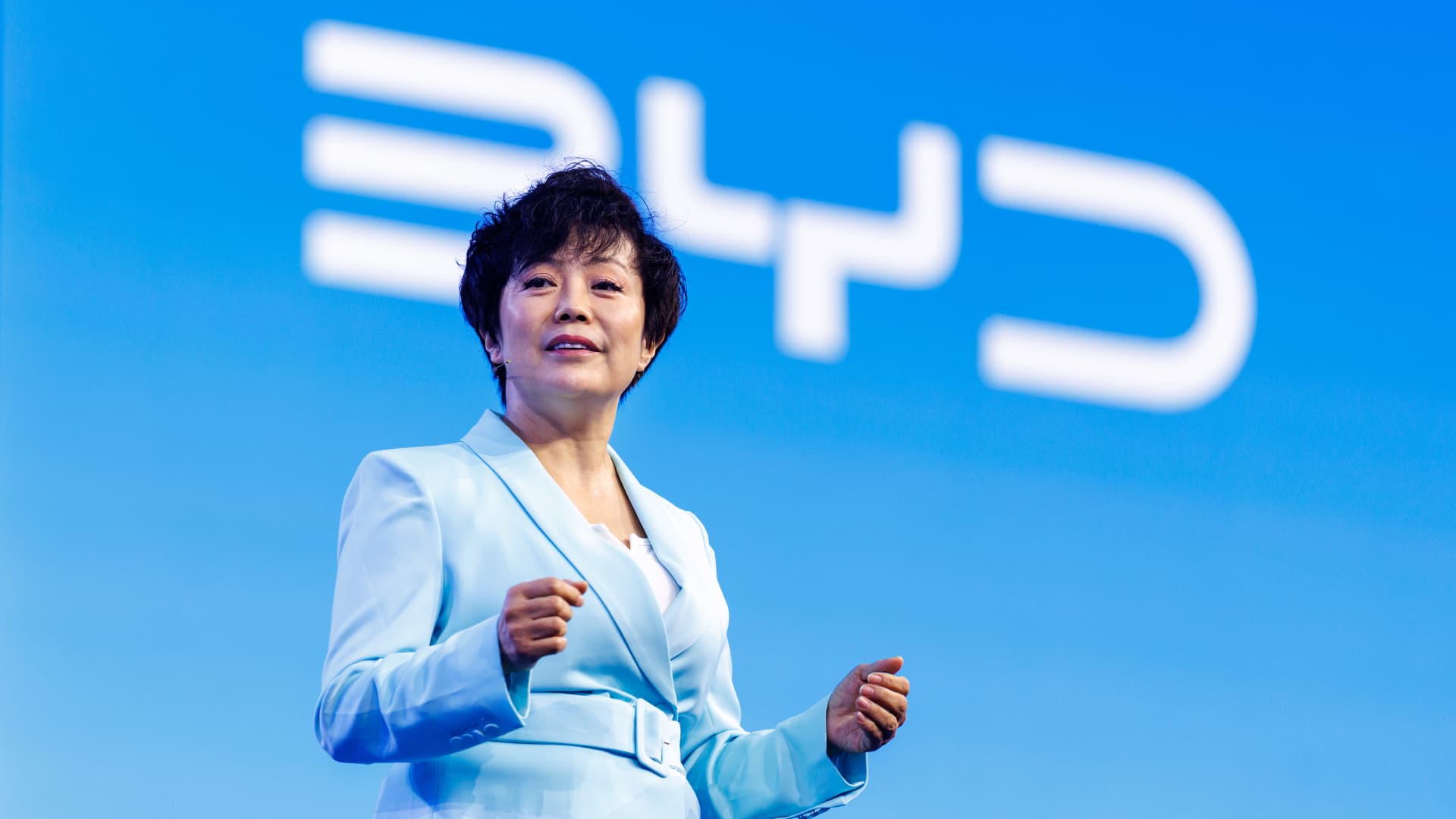
Amidst a deceleration in the Chinese electric vehicle (EV) market’s expansion trajectory, BYD articulates a decidedly optimistic outlook, projecting continued growth for the sector. This perspective sharply contrasts with that of smaller competitor Nio, which recently posited that the industry’s “golden era” had concluded. Stella Li, Executive Vice President at BYD, informed Arjun Kharpal on Monday that, “With all the innovation technology introduced to the market, China’s market very quickly will push to … close to 80% in EV penetration.”
Fueled by robust governmental backing and an expanding array of vehicle choices, the adoption rate for hybrid and fully electric vehicles has witnessed remarkable acceleration. Data from the Chinese Passenger Car Association indicates that these alternative powertrains now constitute over half of all new passenger cars sold, achieving a record 62.9% penetration just last month. This surge is notable when compared to the United States’ EV penetration rate, which hovers around 10%, and the global average of approximately 25%, according to recent International Energy Agency figures.
The imposition of substantial U.S. tariffs, reportedly at 100%, on Chinese-manufactured electric vehicles has presented a significant impediment to local sales. Furthermore, BYD, alongside several other Chinese firms, was recently designated by the Pentagon as a company affiliated with the Chinese military, a development to which the EV manufacturer has not yet formally responded.
The China Connection
Despite these external pressures, BYD remains sanguine about the prospects of its domestic market, placing considerable emphasis on advancements in battery technology. Li indicated that current domestic demand for BYD’s EVs is roughly double the company’s production capacity. This demand is reportedly bolstered by the company’s rapid-charging technology, which is claimed to enable a 70% charge in a mere five minutes.
Compounding the shift towards new energy vehicles, sales of traditional internal combustion engine vehicles in China experienced a significant contraction of 39% in May compared to the previous year, a downturn attributed by the CPCA to elevated oil prices amidst geopolitical tensions in the Middle East.
Looking forward, Li anticipates that the next wave of competitive differentiation within the EV sector will likely revolve around sophisticated driver-assist features. BYD has already made strategic moves in this domain, including an expansion of insurance coverage for “L2+” driver-assist systems on May 28, a move Li believes could enhance customer utilization by approximately five percentage points, pushing it to at least 95%. The company has also disclosed the development of its proprietary driver-assist semiconductor chip.
While BYD is actively developing its own semiconductor capabilities, with approximately 7,000 engineers dedicated to this effort—a fraction of its vast workforce exceeding 869,600 employees—the company intends to primarily leverage Nvidia’s driver-assist chipsets in the interim. This strategy underscores the complex, multi-faceted approach to technological integration and supply chain management in the modern automotive industry.
Expert Analysis
Leon Cheng, head of the mobility practice at YCP, an Asia-focused consultancy, noted that while BYD experienced a sales recovery in May, its overall sales figures remained largely flat on a year-over-year basis. Cheng raised a pertinent question regarding the company’s strategic positioning: “The question is not only whether BYD can maintain its leadership in China, but whether it can defend its position globally as more Chinese EV players compete aggressively in export markets.”
Data from the CPCA shows that BYD sold nearly three times as many vehicles in China as the second-largest automaker in the new energy vehicle segment in May, effectively halting an eight-month period of declining sales. However, the company has also been actively pursuing export markets to compensate for localized growth challenges.
Li stated that BYD aims for 75% of its European sales to be locally produced. She also addressed allegations of labor abuses concerning the construction of BYD’s factory in Hungary, refuting the claims and noting that the European Commission has not initiated an investigation, with the matter falling under the jurisdiction of Hungarian labor authorities, as confirmed by the EU last month.
Business Style Takeaway: BYD’s assertion of continued growth in China’s EV market, despite a broader slowdown, highlights the transformative potential of technological innovation and state support. However, global investors must weigh this domestic optimism against increasing international competition and geopolitical trade considerations that could shape long-term market access and profitability.
According to the portal: www.cnbc.com