

Linda Cardellini has consistently demonstrated her versatility as a performer over several decades. Her career, encompassing comedy, drama, and mystery, is marked by her ability to fully embody diverse characters, making each one feel unique and authentic.
Whether portraying the consistently warm and forgiving Judy Hale in *Dead to Me* or delivering subtly powerful performances in films like *Brokeback Mountain* and *Green Book*, Cardellini has cultivated a reputation for broad range, steering clear of typecasting.
Her talent for immersing herself in a character is showcased exceptionally in Steven Conrad’s highly praised HBO limited series, *DTF St. Louis*. In her role as Carol Love-Smernitch, Cardellini delivers what is arguably her most captivating and complex performance to date.
Carol is a woman grappling with the challenges of middle age, financial anxieties, family expectations, and intricate personal relationships. Throughout much of the series, viewers are left questioning her true identity and the sincerity of her intentions.
“She is quite inscrutable initially, and then her layers begin to unfold as the narrative progresses. I found that aspect very compelling during my reading because I initially assumed, ‘Okay, I understand this character. I see the direction they’re heading.’ But then I realized I was entirely mistaken,” Cardellini shared in an interview. “I believe Steve has a remarkable talent for subverting your expectations and crafting characters with more depth than you initially perceive.”
Is Carol a victim of her circumstances, a shrewd manipulator, or a devoted mother facing insurmountable dilemmas? Cardellini imbues her with such profound ambiguity that the definitive answers remain veiled until the series’ conclusion.
Cardellini stars opposite David Harbour, who plays Carol’s husband, Floyd Smernitch, an ASL interpreter, and Jason Bateman, who portrays Clark Forrest, Floyd’s close friend and a local television meteorologist who develops a romantic relationship with Carol.
Their relationships become entangled in a complex love triangle that ultimately leads to Floyd’s demise, serving as the central mystery that propels the narrative.
Harbour collaborated on the development of the series with Conrad, who was responsible for writing and directing all seven episodes. Both Harbour and Bateman also served as executive producers.
Although the series premiered on March 1st, it has already garnered critical acclaim. Most recently, *DTF St. Louis* received two Gotham Television Awards, securing wins for Outstanding Limited or Anthology Series and Outstanding Supporting Performance in a Limited or Anthology Series for David Harbour.
While Cardellini did not receive an individual award, her exceptional performance has generated significant discussion. The widespread acclaim for the series stands as a testament to both Conrad’s masterful writing and the strength of its outstanding ensemble cast.
What makes Cardellini’s portrayal particularly noteworthy is her ability to continuously reshape the audience’s perception of Carol. Early in the series, Carol appears as a master strategist, especially in her interactions with detectives Jodie (played by Joy Sunday) and Homer (portrayed by Richard Jenkins). Even subtle moments, like her repeated requests for the detectives to speak louder during questioning despite their clear enunciation, seem calculated.
Audience suspicions intensify as details of the love triangle emerge. Carol seems to be planning for a life insurance payout in the period leading up to Floyd’s death. Financial pressures are palpable throughout the series, compelling her to supplement her corporate position at Purina by officiating Little League games.
Furthermore, the affair is not a matter of chance; Carol meticulously studies Clark’s habits, noting his daily visits to Jamba Juice for his signature Go-Getter smoothie. She engineers a seemingly serendipitous encounter that initiates their relationship.
However, beneath these ostensibly manipulative actions lies a more complex reality: Carol is a devoted mother fiercely protective of her troubled son, Richard, played by Arlan Ruf. Her commitment to him profoundly influences many of her decisions and becomes a crucial element in understanding her true motivations.
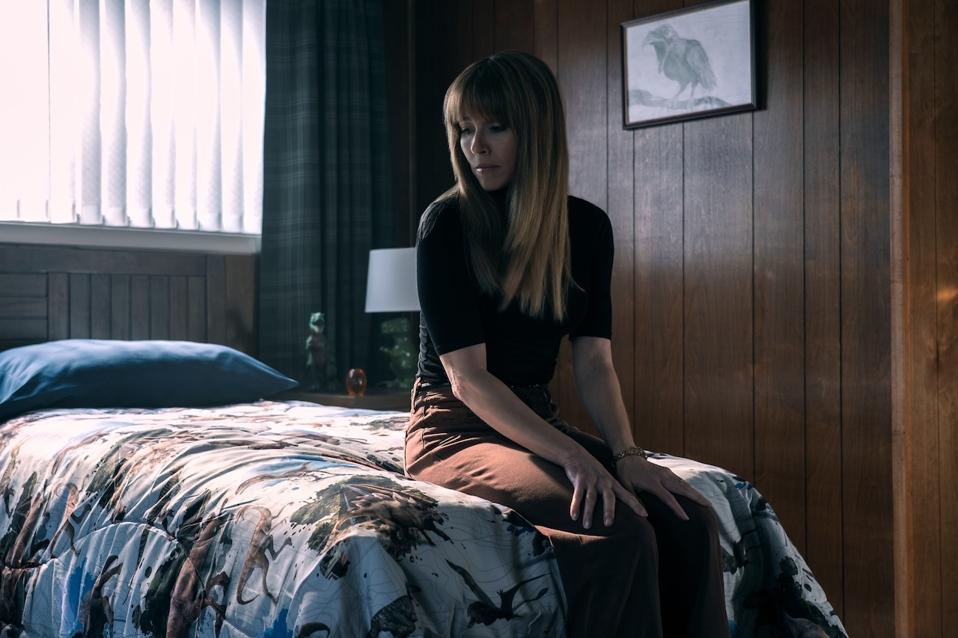
Cardellini observes that Carol is not driven by a need for approval. “One of the aspects I admire most about her is that you believe she’s this deceitful, secretive individual, only to realize that couldn’t be further from the truth. It turns out her husband was aware all along, and this might have even been his strategy.”
She highlights a scene where Floyd expresses his enthusiasm for introducing Carol to Clark. “Looking back on the series, you realize, ‘Wait a minute, was he orchestrating this for her considering the state of their relationship?’ Steve and I discussed Floyd’s character, and he confirmed, ‘He knew everything from the start.’ I find that incredibly powerful because you assume she’s having an affair, when in fact, she’s not.”
This revelation fundamentally alters the audience’s interpretation of Carol. What initially appears as deception gradually reveals itself to be far more nuanced. Carol’s actions, while seemingly self-serving on the surface, often stem from her deep-seated desire to improve her son’s quality of life.
Cardellini herself views Carol as a character often subject to misunderstanding. “I believe she’s someone who has no tolerance for foolishness. She has endured a great deal in life. She dedicates everything she has to the people in her life, leaving little for anyone else.”
She specifically points to Richard’s academic struggles as a primary driver for many of Carol’s choices. “She’s trying to guide him toward a path that brings him greater happiness and allows him to foster friendships. Her sole wish is for him to have the best. I believe that upon closer examination, one discovers a profoundly endearing individual.”
Just as the audience begins to feel they comprehend the characters, Conrad consistently introduces new narrative elements that compel a reevaluation of all prior assumptions.
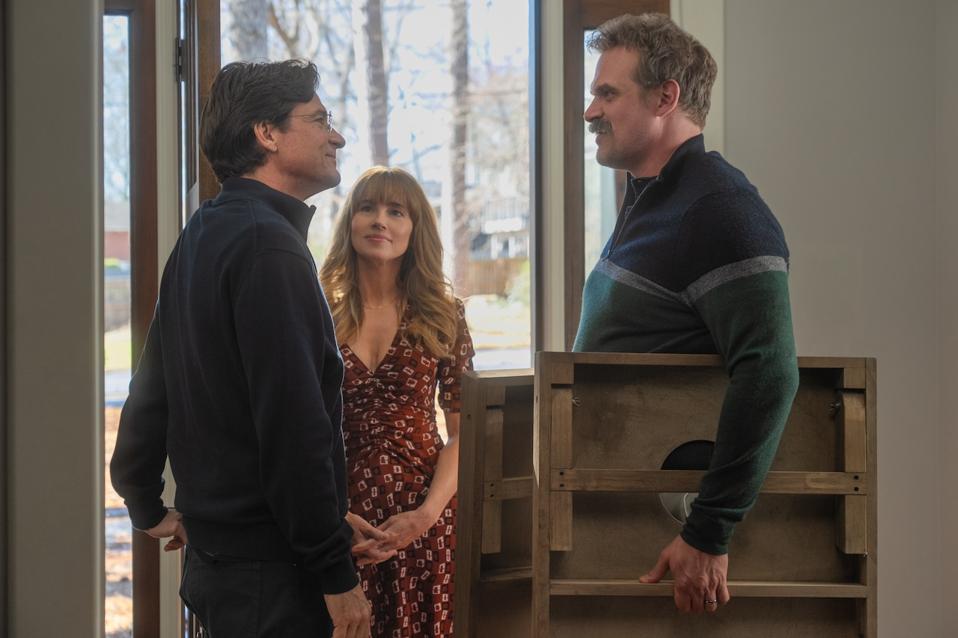
One of the most unexpected plot developments involves Carol’s relationships with both Floyd and Clark. When asked about the nature of Carol’s feelings for both men, Cardellini offered her perspective. “I have my own interpretations of her emotions. She genuinely loved Floyd. However, over time, their intimacy unfortunately waned. I believe they were both endeavoring to rekindle that connection.”
Cardellini finds the public reaction to her character particularly interesting. “The irony is how critically Carol has been perceived. Clark was acting duplicitously, yet concurrently, people hold Carol in low regard. I believe this serves as a compelling examination of our assumptions, our beliefs, and whom we judge most severely.”
Every character created by Conrad possesses ambiguous motives and questionable actions. “I appreciate the way suspicion shifts to everyone, including my character’s son,” Cardellini remarked. “I think it’s a beautifully constructed narrative. Steve possessed a remarkable story and a vivid mental blueprint of these individuals and how their true natures would be revealed.”
Carol presented a unique acting challenge, naturally inviting comparisons to another beloved role: Judy Hale from *Dead to Me*. In drawing parallels between the two characters, Cardellini highlighted that both required a delicate balancing act.
“Judy was demanding because, naturally, you empathize with Jen (Christina Applegate’s character) and her situation. Then, to introduce a character who is consistently deceiving someone navigating profound grief… finding Judy’s heart and her vulnerability was a beautiful challenge, ensuring that the audience would care about Judy as well, rather than simply viewing her as a manipulative opportunist.”
Cardellini contrasted Judy’s tendency towards people-pleasing with Carol’s guarded demeanor. “That was an enjoyable challenge for me because, personally, my emotions are often transparent. It’s always been that way. Consequently, I tend to reveal a lot about myself. Carol is exceptionally difficult to decipher, which posed a challenge for me. Not many characters present one way and turn out to be something entirely different. That was wonderfully engaging and distinctly different for me.”
Ultimately, Carol emerged as one of Cardellini’s most cherished roles to date. “She is certainly ranked very highly for me.”
Interestingly, some of the series’ most memorable details are also among its most peculiar. Conrad infuses the series with idiosyncratic recurring elements that initially appear minor before gaining significant narrative importance. A prime example is Clark’s distinctive ergonomic recumbent bicycle.
“The bicycle seems quite absurd at first glance,” Cardellini commented, with a laugh. “The initial shot of Jason riding down the road becomes a crucial plot element, with various characters eventually possessing or riding that bike. It also perfectly suits the character. It genuinely reveals who Clark Forrest is. Seeing Jason on that bike for the first time, wearing those tight-fitting trousers, was hilarious, yet the scene is treated with utmost seriousness.”
The same principle applies to the characters’ preferred Jamba Juice beverages. Regarding Carol’s Watermelon Breeze and Clark’s Go-Getter, Cardellini stated, “Who would have imagined that the names of those drinks would acquire such significance? It’s precisely in these moments that Carol’s deception becomes apparent. I find it fascinating how everyday items are elevated to pivotal roles within the narrative. This is very characteristic of Steve Conrad’s style and is quite remarkable.”
Even Carol’s confrontational exchanges with the detectives carry deeper implications. Cardellini posits that her insistence on the investigators speaking louder is an act of reclaiming agency.
“Carol has a strained history with law enforcement. In her youth, she was apprehended for an incident that is later revealed to be a consequence of sad and necessary circumstances, likely quite embarrassing for her at the time,” Cardellini explained. “They could have released a child who was stealing toilet paper, but instead, they arrested her, processed her, and assigned her a record that had to be sealed.”
In conclusion, Cardellini emphasized that Carol is navigating her own midlife crisis. “She’s contemplating, ‘Is this the entirety of my life? How do I achieve my goals? What are my available options?’ And she must ensure her child’s well-being.”
Through a nuanced and profoundly layered performance, Cardellini transforms a potentially one-dimensional femme fatale into a compelling and formidable protagonist. Her flawless portrayal of Carol Love-Smernitch is a clear demonstration of the skill, range, and emotional precision she consistently brings to every role.
Business Style Takeaway: Linda Cardellini’s complex portrayal in *DTF St. Louis* highlights the strategic value of character depth and ambiguity in storytelling, a technique that can be applied to brand narratives to foster audience engagement and critical acclaim. The series’ success underscores the power of intricate character development and unexpected narrative turns in capturing viewer attention and achieving critical recognition.
Learn more at : www.forbes.com