


A significant advancement in AI retrieval capabilities has emerged from a joint research effort involving the University of Illinois Urbana-Champaign (UIUC), UC Berkeley, and Chroma, an open-source vector database platform. They have introduced Harness-1, a 20-billion parameter open-source search agent built upon OpenAI’s gpt-oss-20B foundational model. This new system fundamentally redefines the execution of complex retrieval tasks by AI.
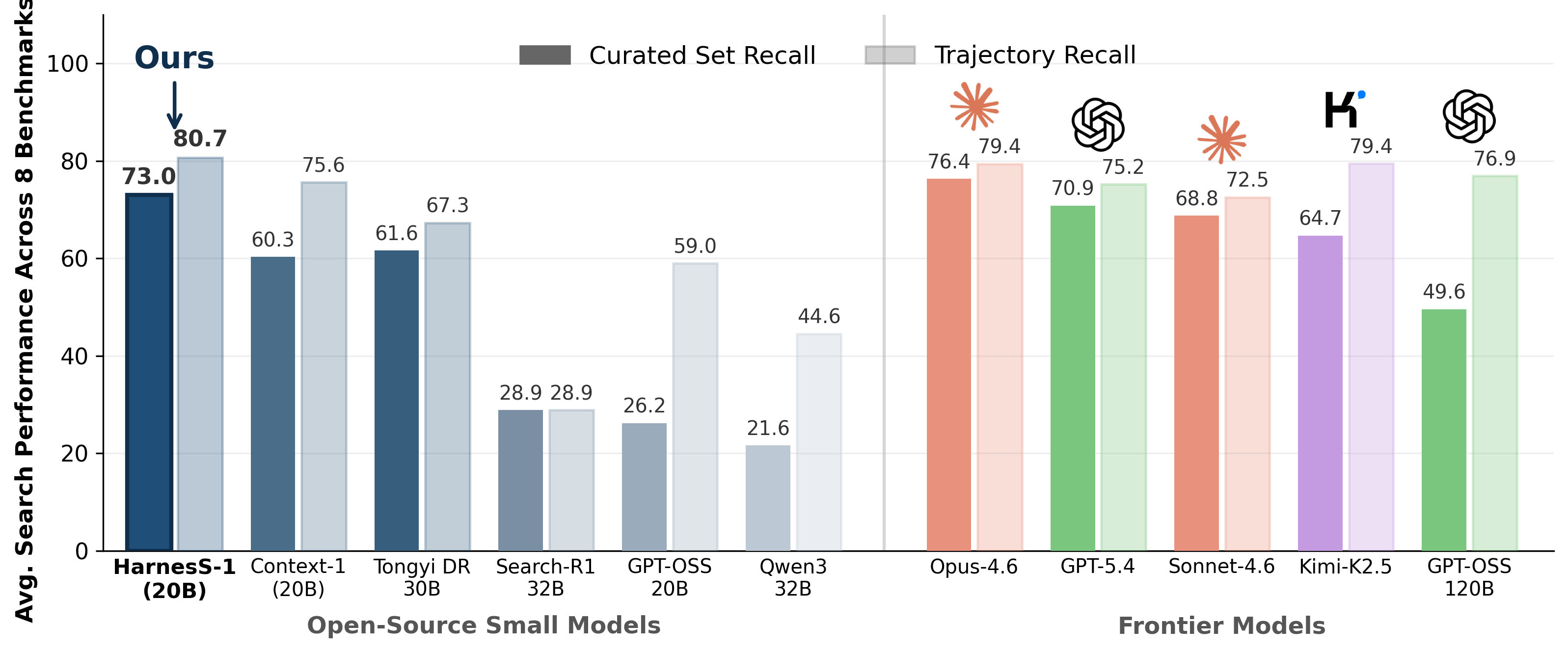
Harness-1 demonstrates a remarkable leap in performance, achieving an average score of 73% in accurately recalling relevant information from a curated dataset. This surpasses the performance of GPT-4.5 (70.9%) and leads the next best open-source search agent, Tongyi DeepResearch 30B, by a substantial 11.4 percentage points. It is worth noting that while GPT-4.5 has been available for over a month, the researchers did not include it in their benchmark comparisons as it was not accessible during their development phase.
The model and its supporting framework are immediately available to developers under the permissive Apache 2.0 license, with code and weights accessible on Hugging Face.
Furthermore, Harness-1 serves as a practical demonstration of Tinker, a distributed, web-based API for AI model training and fine-tuning developed by Thinking Machines. Tinker was instrumental in training and running inference for Harness-1, underscoring how adaptable infrastructure is accelerating the development of next-generation autonomous models.
Decoding the Benchmarks: A Boon for Enterprises
To rigorously assess its capabilities, the researchers evaluated Harness-1 and its competitors across eight complex search benchmarks. These tests mimicked the workflow of a professional researcher, requiring the AI to analyze diverse and dense data sources, rather than just answering simple factual queries.
The benchmarks covered a range of domains, including broad internet searches, intricate financial disclosures from regulatory bodies like the SEC, technical patent databases from the USPTO, and sophisticated multi-hop reasoning tasks. In these latter tasks, the AI needed to synthesize information scattered across multiple documents to derive a conclusive answer.
The results revealed Harness-1’s dominance in open-source information retrieval accuracy. Notably, this 20-billion parameter model performed comparably to significantly larger proprietary AI systems, outperforming models such as GPT-4.5, Sonnet-4.5, and Kimi-K2.5, which are presumed to have hundreds of billions or even trillions of parameters. Only one cutting-edge frontier model, Opus-4.5, marginally outperformed Harness-1 in overall average performance.
Harness-1 achieves its superior performance by externalizing the intensive record-keeping of a search session from the model’s internal memory to a structured software environment. This addresses a critical failure point in current AI search agents: “search amnesia.” As AI models are tasked with analyzing vast corporate documents or financial reports, they often forget their initial objectives, get stuck in repetitive loops, or lose track of the specific facts they are verifying.
Traditionally, this problem has been tackled through brute force, by feeding the model an ever-expanding transcript of its own actions. This approach floods the model’s limited context window, increasing computational cost and reducing efficiency. Harness-1 offers a paradigm shift, demonstrating that the key to advanced AI autonomy is not necessarily model size, but the efficiency with which its operational environment manages its state. This aligns with observations that the surrounding framework or “harness” can be as critical as the raw model itself.
Technological Innovation: Environmental Management for AI
To grasp the technical leap represented by Harness-1, consider an analogy. Imagine an exceptionally intelligent research assistant placed in an empty room, without any organizational tools like desks or filing cabinets. Tasked with producing a detailed report from numerous books, they would be forced to retain every quote, citation, and dead-end by rote memory. Eventually, their cognitive capacity would be overwhelmed, leading to errors and loss of focus.
This scenario mirrors the operation of conventional search agents. They are trained as policies that operate over expanding transcripts, where each search, read, and intermediate thought is appended to the model’s context. As lead researcher Patrick (Pengcheng) Jiang of UIUC articulated on X, “At some point the model is not just ‘searching’ anymore. It is also being asked to be a memory system, a note taker, a verifier, and a librarian.”
Harness-1 resolves this by equipping the AI with a structured workspace—termed a “state-externalizing harness.” This harness acts as an active environment responsible for managing routine bookkeeping. It maintains a recoverable working memory that includes:
- A pool of candidate documents
- An evidence set tagged by importance
- Compact evidence links
- Verification records
By decoupling semantic decision-making from structural state management, the AI is freed to concentrate on its core reasoning capabilities. The policy continues to determine search queries, select documents, and decide when to conclude, while the environment meticulously manages the state.
Training Harness-1: A Model of Data Efficiency
The training methodology for Harness-1 marks a significant departure from conventional approaches to agentic learning in the AI industry. Historically, search agents have been treated as policies navigating massive, continuously growing transcripts, forcing reinforcement learning (RL) algorithms to optimize both semantic understanding and the management of search state simultaneously.
Harness-1’s developers adopted a fundamentally different strategy. Since their custom “harness” assumes responsibility for all routine bookkeeping—such as maintaining evidence links, candidate pools, and verification records—the training process was simplified to focus solely on teaching the model how to interact with this structured interface.
This division of labor drastically reduced the learning burden on the underlying 20-billion parameter model. The training commenced with a highly targeted Supervised Fine-Tuning (SFT) stage. Instead of processing vast quantities of new behavioral data, the team generated a concise set of 899 filtered trajectories using a GPT-4.5 teacher agent operating within the identical harness environment that the student model would utilize.
The objective of this SFT phase was not to imbue the model with extensive domain knowledge, but to instill the fundamental procedural discipline of effective research: how to format tool calls, how to assign importance to documents, and the necessity of verifying claims before inclusion in the final curated set.
Following SFT, the model underwent Reinforcement Learning (RL) using the CISPO algorithm, applied over complete search episodes capped at 40 turns. The researchers implemented a precise terminal reward function that distinctly separated the concepts of discovery and selection. The model was rewarded for successfully promoting a relevant document to the final answer set, while being penalized for finding the answer but failing to curate it appropriately.
An additional “tool diversity” bonus was incorporated. Without this incentive, the policy tended to default to a less efficient strategy of excessive searching, bypassing the critical steps of reading and verifying source material. Harness-1’s true innovation lies in its unprecedented data efficiency. The entire model was trained using approximately 4,400 unique data points—comprising 899 SFT trajectories and 3,453 RL queries. In stark contrast, competing open-source models required substantially larger datasets to achieve inferior results: Context-1 utilized over 17,200 training items, and Search-R1 employed a remarkable 221,300 items to train its search behaviors. By demonstrating that a more intelligent external cognitive architecture can replace brute-force data scaling, Harness-1 suggests that the future of agentic AI hinges on developing superior operational environments for models, rather than solely on increasing model size and data volume.
Productization: Enterprise Viability and Generalization Capabilities
From a product perspective, Harness-1 is integrated into the openai/gpt-oss-20b base architecture, delivering a highly capable 20B agent. Its applicability for enterprise technology stacks is substantial, as businesses increasingly require AI to perform complex, multi-step research across proprietary databases without generating hallucinations or incurring prohibitive computational expenses.
Harness-1 achieves its state-of-the-art performance at costs and latency comparable to models like Context-1. Because the harness strictly manages the context window within defined budget constraints, enterprises can deploy this agent autonomously, avoiding the exponential token costs typically associated with long-horizon AI tasks.
Furthermore, Harness-1 demonstrates impressive generalization capabilities beyond its training data. The research team highlights its exceptionally low training cost, requiring only 899 supervised fine-tuning (SFT) trajectories and a mere 3,453 reinforcement learning (RL) queries. As Jiang explained, “Instead of training the model to survive a giant append-only transcript, we train it to use a structured search interface: search, curate, revisit, verify, and submit.” This efficiency validates a key insight for the AI industry: developers may not need vast datasets of new behavioral data if they can architect superior cognitive frameworks for their models.
Licensing: The Strategic Advantage of Apache 2.0
A particularly critical aspect of the Harness-1 release is its licensing. The Apache 2.0 license is a highly permissive and enterprise-friendly framework that explicitly enables commercialization. Unlike “copyleft” licenses (such as GPL), which can mandate the open-sourcing of proprietary code that integrates them, or “research-only” licenses that prohibit commercial use, Apache 2.0 grants businesses the freedom to build, modify, and monetize the technology without restriction.
This allows developers and startups to seamlessly integrate Harness-1 into commercial enterprise search products, internal data retrieval tools, or customer-facing AI applications, free from concerns about legal repercussions. The primary requirement is the inclusion of the original copyright notice and disclosure of any significant modifications made to the source code, positioning Harness-1 as a robust and commercially viable foundational component for businesses.
Community Reception: Strong Validation of a New Approach
The announcement has resonated strongly within the developer community, validating the significant challenges engineers face when constructing agentic systems. Jiang’s detailed announcement thread on X garnered substantial attention, exceeding 256,100 views, 3,700 likes, 2,900 bookmarks, and nearly 300 reposts within days. This high level of engagement reflects a growing industry consensus that relying solely on expanding context windows is an unsustainable strategy.
Jiang’s observation, “I’ve been wondering: maybe search agents are bad at search partly because we make them do all the paperwork in their head,” struck an immediate chord. For developers who have struggled with AI agents that lose focus or instructions mid-task, the Harness-1 methodology represents a much-needed course correction. The overall community sentiment signals a significant shift in industry priorities, moving from questions about the maximum size of AI context windows to inquiries about how effectively an AI’s operational environment can manage that context. By offloading the burdensome “paperwork,” Harness-1 demonstrates that smaller, more intelligently designed systems can outperform larger counterparts when provided with the appropriate operational framework.
Business Style Takeaway: Harness-1’s innovative “state-externalizing harness” architecture significantly enhances AI’s ability to perform complex retrieval tasks efficiently and cost-effectively, directly addressing enterprise needs for reliable data analysis without hallucination. The Apache 2.0 licensing further lowers adoption barriers, making advanced AI retrieval capabilities more accessible for commercial applications and competitive product development.
Source: : venturebeat.com