

French-Iranian author, illustrator, director, and activist Marjane Satrapi, celebrated globally for her autobiographical graphic novel series and subsequent film *Persepolis*, has passed away at the age of 56. The Élysée Palace in Paris confirmed the news, noting her profound impact on global culture.
Satrapi “captivated a global audience with Persepolis,” the palace stated, recognizing her as a “leading figure in French culture and an artist devoted to freedom, whose work carried a universal message and earned her immense international renown.” Her seminal work, *Persepolis*, first published in 2000, chronicles her formative years in Tehran amidst the upheaval of the 1979 Islamic Revolution. The critically acclaimed animated film adaptation, co-directed by Satrapi, earned an Academy Award nomination for best animated feature in 2008.
A close associate indicated that Satrapi died of grief, following the passing of her husband, Mattias Ripa, over a year prior. French President Emmanuel Macron lauded her as “a great artist who transformed an Iranian childhood into a universal fable,” emphasizing how her “childlike perspective, her irony, her tenderness, and her inner demons” created a deeply resonant narrative that connected with readers worldwide.
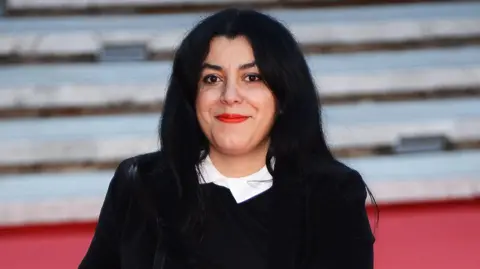 Getty Images
Satrapi was a vocal critic of the Iranian government. Her graphic memoir, *Persepolis*, vividly depicts her childhood experiences under the increasingly restrictive Islamic regime in Tehran and her subsequent move to Europe as an exile. In a 2024 interview with The Guardian, Satrapi articulated her intention behind *Persepolis*: to foster empathy and understanding among Western readers, highlighting the shared humanity of the Iranian people.
The animated film adaptation featured the voices of Chiara Mastroianni as young Marjane and Catherine Deneuve as her mother. Yaël Braun-Pivet, President of the French National Assembly, honored Satrapi as “an immense artist” who used her work as an “act of freedom,” giving a face and voice to the Iranian Revolution and championing the struggle for women’s freedom and dignity.
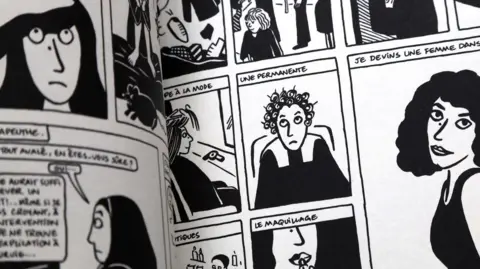 Getty Images
Satrapi pursued her education in Austria at the Lycée Français de Vienne before returning to Iran, where she obtained a master’s degree in visual communication. She later relocated to France to continue her studies at the Haute School Arts Du Rhin in Strasbourg, eventually acquiring French nationality in 2006.
In a notable act of protest against what she termed France’s “hypocrisy” in its relations with her homeland, Satrapi declined the French Legion of Honour in 2023.
Women’s Rights and Activism
 Getty Images
Satrapi consistently championed human rights and freedom, particularly for Iranian women. Her 2022 collection, *Woman, Life, Freedom*, documented the protests following the death of Mahsa Amini. Satrapi recalled her father’s participation in earlier protests against mandatory hijab laws, noting the broader societal implications of women’s rights. She openly shared that she had faced threats and harassment from the Iranian regime due to her activism and artwork.
“I’ve learned in life not to be scared,” she stated, explaining that while fear is present, one can choose not to be governed by it, especially when comparing her experiences to the risks faced by young people in her home country.
In 2023, she led a protest outside the Iranian embassy in Paris in solidarity with teenagers arrested for a TikTok video. She believed that artists have a moral obligation to speak out, stating, “We artists must be humble but doing nothing is worse, being indifferent is worse.”
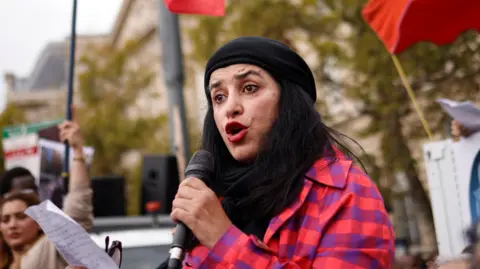 EPA-EFE/REX/Shutterstock
She told the BBC in 2024, “If you take the art and culture out from any society, this society falls down.” Satrapi’s directorial work extended beyond *Persepolis* to include the horror comedy *The Voices* (2014), starring Ryan Reynolds, and the biopic *Radioactive* (2019) with Rosamund Pike. Her other directorial projects include *Poulet aux Prunes* (2011) and *La Bande des Jotas* (2012), alongside graphic novels such as *Embroiderie* and *Woman, Life, Freedom*. Her personal life was marked by the loss of her husband, Swedish producer Mattias Ripa, a profound event she shared through heartfelt social media posts.
Business Style Takeaway: Marjane Satrapi’s legacy underscores the power of art and narrative to bridge cultural divides and foster global empathy. For businesses and executives, understanding how personal stories, rooted in specific cultural contexts like the Iranian Revolution, can achieve universal resonance is key to crafting authentic brand messages and connecting with diverse international audiences.
Learn more at : www.bbc.com