

Google is challenging the prevailing trend of ever-larger AI models with the release of Gemma 4 12B, an open-weights model designed for efficient local deployment. This 11.95-billion-parameter model, licensed under Apache 2.0, is optimized to run on standard enterprise laptops requiring as little as 16GB of VRAM or unified memory. This development significantly lowers the barrier for organizations seeking to leverage AI capabilities offline, whether for enhanced security, uninterrupted operations during travel, or cost reduction.
A key innovation in Gemma 4 12B is its encoder-free “Unified” architecture. This design allows raw audio waveforms and visual data, processed as patches, to be fed directly into the core Large Language Model (LLM) backbone. This bypasses the need for separate, resource-intensive processing modules that typically add latency and memory overhead in traditional multimodal AI systems.
The model is readily accessible for download on platforms like Hugging Face and Kaggle, and can be utilized through the Google AI Edge Gallery. Gemma 4 12B boasts a substantial 256K token context window, integrated capabilities for agentic tool use, and a distinct step-by-step reasoning mode, all within a compact footprint that bridges the gap between mobile edge devices and large-scale data center infrastructure.
Architectural Innovation: The Unified, Encoder-Free Advantage
The novel “Unified” structure of Gemma 4 12B holds significant implications for enterprise AI architecture. Conventional multimodal systems commonly employ distinct encoders to convert audio signals and visual information into formats digestible by the central language model. This multi-stage process typically results in increased inference latency and higher overall memory demands.
Gemma 4 12B fundamentally redefines this workflow by eliminating the need for these supplementary encoders. Instead, visual patches and raw audio waveforms are mapped directly into the LLM’s embedding space via lightweight linear layers. The visual encoder is effectively replaced by a compact 35-million-parameter module relying on a single matrix multiplication, while the audio encoder has been entirely removed.
For engineering teams within enterprises, this unified architecture offers tangible operational benefits: reduced latency for multimodal processing tasks, lower VRAM requirements (making it suitable for standard laptops with 16GB of memory), and the ability to fine-tune the entire multimodal system in a single, streamlined process.
Performance Benchmarks and Core Functionality
Remarkably, Gemma 4 12B achieves performance benchmarks that closely rival Google’s larger 26B Mixture-of-Experts model, despite its significantly smaller size.
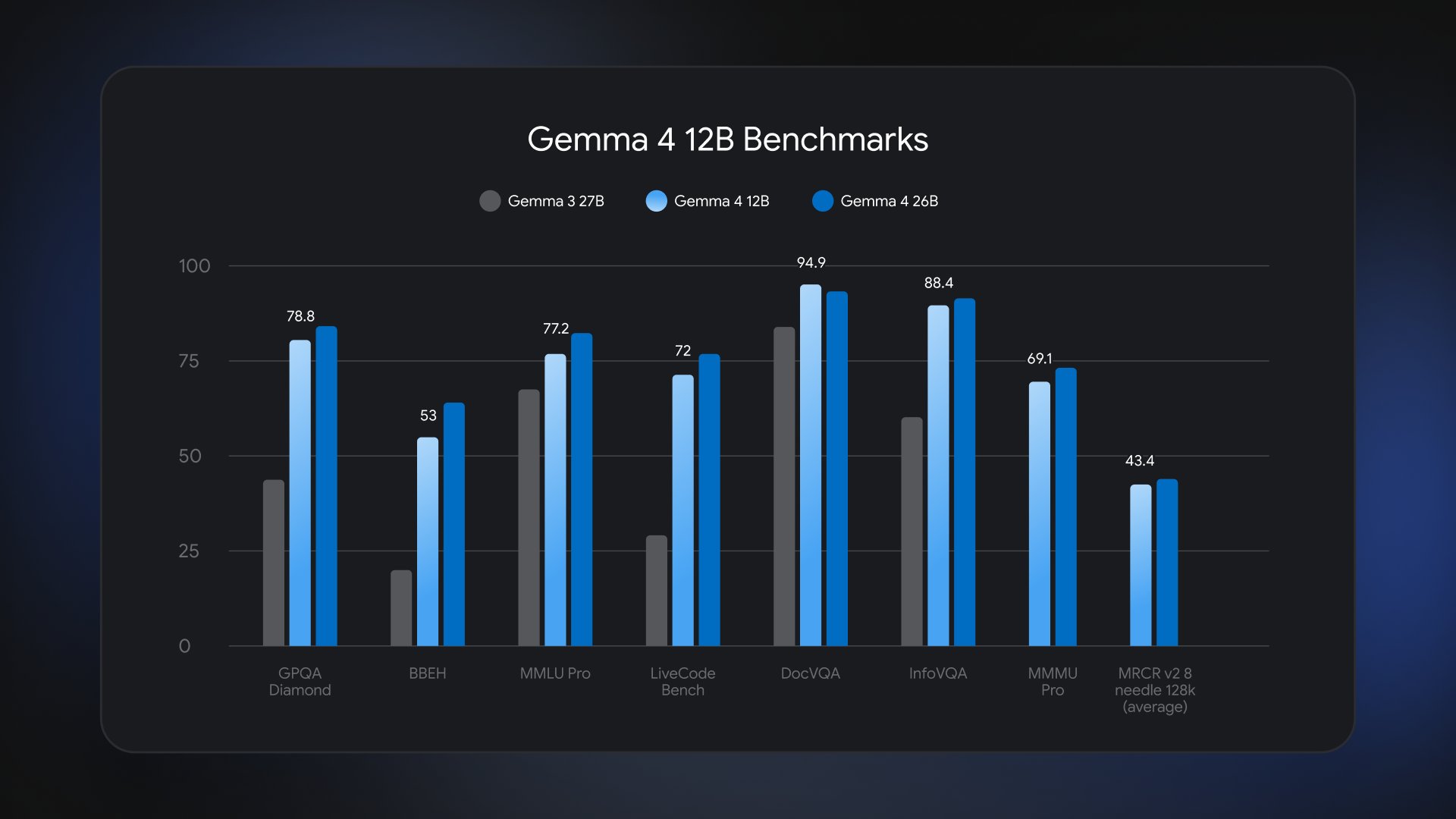
Beyond its performance on standard benchmarks, the model’s support for a vast 256K token context window is particularly significant for enterprises dealing with extensive documents, large codebases, or lengthy audio recordings. Furthermore, Gemma 4 12B incorporates a native “thinking” mode designed to outline step-by-step reasoning processes before generating a response. It also includes out-of-the-box support for native function calling and system prompts, essential components for developing sophisticated autonomous software agents.
Enterprise Suitability: Evaluating Gemma 4 12B Adoption
The decision to adopt Gemma 4 12B should be guided by specific operational requirements, particularly those related to edge computing, stringent data privacy, or the implementation of agentic automation. It is best viewed as a specialized tool rather than a universal replacement for existing AI infrastructure.
-
Upholding Data Privacy and Regulatory Compliance: Industries such as healthcare, finance, and defense often face strict regulations that prohibit the transmission of sensitive data to third-party cloud services. Gemma 4 12B’s ability to run locally on devices with minimal memory requirements allows organizations to process confidential multimodal data entirely on-premises or directly on user laptops, thereby mitigating data breach risks and ensuring adherence to regulatory mandates.
-
Enabling Multimodal Autonomous Agent Frameworks: For organizations developing autonomous agents that interact with real-world inputs, Gemma 4 12B is exceptionally well-suited as the core reasoning engine. Its native function calling capabilities, combined with robust coding skills and the capacity to process real-time audio and variable-resolution images, make it ideal for agentic applications. Google also offers a dedicated Gemma Skills Repository to facilitate agentic development with these new models.
-
Cost-Effective Edge Deployments: In edge computing scenarios, such as retail analytics, customer service kiosks, or field service applications where consistent cloud connectivity may be impractical or expensive, Gemma 4 12B offers substantial cost savings. Its efficient architecture reduces hardware prerequisites for inference, and local deployment eliminates ongoing API fees and unpredictable cloud computing expenses.
Considerations for Alternative Solutions
Despite its strengths, Gemma 4 12B has limitations that enterprises must consider.
-
Extensive Knowledge Retrieval Needs: As with other LLMs, Gemma 4 12B functions primarily as a reasoning engine, not a comprehensive knowledge base. If the core requirement is the retrieval of broad, factual information without the support of a robust Retrieval-Augmented Generation (RAG) system, larger foundation models might still be necessary.
-
Processing Extended Video and Audio Content: The model has specific limitations for media input length. Audio processing is restricted to 30 seconds, and video analysis is capped at 60 seconds (at one frame per second). For tasks involving lengthy video or extensive audio archives, alternative API-based solutions or chunking strategies would be more appropriate.
Integration and Ecosystem Readiness
A significant advantage for enterprise adoption is Gemma 4 12B’s seamless integration with the existing open-source AI ecosystem. Google has ensured the model is production-ready, with weights available on Hugging Face and Kaggle.
It is designed to work efficiently with industry-standard deployment frameworks such as vLLM, SGLang, MLX, and llama.cpp. For organizations utilizing Google Cloud, deployment endpoints can be rapidly established through the Gemini Enterprise Agent Platform Model Garden, Cloud Run, or Google Kubernetes Engine.
Gemma 4 12B presents a compelling option for enterprise leaders looking to decentralize AI operations, offering a rare combination of edge efficiency and advanced reasoning capabilities. Organizations prioritizing highly secure, multimodal processing without the latency and costs associated with cloud dependency should strongly evaluate Gemma 4 12B for their next production pipeline.
Business Style Takeaway: Google’s Gemma 4 12B signifies a strategic shift towards accessible, on-device AI, directly addressing enterprise needs for data privacy, reduced latency, and cost efficiency. This move empowers businesses, particularly in regulated sectors, to deploy sophisticated multimodal AI capabilities locally, fostering innovation in agentic workflows and edge computing without compromising security or incurring prohibitive cloud costs.
Based on materials from : venturebeat.com