

OpenAI Expands Codex Capabilities to Capture Enterprise Market
OpenAI is intensifying its strategic pivot towards enterprise adoption with a significant enhancement of its Codex platform. The AI laboratory has unveiled a suite of new capabilities designed to broaden the application of its agentic tool, Codex, within corporate environments. This expansion is accompanied by an internal report detailing Codex’s growing utility in knowledge work, demonstrating its value extends well beyond traditional software engineering.
Codex User Growth and Diversification
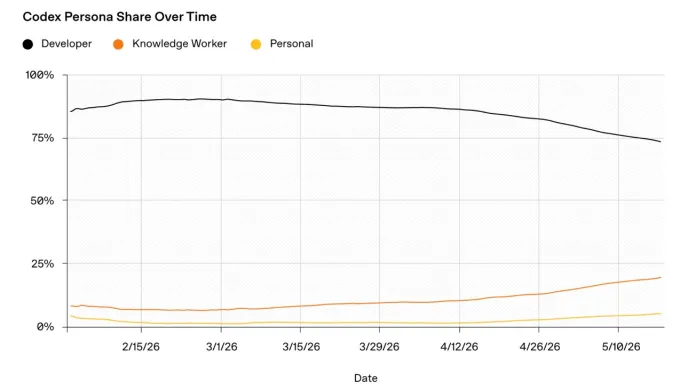
According to OpenAI’s internal data, Codex now boasts over five million weekly active users, marking a substantial six-fold increase since the introduction of its desktop application in February. While developers still constitute the largest user segment, knowledge workers now represent approximately 20 percent of the user base and are experiencing growth at more than three times the overall rate. This demographic shift underscores the platform’s evolving appeal and its capacity to address a wider range of professional tasks.
Targeted Plugins for Professional Roles
To further cater to this burgeoning knowledge worker segment, OpenAI has introduced six specialized plugins. These tools are tailored for distinct professional domains, including data analytics, creative production, sales, product design, equity investing, and investment banking. Accessible directly within the Codex application, each plugin integrates specific workflows, instructions, and contextual data, enabling Codex to function as a proficient assistant for these specialized jobs.
Expanding Ecosystem and Infrastructure
These new plugins follow a similar strategic initiative by Anthropic, which launched its enterprise agents program earlier this year. While OpenAI initially focused on consumer applications, its foray into enterprise solutions began with the introduction of plugin support for Codex in March. Complementing the plugin suite, OpenAI has also launched a new “Sites” feature, enabling Codex to generate interactive, hosted websites from its work product, moving beyond local file outputs. This feature is being supported by a network of partners, including Wix, Base44, Replit, Lovable, Figma, and Emergent, with plans to cultivate a broader ecosystem.
Further enhancing user interaction, a new “Annotations” feature allows for precise designation of specific document sections within Codex, facilitating more targeted commands and contextual operations.
Strategic Investment in Enterprise AI
The introduction of these enterprise-focused features follows closely on the heels of OpenAI’s recent establishment of the OpenAI Deployment Company, a joint venture specifically aimed at enterprise clients. This new entity has secured over $4 billion in funding from global investment firms, signaling a significant commitment to integrating OpenAI technologies more deeply into global business infrastructures.
Denise Dresser, OpenAI’s Chief Revenue Officer, emphasized the growing potential of AI in organizational functions, stating, “AI is becoming capable of doing increasingly meaningful work inside organizations. The challenge now is helping companies integrate these systems into the infrastructure and workflows that power their businesses.” This initiative directly addresses that challenge by providing both the specialized tools and the foundational investment necessary for widespread enterprise adoption.
Business Style Takeaway: OpenAI’s aggressive expansion into specialized enterprise applications for Codex signifies a critical maturation of AI tools from developer-centric utilities to core business process enablers. The strategic focus on vertical-specific plugins and infrastructure partnerships indicates a move towards deep integration, positioning AI not just as an efficiency tool, but as a foundational component of future business operations and competitive advantage.
Based on materials from : techcrunch.com