

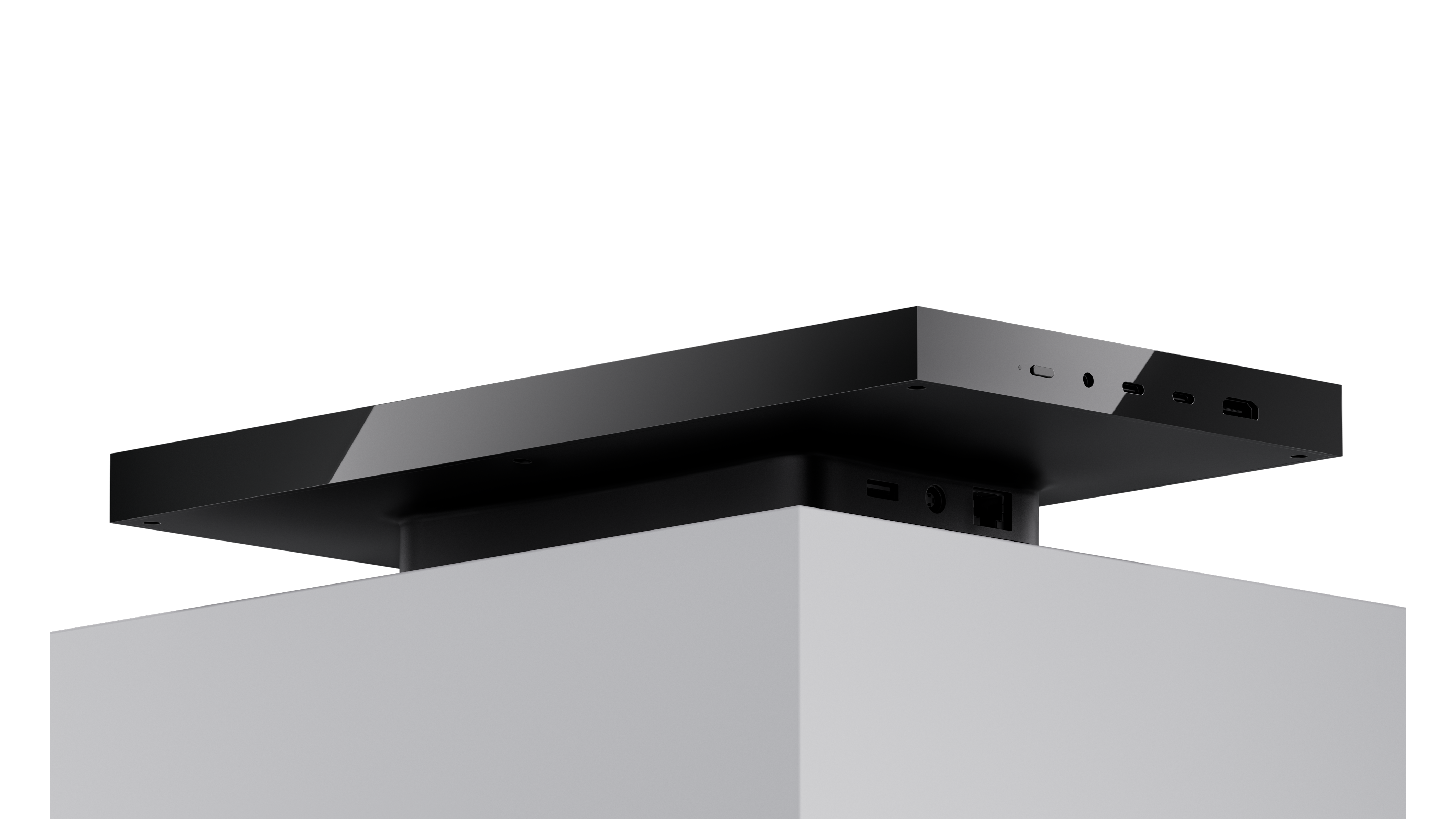
Microsoft has introduced the Surface RTX Spark Dev Box, a compact desktop computer engineered to empower software developers with the capability to run substantial artificial intelligence models directly on their workstations. This innovation presents a direct challenge to the per-token pricing models that have largely dictated the economics of the AI industry since the advent of ChatGPT. Instead of relying on cloud computing resources, developers can now leverage local hardware for complex AI tasks.
Unveiled at Microsoft Build 2026, the Dev Box features Nvidia’s new RTX Spark processor, based on the Blackwell architecture, and is equipped with 128 gigabytes of unified memory within a small-form-factor chassis. This configuration delivers an impressive one petaflop of AI compute power, according to Nvidia’s specifications. The practical implication for developers is the ability to load, execute, and interact with AI models possessing over 120 billion parameters without incurring any API call charges to cloud services.
“We anticipate that devices of this class will be capable of running models with approximately 100 billion parameters,” stated Pavan Davuluri, Microsoft’s Executive Vice President of Windows and Devices, during a pre-event press briefing. He further elaborated that model size is only one facet of performance, emphasizing the critical need for extensive context. “Model size is one thing, but for the model to be effective, it needs sufficient context, as a larger model can process larger contexts.” Davuluri highlighted that a context window of 100,000 tokens alone can necessitate 40 to 50 gigabytes of memory for the key-value cache, underscoring the design rationale behind the device’s 128-gigabyte unified memory pool shared dynamically between the CPU and GPU.
The Surface RTX Spark Dev Box is slated for release in the United States later this year, available exclusively through Microsoft.com. Pricing details have not yet been disclosed.
Microsoft’s Strategic Pivot: Fixed Costs Over Cloud Meters for AI’s Future
The introduction of the Surface RTX Spark Dev Box arrives at a critical juncture where the financial implications of AI development are a significant concern for businesses. Organizations of all sizes are confronting escalating cloud GPU expenses, which can become unpredictable with frequent fine-tuning operations, inference requests, and agentic workflows that involve large language models. For developers engaged in rapid prototyping, the costs associated with running the same model numerous times daily can accumulate rapidly.
Microsoft is positioning the Dev Box as a solution to alleviate this financial pressure. Andrew Hill, Corporate Vice President of Surface, noted in the announcement that the device “changes that equation” by enabling developers to “reserve frontier model calls for truly frontier problems and handle the rest on their own hardware.” The underlying message is not that cloud computing is becoming obsolete, but rather that a considerable portion of tasks currently outsourced to remote data centers do not necessitate the most advanced models and would be more efficiently handled by capable local hardware with predictable, fixed costs.
This represents a notable strategic maneuver for Microsoft, a company that generates substantial annual revenue from its Azure cloud services. By promoting hardware that intentionally reduces customer reliance on the cloud, Microsoft acknowledges a growing industry-wide tension: the marginal cost of AI inference at scale is proving unsustainable for many development teams, thereby creating a market demand for alternatives. The underlying strategy appears to be that developers who prototype locally will still opt for Azure for scaling their applications, and that controlling both the local development environment and the cloud deployment infrastructure offers a more enduring competitive advantage than solely owning the cloud infrastructure.
The 128GB Unified Memory Architecture Enabling Local AI Execution
The technical specifications of the Dev Box reflect a deliberate engineering approach focused on sustained performance rather than peak output, a crucial distinction for AI workloads that can span extended periods.
Central to the device is Nvidia’s RTX Spark system-on-chip, which integrates a highly efficient ARM-based CPU with a Blackwell-generation RTX GPU. As explained by Davuluri during the press briefing, this configuration in a conventional Windows PC would typically involve four distinct components: a CPU, a discrete GPU, dedicated graphics memory, and system RAM. The RTX Spark consolidates these into a single chip, paired with a unified memory pool.
This memory unification is a pivotal design choice. High-end gaming laptops equipped with Nvidia GPUs generally offer up to 24 gigabytes of GPU-accessible memory. The Dev Box’s 128 gigabytes of unified memory, accessible by both the CPU and GPU via Nvidia’s Unified Memory Access architecture, is instrumental in enabling the execution of models that would otherwise require cloud-based GPU instances with specialized high-bandwidth memory configurations.
Microsoft has implemented significant optimizations at the operating system level to leverage this architecture. New memory management protocols within Windows enhance the GPU’s addressable system memory, introduce more intelligent page-size allocation for shared memory segments, and ensure that intensive GPU tasks do not compromise the CPU’s multitasking capabilities. Furthermore, the Windows scheduler has been fine-tuned for the RTX Spark’s heterogeneous core design, directing demanding operations to performance cores while maintaining efficiency cores for background processes.
3D-Printed Aluminum Chassis: A Fusion of Design and Thermal Management
The thermal management system is equally innovative. The Dev Box operates within a sustained thermal envelope of approximately 100 watts—a modest figure by desktop standards, yet significant for a device designed for continuous training and inference workloads. The aluminum chassis itself functions as an integrated passive heatsink. The manufacturing method employed for the chassis is particularly noteworthy.
The top panel is produced using metal 3D printing, a process that allows for intricate internal geometries unattainable through conventional CNC machining or injection molding. The perforations are not simple openings; they are angled in multiple directions around the internal fan to optimize airflow, facilitating efficient heat dissipation from the cold-air intake. Harry, a Surface industrial designer, explained the design philosophy during the press briefing: “The complexity is something other manufacturers wouldn’t be able to do, like CNC, or like any molding, because of the complexity of shape.”
Addressing concerns about mass production scalability with 3D printing, the designer confirmed that Microsoft has developed a robust process capable of meeting production demands. The result is a device that operates quietly enough for open-office environments while sustaining the continuous GPU workloads that would typically cause throttling in most conventional desktops of similar size. For a device intended for developers to run overnight fine-tuning jobs, quiet, sustained performance is a fundamental requirement, not a luxury.
Developer-Centric Setup Minimizes Configuration Time
The Surface RTX Spark Dev Box comes with Windows 11 Pro pre-configured at the OS image level, specifically tailored for development tasks. This thoughtful approach addresses a recognized historical weakness in the out-of-the-box experience for developer hardware.
Upon booting, the device defaults to a dark theme with a streamlined taskbar, the removal of widgets, and Do Not Disturb mode enabled. Developer Mode is activated by default. PowerShell 7 serves as the primary command-line shell. The Windows Subsystem for Linux (WSL 2) is pre-installed and configured with GPU passthrough and CUDA support. Essential development tools such as Visual Studio Code, GitHub Copilot, Git, Python, and Node.js are all included and ready for immediate use.
“We’ve adopted the philosophy of ‘We’ve got you covered; we know you want to move fast’,” remarked a Microsoft engineer during a demonstration of the setup process. The underlying principle is that developers would invariably install these tools, and the primary friction point has always been the extensive setup and configuration required before coding can commence.
The Dev Box also offers seamless integration with Microsoft’s AI ecosystem. It includes the AI Toolkit for VS Code for model conversion and fine-tuning, Windows ML and Windows Copilot Runtime for local inference, and Microsoft Foundry for connecting local prototypes to cloud deployment pipelines. For enterprise customers, the device supports integration with Entra ID and Intune for identity and device management, and incorporates Secured-core PC architecture, BitLocker encryption, and Microsoft Defender.
Beyond the Mac Mini: Redefining Compact Developer Workstations
While Apple’s Mac Mini has traditionally dominated the compact desktop market and garnered significant adoption among developers drawn to Apple Silicon’s unified memory and power efficiency, the Surface RTX Spark Dev Box enters the arena with distinct performance advantages.
Davuluri directly addressed this comparison, stating that the Dev Box is “in a different class of performance than Mac Minis, intentionally.” Although specific benchmarks were not shared, with detailed specifications and performance targets to be released closer to the fall launch, the claimed architectural superiority is evident. While current Mac Mini configurations max out at 48GB of unified memory (or 128GB with M4 Max), the RTX Spark Dev Box combines its 128GB of unified memory with a Blackwell-class GPU. This GPU features a fundamentally different CUDA-based compute model, for which the vast majority of the AI/ML ecosystem’s tooling—including PyTorch, TensorRT, llama.cpp, and Hugging Face frameworks—is already highly optimized.
The advantage conferred by the mature CUDA ecosystem cannot be overstated. Despite advancements in Apple’s Metal framework, the predominant AI training and inference frameworks are developed and rigorously tested against Nvidia’s CUDA stack. Developers utilizing the Dev Box can employ the same code, libraries, and workflows as they would on cloud GPU instances, offering a level of portability currently unmatched by Apple Silicon.
Microsoft’s Three-Tiered Approach to Local AI Hardware: From Laptop to Supercomputer
The Dev Box is part of a broader three-tier hardware strategy announced by Microsoft at Build. The Surface Laptop Ultra, unveiled shortly before at Computex, integrates the same RTX Spark silicon into a 15-inch laptop form factor, catering to mobile developers and creators. At the high end, the DGX Station for Windows, powered by Nvidia’s GB300 Grace Blackwell Ultra Superchip, is designed for organizations requiring deskside systems capable of running frontier models up to one trillion parameters. This system is anticipated for release in the fourth quarter.
These three devices align with a tiered computing model Microsoft terms “unmetered intelligence.” This model involves utilizing small, on-device language models (such as Microsoft’s new Aion 1.0 family) for low-cost, lightweight tasks; employing RTX Spark-class hardware for local execution of mid-range models during the majority of development work; and reserving cloud resources exclusively for highly demanding, frontier-scale AI challenges.
This model is being concretely implemented within the GitHub Copilot CLI through a new feature called `/fleet`. This feature enables a cloud-based primary agent to formulate plans, assess task complexity, and intelligently route appropriate subtasks to a local model running on the developer’s hardware. The cloud agent manages tasks requiring frontier AI capabilities, while the local model handles less demanding operations. The projected outcome is a reduction in costs without compromising on quality.
The Crucial Question: Can Hybrid AI Transition from Buzzword to Viable Business Model?
The ultimate success of Microsoft’s strategic initiative hinges on factors that will unfold over the coming months. Key questions include the Dev Box’s real-world performance under sustained workloads, its pricing structure, the pace at which the open-source model ecosystem will develop capable models within the 70-to-120-billion-parameter range that fit its memory capacity, and critically, whether enterprise procurement departments, accustomed to treating AI as a cloud operational expense, will embrace capital expenditures on desk-based hardware as a viable alternative.
However, the strategic rationale behind this move is compelling. For the past three years, the AI industry has operated under the implicit assumption that substantial AI development necessitates cloud infrastructure, with associated costs viewed as standard business expenses. Microsoft, uniquely positioned to both benefit from and challenge this paradigm, is now offering a device that fundamentally shifts this dynamic. This is not a contradiction but rather a pragmatic acknowledgment of evolving market demands and the enduring value of controlling both the developer’s local computing environment and their cloud deployment platform.
Every dollar saved by developers on cloud inference translates directly into resources that can fuel additional experimentation, iterative development, and prototype creation. After years of the AI industry promoting a “rent-by-the-token” model for accessing intelligence, Microsoft is now posing a compelling alternative: “What if you could simply purchase it?”
Business Style Takeaway: Microsoft’s Surface RTX Spark Dev Box signals a significant shift towards democratizing high-end AI development by offering predictable, fixed-cost hardware, challenging the dominant cloud-centric, pay-per-use model. This move empowers businesses to better manage AI development budgets and accelerates innovation by reducing reliance on potentially volatile cloud expenses for routine tasks.
Based on materials from : venturebeat.com