

From over 10,500 miles away, an Australian solicitor has played a pivotal role in the recovery of two historical artefacts, both stolen from English churches.
 Richard d'Apice
Richard d’Apice, an 80-year-old solicitor based in Sydney, who has a deep-seated passion for heraldry, particularly funeral heraldry, stumbled upon the items—a commemorative panel and a funeral hatchment—while browsing online marketplaces. His keen eye and extensive knowledge led him to identify them as originating from churches in Norfolk and Hertfordshire, respectively.
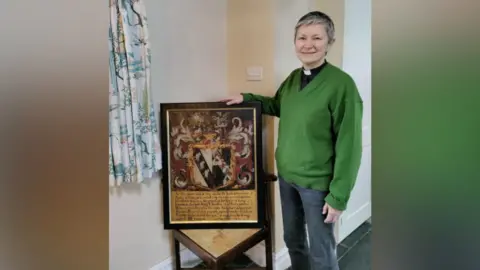 St Leonard's Church
His dedication to symbols and heritage is evident in his statement that it “feels wonderful” to know his expertise facilitated the return of these artefacts to their rightful places. D’Apice, who admits to a compulsion to explore any open church door, describes his fascination with funeral heraldry as a lifelong pursuit.
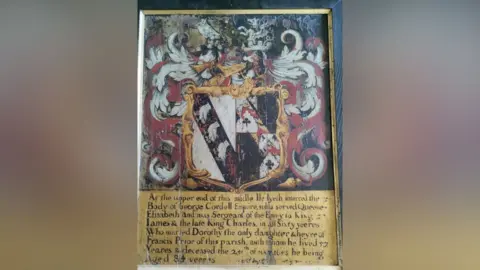 St Leonard's Church
The journey to recovery began last December when d’Apice encountered a painted wooden panel at Dreweatt Auction House. His diligent research revealed its origins in St Leonard’s Church in Flamstead, Hertfordshire, dating back to the 1600s. This significant piece commemorates George Cordell, who served in the royal households of three monarchs and is valued at approximately £3,000.
D’Apice noted the unusual circumstances of the item’s availability, stating, “These things are very hard to obtain ecclesiastical permission to be removed from church furnishings, so it was unusual to see it outside the church.” He promptly contacted the church authorities, who confirmed the panel’s theft in 1996, along with another painting. Due to its registration with the police and the Art Loss Register, its ownership was clearly established, leading to its withdrawal from sale and subsequent retrieval.
This successful recovery followed closely on the heels of another intervention. D’Apice had also been instrumental in the restoration of a funeral hatchment from St Margaret’s Church in Felbrigg, Norfolk. This item, a decorative panel depicting the coat of arms of Cecilia, the widow of MP William Windham, who passed away in 1824, was being auctioned by Sworders Fine Art Auctioneers.
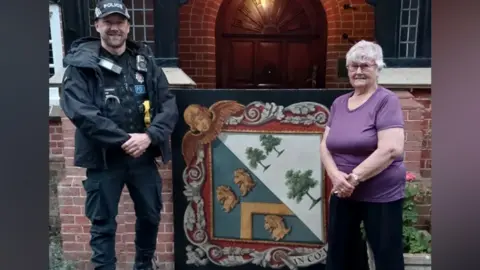 Essex Police
The recovery efforts, supported by Essex Police’s rural engagement team, saw the hatchment returned to St Margaret’s in October. Police Constable Dane Wyatt reported that the item was recovered from a seller who had purchased it in good faith approximately two decades prior. He expressed satisfaction in delivering it safely back to its rightful custodians.
Sworders Fine Art Auctioneers confirmed their pride in assisting with the artefact’s return. D’Apice highlighted the persistent issue of church content erosion through theft, emphasizing the critical role of the Art Loss Register in substantiating losses and ownership, a process he deems highly effective across the art world.
D’Apice is scheduled to attend St Leonard’s Church on June 4th to participate in the unveiling of the returned panel as part of the Flamstead Arts Festival. He conveyed his excitement at seeing the memorial board restored to its centuries-old location.
Business Style Takeaway: This narrative underscores the global interconnectedness of cultural heritage and the power of specialized knowledge, even from afar, to impact tangible assets. For businesses operating internationally, understanding and respecting local cultural histories, and leveraging niche expertise for provenance verification, can prevent significant reputational and financial risks, while fostering goodwill.
Learn more at : www.bbc.com