

When AI agents encounter operational failures, the immediate assumption often defaults to shortcomings in the underlying model’s reasoning capabilities. However, a deeper analysis frequently reveals that the primary constraint lies in the limited information accessible through conventional retrieval interfaces.
Researchers from several prominent universities have introduced a novel technique known as Direct Corpus Interaction (DCI). This approach empowers AI agents to bypass embedding models entirely, enabling them to query raw data repositories directly using standard command-line utilities.
The Limitations of Traditional Retrieval Methods
In conventional retrieval systems, such as Retrieval-Augmented Generation (RAG), documents are typically segmented into smaller pieces, converted into vector representations (embeddings), and subsequently indexed within a vector database. When an AI system processes a query, a retriever sifts through this database to furnish a ranked list of document segments deemed most relevant to the query. Crucially, all evidence must first pass through this semantic scoring mechanism before any advanced reasoning can occur.
However, the demands of modern agentic applications extend far beyond simple semantic recall. As the creators of the DCI methodology noted, “Dense retrieval is very useful for broad semantic recall, but when an agent has to solve a multi-step task, it often needs to search for exact strings, numbers, versions, error codes, file paths, or sparse combinations of clues. These long-tail details are precisely where semantic similarity can be brittle.”
Unlike static search mechanisms, AI agents must also adapt their search strategies dynamically based on observed partial or localized evidence. Executing precise lexical constraints or refining multi-step hypotheses proves challenging with semantic retrievers. Because the retrieval process compresses data access into a single step, any critical piece of evidence filtered out by the similarity search is irrecoverably lost, regardless of the sophistication of the agent’s downstream reasoning abilities. The researchers highlight that current retrieval pipelines can become a bottleneck because “they decide too early what the agent is allowed to see.”
Direct Corpus Interaction (DCI) Explained
This direct access methodology tackles a fundamental challenge within enterprise environments: data staleness. Embedding indexes represent a static snapshot of data at a particular moment, requiring significant computational resources and time to construct and maintain.
“In many enterprise settings, the data is not a stable document collection. It is daily financial reports, live logs, tickets, code commits, configuration files, incident timelines, and internal documents that keep changing,” the researchers explained. DCI allows agents to reason over the current state of the operational environment rather than relying on an outdated vector index.
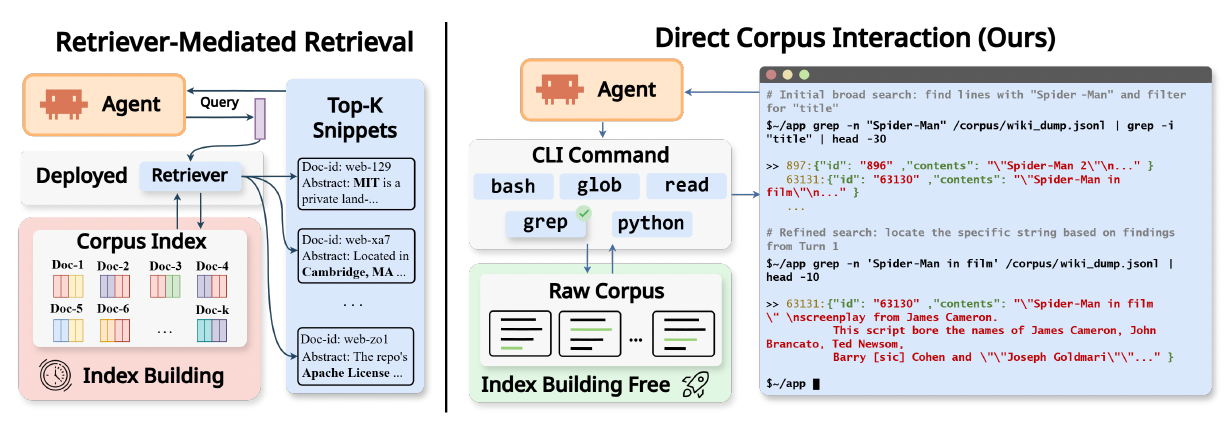
In this paradigm, the agent operates within a terminal-like environment, receiving raw outputs from tools such as file paths, identified text segments, and surrounding contextual lines. DCI provides a set of highly expressive, yet minimal, core tools. Agents utilize commands like “find” and “glob” for navigating directory structures and locating files. For precise text matching, they employ “grep” and “rg” to pinpoint specific keywords, regular expressions, and exact character sequences. When localized inspection is necessary, tools such as “head,” “tail,” “sed,” “cat,” and lightweight Python scripts allow the agent to examine the context around a match or read specific file segments.
The agent can chain these tools together using shell pipelines to execute sophisticated search logic in a single operation. This enables the agent to enforce strict lexical constraints, for instance, by searching a file for one term and piping the results to search for a second term. It can also combine multiple subtle clues across a corpus by identifying a specific file type, searching for a keyword like “report,” and then filtering for a year such as “2024.” Furthermore, it can instantly validate hypotheses by inspecting the exact lines adjacent to a keyword match.
DCI shifts the responsibility of semantic interpretation directly to the agent, rather than relying on embedding-based similarity searches. This allows the agent to formulate hypotheses, test precise lexical patterns, and extract granular information that a traditional semantic retriever might overlook.
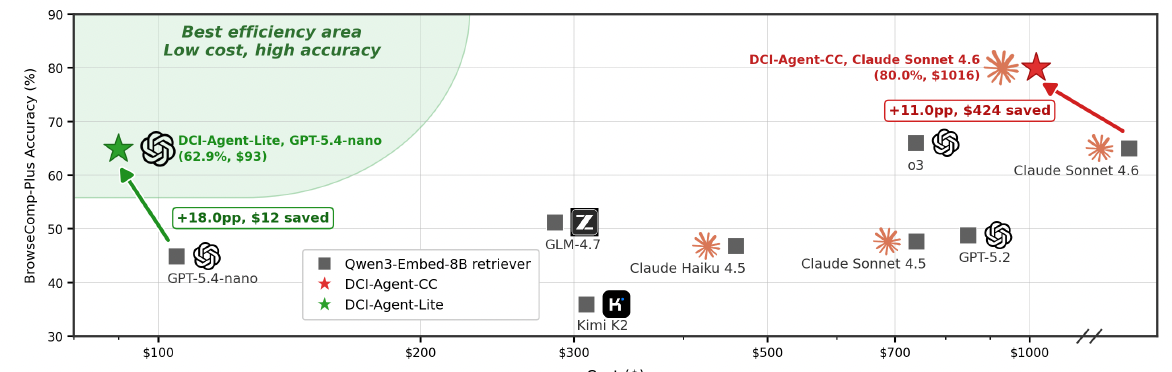
The research proposes two distinct versions of this system. DCI-Agent-Lite is engineered as a minimalist, cost-effective solution built upon the GPT-5.4 nano model, exclusively interacting with raw terminal commands and basic file operations. Due to the potential for reading raw files to quickly exhaust the memory of smaller models, this version employs efficient runtime context management strategies to support extended exploration horizons.
DCI-Agent-CC represents the higher-performance tier, targeted at organizations with greater computational resources. It leverages Claude Code, powered by Claude Sonnet 4.6. Claude Code offers enhanced prompting capabilities, more robust tool orchestration, and superior built-in context management, thereby improving agent stability during complex, multi-step searches across diverse datasets.
DCI’s Performance in Benchmarks
The researchers evaluated both DCI versions across established agentic search benchmarks, including BrowseComp-Plus, knowledge-intensive question-answering tasks requiring both single-hop and multi-hop reasoning, and information retrieval ranking for tasks necessitating domain-specific logic and scientific fact-checking.
The performance of DCI was compared against three distinct baseline categories. The first included open-weight retrieval agents like Search-R1 and proprietary agents utilizing advanced models such as GPT-5 and Claude Sonnet 4.6, coupled with conventional retrievers. The second baseline comprised classical sparse retrievers like BM25 and dense retrievers such as OpenAI’s text-embedding-3-large and Qwen3-Embedding-8B. The third baseline consisted of high-performance reasoning-focused re-rankers, including ReasonRank-32B and Rank-R1.
According to the researchers, DCI consistently surpassed these baselines. On the intricate BrowseComp-Plus benchmark, substituting a traditional Qwen3 semantic retriever with DCI on a Claude Sonnet 4.6 framework resulted in an accuracy improvement from 69.0% to 80.0%, while concurrently reducing API costs from $1,440 to $1,016. The return on investment for the lightweight agents was also significant. DCI-Agent-Lite, utilizing GPT-5.4 nano, achieved performance comparable to the OpenAI o3 model with traditional retrieval but at a cost reduction exceeding $600.
In multi-hop question-answering tasks, DCI-Agent-CC achieved an average accuracy of 83.0%, marking a substantial improvement of 30.7 points over the most capable open-weight retrieval baseline, according to the study’s findings.
The data indicates that while DCI exhibits lower broad document recall compared to dense embedding models, it extracts significantly more value from a relevant document once it is identified. This suggests a trade-off between exhaustive search and deep, precise analysis.
“If an enterprise AI lead asked where DCI is most clearly useful, I would point to tasks that require exact evidence localization in a dynamic workspace: debugging production incidents, searching large codebases, analyzing logs, compliance investigation, audit trails, or multi-document root-cause analysis,” the researchers elaborated.
In a particularly complex deep-research scenario, the agent was tasked with identifying a specific soccer match based on twelve interconnected clues, including precise attendance figures, yellow card counts, and player birth dates. A conventional retriever would likely surface fragmented snippets. In contrast, the DCI agent navigated the file system, accessed specific lines within a 1990 England versus Belgium match report to confirm the exact number of substitutions, extracted a precise quote from an interview file, and verified the birth dates of two players by examining their associated Wikipedia text files. By chaining these straightforward commands, DCI ensures that no critical evidence is lost due to the limitations of a flawed semantic search algorithm.
Constraints and Practical Implementation of DCI
DCI demonstrates excellent scalability in search depth but encounters challenges with search breadth. When the experimental corpus was expanded from 100,000 to 400,000 documents, the system’s accuracy saw a notable decline, and the average number of tool calls increased significantly. While DCI excels at deep analysis once a promising document is located, the effort required to find that initial anchor document escalates sharply as the search space grows.
Furthermore, DCI offers lower broad document recall compared to dense embedding models, prioritizing high-resolution local precision over exhaustive recall. If an enterprise workflow critically depends on identifying every single relevant document across an immense dataset, DCI might not be the optimal solution.
Granting an agent extensive tools like an unrestricted bash shell can increase latency and computational overhead due to the high volume of iterative tool calls required for search completion. It also introduces substantial context management and security considerations for IT departments.
“Tool calls can return large outputs; long trajectories can fill the context window; and raw terminal access requires sandboxing, permission control, and careful engineering,” the researchers cautioned. To manage context window limitations, they found that moderate truncation and compaction techniques enable the agent to sustain longer searches, whereas overly aggressive summarization risks discarding valuable evidence.
Given these operational realities, DCI is not positioned as a complete replacement for existing vector infrastructure but rather as a complementary technology.
“For orchestration engineers and data architects, our view is that the most practical near-term deployment pattern is hybrid,” the authors stated. Semantic retrieval can still effectively provide high-recall candidate discovery for broad or underspecified user intents. “DCI can then operate as a precision and verification layer: the agent can search within the retrieved documents, expand from them into neighboring files, check exact constraints, and combine weak signals across documents.”
The researchers have made the DCI codebase publicly available under the permissive MIT license.
“Longer term, DCI changes how we think about enterprise data. Data will not only need to be stored for humans or indexed for search engines; it will need to be organized for agents that can inspect, compare, grep, trace, and verify,” the authors concluded. “File names, timestamps, stable identifiers, metadata, version history, and machine-readable structure become part of the retrieval interface.”
Business Style Takeaway: The Direct Corpus Interaction (DCI) approach fundamentally challenges traditional retrieval limitations by enabling AI agents to interact directly with raw data using command-line tools. This innovation is crucial for enterprises dealing with dynamic, complex data environments, offering enhanced precision and efficiency for tasks like debugging, log analysis, and compliance, while also presenting new considerations for data organization and system security.
Learn more at : venturebeat.com