

AI agents often struggle with memory limitations, leading to inefficiencies in workflows, increased token costs, and a degradation of performance in long-running tasks. Traditional solutions like expanding context windows or implementing Retrieval-Augmented Generation (RAG) are proving to be expensive and not always effective for maintaining continuity. Addressing this challenge, researchers have introduced delta-mem, an innovative technique designed to compress an AI model’s historical information into a dynamically updating matrix without altering the core model parameters. This method adds a negligible fraction of parameters compared to existing alternatives, yet significantly outperforms them on memory-intensive benchmarks, enabling continuous accumulation and reuse of historical data.
The Challenge of Sustained AI Memory
The current standard approach to managing AI memory involves feeding all relevant historical information directly into the model’s context window. However, this method faces significant limitations. Jingdi Lei, a co-author of the research, highlighted that contemporary systems treat memory primarily as a context management issue, relying on expanding context windows or enhancing RAG. While valuable, these methods become increasingly costly and less reliable for agents engaged in extended, multi-step interactions. Moreover, unlike human memory, these approaches function more like document lookups than a dynamic recall mechanism.
For enterprise applications, the critical factors are not just the accessibility of historical data but its efficient, continuous, and low-latency reuse. Standard attention mechanisms experience a quadratic increase in computational cost with longer sequences. Furthermore, a larger context window does not guarantee effective information recall; models can suffer from context degradation, or “context rot,” when overwhelmed with extensive and potentially conflicting information, even if theoretically supporting millions of tokens.
The researchers advocate for advanced memory mechanisms capable of representing historical information compactly and dynamically maintaining it across interactions. Existing solutions typically fall into one of three paradigms, each with its own drawbacks:
- Textual Memory: Stores historical data as text within the context window, which is limited in size and prone to information loss during compression.
- Outside-Channel (RAG): Utilizes external modules for encoding and retrieval, introducing latency, integration complexity, and potential misalignment with the core model.
- Parametric Memory: Encodes memory directly into the model’s weights via adapters. This approach is static post-training and cannot adapt to new information during live interactions.
Introducing Delta-Mem
To achieve efficient, dynamic memory management, delta-mem compresses an agent’s past interactions into what is termed an “online state of associative memory” (OSAM). This state is maintained as a fixed-size matrix that preserves crucial historical details while keeping the underlying large language model (LLM) frozen. For enterprise workflows, this translates to overcoming significant operational bottlenecks. Lei noted that a persistent coding assistant, for instance, could benefit from remembering project conventions, recent debugging efforts, user preferences, or intermediate decisions throughout a complex task. Similarly, a data analysis agent could maintain task state, assumptions, and prior observations across multiple tool calls.
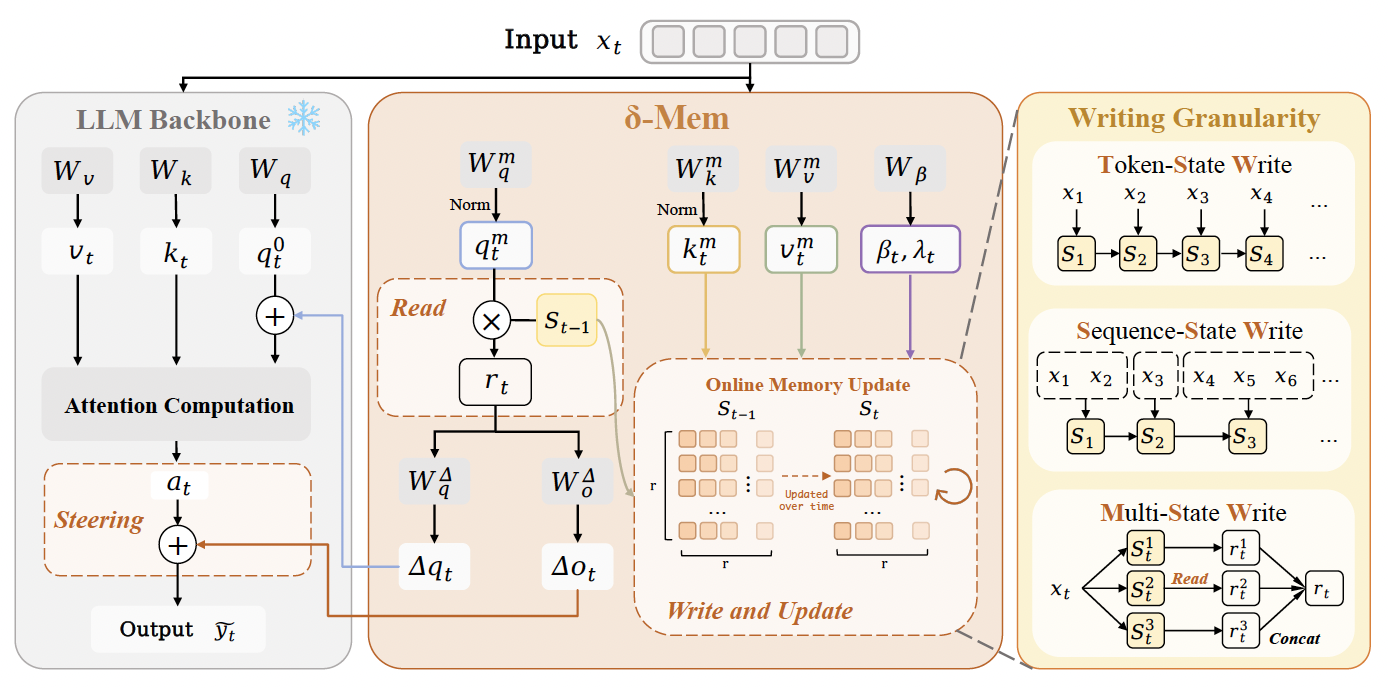
Instead of repeatedly retrieving and re-inserting extensive historical context into prompts, the delta-mem matrix provides an efficient mechanism to carry forward useful interaction states directly within the model’s computational process. During generation, the LLM’s current hidden state is projected into the matrix to retrieve relevant historical signals. These signals are then transformed into numerical adjustments applied to the model’s computations, guiding its reasoning at inference time without modifying its underlying parameters.
Following each interaction, delta-mem updates its OSAM state using a “delta-rule learning” mechanism. This process involves the memory module predicting attention values based on the previous state, comparing these predictions with actual values, and correcting the memory matrix to minimize discrepancies. A “gated delta-rule” further refines this by controlling the balance between retaining old memory and incorporating new information. This controlled error correction and forgetting capability allows the matrix to evolve dynamically, preserving stable historical associations while filtering out short-term noise.
The researchers explored three update strategies for managing the memory matrix:
- Token-State Write: Captures granular changes but is susceptible to short-term noise.
- Sequence-State Write: Averages token-level updates within message segments, smoothing the memory evolution at the expense of some fine-grained detail.
- Multi-State Write: Decomposes memory into distinct sub-states, potentially representing different types of information such as facts or task progress.
Delta-Mem Performance and Efficiency
The delta-mem framework was evaluated across three LLM backbones—Qwen3-8B, Qwen3-4B-Instruct, and SmolLM3-3B—using a compact 8×8 matrix configuration. Testing encompassed general capability benchmarks like HotpotQA, GPQA-Diamond, and IFEval, as well as memory-intensive tasks such as LoCoMo (for conversational memory) and Memory Agent Bench (assessing retention, retrieval, selective forgetting, and test-time learning over extended interactions). These results were benchmarked against established memory paradigms, including textual memory (BM25 RAG, LLMLingua-2, MemoryBank), parametric systems (Context2LoRA, MemGen), and outside-channel approaches (MLP Memory).
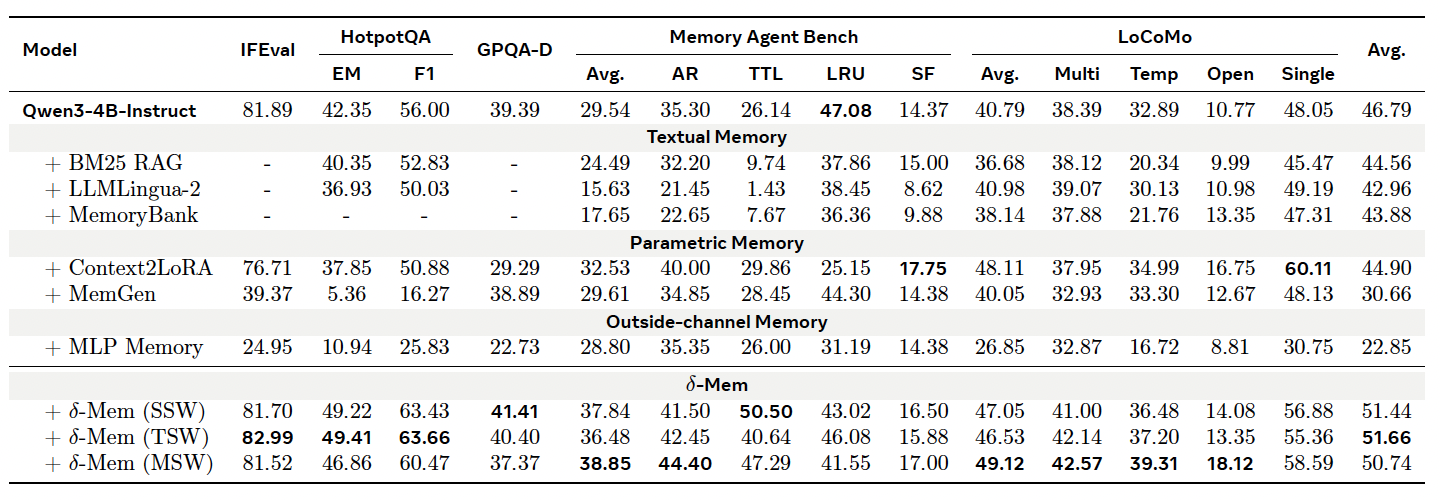
The findings indicate that delta-mem consistently outperformed baseline models. On the Qwen3-4B-Instruct backbone, the token-state write variant achieved an average score of 51.66%, surpassing the unmodified backbone (46.79%) and the leading baseline, Context2LoRA (44.90%). For memory-intensive tasks on the Memory Agent Bench, the average score improved from 29.54% to 38.85%, with performance on the test-time learning subtask nearly doubling from 26.14% to 50.50%.
Crucially, delta-mem demonstrates remarkable operational efficiency. In tests where historical text was entirely removed from the context, the framework still successfully retrieved context-relevant evidence for multi-hop tasks, suggesting effective memory recall without the need for large prompt tokens. The system adds only 4.87 million trainable parameters (0.12% of the Qwen3-4B-Instruct backbone), a stark contrast to the 3 billion parameters (76.40% of the backbone) required by MLP Memory, which yielded inferior results. During inference tests with prompt lengths scaling to 32,000 tokens, delta-mem maintained a GPU memory footprint nearly identical to a standard model, avoiding the significant memory bloat seen in systems like MemGen and MLP Memory.
The optimal update strategy varied based on model capacity. The sequence-state write proved most effective for robust backbones like Qwen3-8B, smoothing updates by averaging at the segment level. For smaller backbones such as SmolLM3-3B, the multi-state write strategy was crucial for performance gains by minimizing information interference.
Integrating Delta-Mem into Enterprise AI Stacks
The delta-mem codebase and trained adapter weights are publicly available on GitHub and Hugging Face, respectively, facilitating integration into existing AI inference stacks with minimal computational overhead. Lei explained that implementing delta-mem involves attaching adapter modules to selected attention layers of an existing instruction-tuned backbone, training only these adapter parameters on domain-specific multi-turn or long-context data, and then running inference with the memory state updated dynamically. This process does not require extensive pretraining corpora, only data that reflects the desired memory behaviors.
While compressing interaction history into a fixed-size matrix offers significant efficiency, it is not a lossless replacement for explicit text logs or document retrieval. The risk of “memory blending” exists, as different pieces of information compete within the same limited state. Delta-mem is best suited for scenarios requiring fast, online, continuously updated behavioral state, whereas RAG excels at exact factual recall, citation, compliance, and accessing large knowledge bases.
The future of enterprise AI architectures likely involves a hybrid approach. Delta-mem can serve as a lightweight internal working memory, reducing the constant need for extensive retrieval, while RAG acts as a high-capacity, explicit memory layer. Lei anticipates that vector databases will remain essential, but enterprise AI stacks will become more layered, incorporating internal short-term working memory, external long-term retrieval systems, and policy layers to manage information storage, retrieval, and exposure.
Business Style Takeaway: The introduction of delta-mem signifies a critical advancement in making AI agents more efficient and cost-effective by creating a persistent, low-overhead “working memory.” This innovation directly addresses the practical limitations of current LLM applications in long-term task execution, potentially unlocking new opportunities for autonomous agents and complex workflow automation in enterprises. Businesses should monitor this technology as it could fundamentally change the economics and capabilities of AI-driven services by reducing reliance on expensive context management and RAG systems.
According to the portal: venturebeat.com