

Retrieval-Augmented Generation (RAG) has become the standard methodology for grounding large language models (LLMs) in proprietary data. The typical architecture—which involves segmenting documents, embedding them into a vector database, and retrieving the top ‘k’ results using cosine similarity—is highly effective for unstructured semantic search.
However, in enterprise domains characterized by deeply interconnected data, such as supply chain management, financial compliance, or fraud detection, vector-only RAG often falls short. While it excels at capturing similarity, it frequently misses the underlying structure. This limitation becomes apparent when attempting to answer multi-hop reasoning questions, like “How will the delay in Component X impact our Q3 deliverable for Client Y?” The standard vector store lacks the inherent understanding to connect Component X directly to Client Y’s deliverable.
This article delves into the concept of graph-enhanced RAG. Drawing from extensive experience in building high-throughput logging systems at Meta and private data infrastructure at Cognee, we will outline a reference architecture that harmoniously integrates the semantic flexibility of vector search with the deterministic structural integrity of graph databases.
The Challenge: When Vector Search Loses Critical Context
Vector databases are adept at capturing semantic meaning but often overlook topological relationships. When documents are chunked and embedded, explicit connections—such as hierarchies, dependencies, or ownership—are frequently flattened or lost altogether.
Consider a supply chain risk scenario, a hypothetical yet representative example of the structural complexities inherent in enterprise data architectures:
- Structured Data: A SQL database explicitly defines that Supplier A provides Component X to Factory Y.
- Unstructured Data: A news report states, “Flooding in Thailand has halted production at Supplier A’s facility.”
A conventional vector search for “production risks” would successfully retrieve the news report. However, it would likely lack the specific context to link this report directly to the output of Factory Y. Consequently, the LLM would receive the news but would be unable to answer the critical business question: “Which downstream factories are at risk?”
In operational environments, this deficiency often manifests as model hallucination. The LLM attempts to infer relationships between the news report and the affected factory, but without explicit links, it may resort to guessing or returning an “I don’t know” response, even when the necessary data exists within the system.
The Solution: A Hybrid Retrieval Pattern
To overcome these limitations, we transition from a “Flat RAG” architecture to a “Graph RAG” approach. This involves a sophisticated three-layer stack:
- Ingestion (Lessons from Meta): Experience with the Shops logging infrastructure at Meta highlighted the critical importance of enforcing structure during the ingestion phase. Reconstructing structure from disparate, unstructured logs post-ingestion is often unreliable for analytics. Similarly, in RAG, entities (nodes) and their relationships (edges) must be extracted during ingestion. This can be achieved using an LLM or a Named Entity Recognition (NER) model to identify entities within text chunks and map them to existing records in the graph.
- Storage: A graph database, such as Neo4j, is employed to store the structural graph. Vector embeddings are then stored as properties associated with specific nodes; for instance, an embedding might be linked to a ‘RiskEvent’ node.
- Retrieval: A hybrid query mechanism is implemented, combining two key steps:
- Vector Scan: Identify potential entry points within the graph based on semantic similarity.
- Graph Traversal: Navigate the relationships emanating from these identified entry points to gather comprehensive context.
Reference Implementation: A Supply Chain Risk Analyzer
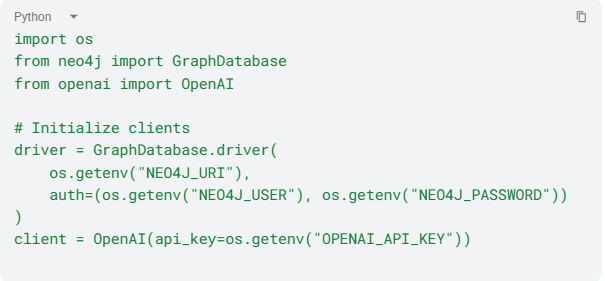
Let’s explore a simplified implementation of this supply chain risk analysis system using Python, Neo4j, and OpenAI.
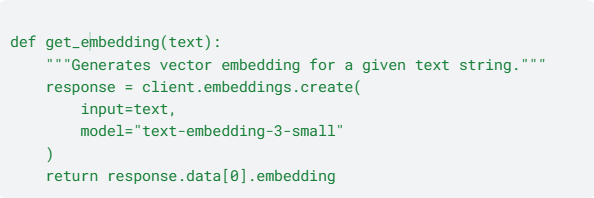
1. Graph Modeling
A well-defined schema is essential to connect unstructured “risk events” with structured “supply chain” entities.
2. Ingestion: Integrating Structure and Semantics
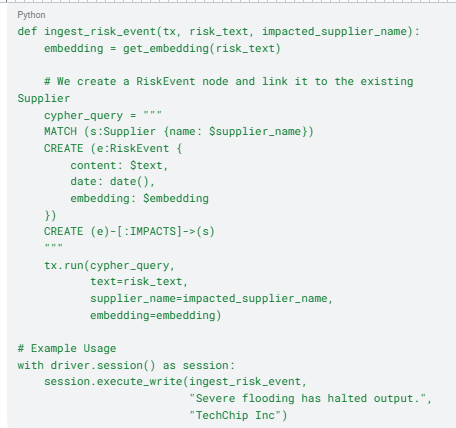
In this phase, we assume the foundational supply chain graph (suppliers connected to factories) is already established. We then ingest a new unstructured “risk event” and procedurally link it into the existing graph structure.
3. The Hybrid Retrieval Query in Action
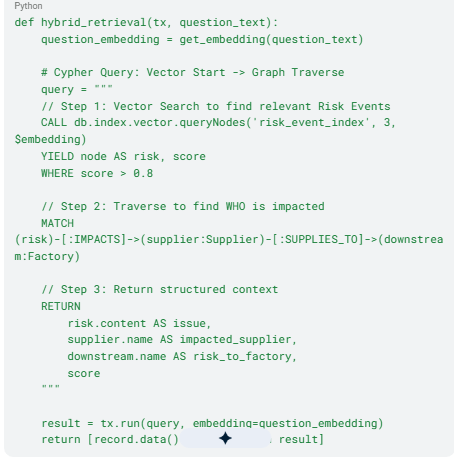
This is the pivotal component that distinguishes the Graph RAG approach. Instead of merely returning the top ‘k’ text chunks, we employ Cypher queries to execute a vector search, identify the relevant event, and subsequently traverse the graph to pinpoint the downstream impacts.
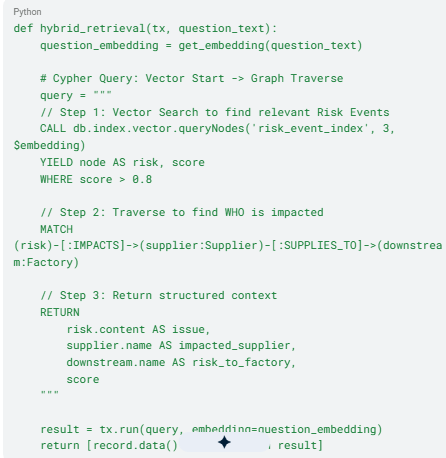
The system’s output is not merely a generic text chunk but a structured payload:
[{‘issue’: ‘Severe flooding…’, ‘impacted_supplier’: ‘TechChip Inc’, ‘risk_to_factory’: ‘Assembly Plant Alpha’}]
This structured information empowers the LLM to generate a precise and contextually relevant answer: “The flooding at TechChip Inc puts Assembly Plant Alpha at risk.”
Production Considerations: Latency and Data Consistency
Transitioning this architecture from a development environment to a production setting necessitates addressing critical trade-offs, particularly concerning latency and data consistency.
1. The Latency Overhead
Graph traversals inherently involve higher computational costs compared to straightforward vector lookups. During the development of product image experimentation systems at Meta, strict latency budgets were paramount, as even milliseconds could impact user experience. This architectural lesson is directly applicable to Graph RAG: computations cannot always be performed on-the-fly.
- Vector-Only RAG: Typically exhibits retrieval times in the range of 50-100 milliseconds.
- Graph-Enhanced RAG: May incur retrieval times between 200-500 milliseconds, depending on the depth of the graph traversal.
Mitigation Strategy: Semantic caching is employed to address this latency challenge. When a user submits a query that is semantically similar (cosine similarity score above 0.85) to a previously answered query, the cached graph result is served. This significantly reduces the “graph tax” for frequently asked questions.
2. The “Stale Edge” Problem
In vector databases, data points are typically independent. In contrast, a graph database signifies interdependence. If Supplier A ceases to supply Factory Y, but the corresponding edge persists in the graph, the RAG system might confidently return information based on a relationship that is no longer valid, leading to hallucinations.
Mitigation Strategy: Graph relationships must incorporate a Time-To-Live (TTL) mechanism or be synchronized through Change Data Capture (CDC) pipelines directly from the system of record, such as the ERP system.
An Infrastructure Decision Framework
When considering the adoption of Graph RAG, the following framework, utilized at Cognee, can guide the decision-making process:
- Opt for Vector-Only RAG if:
- The data corpus is largely unstructured and lacks significant interdependencies (e.g., a collection of internal wikis or Slack messages).
- User queries are generally broad and do not require deep relational context (e.g., “How do I reset my VPN?”).
- A hard requirement for retrieval latency under 200 milliseconds exists.
- Adopt Graph-Enhanced RAG if:
- The operational domain is highly regulated (e.g., finance, healthcare), demanding strict data integrity and auditability.
- “Explainability” is a critical requirement, necessitating the ability to trace the reasoning path (e.g., showing the traversal path used to derive an answer).
- Answers fundamentally depend on understanding multi-hop relationships (e.g., “Which indirect subsidiaries are impacted by this event?”).
Conclusion
Graph-enhanced RAG represents not a mere replacement for traditional vector search but a crucial evolution for tackling complex, interconnected data domains. By architecting your infrastructure as a knowledge graph, you equip LLMs with an indispensable element they cannot fabricate: the structural truth underpinning your business operations.
Daulet Amirkhanov is a software engineer at UseBead.
Welcome to the VentureBeat community!
Our guest posting program serves as a platform for technical experts to share valuable insights and deliver neutral, unbiased deep dives into AI, data infrastructure, cybersecurity, and other transformative technologies shaping the future of enterprise.
Explore more contributions from our guest post program—and review our guidelines if you are interested in submitting your own article!
Business Style Takeaway: For enterprises dealing with complex, interconnected data, moving beyond simple vector search to a graph-enhanced RAG approach is essential for accurate insights and mitigating AI-driven hallucinations. This hybrid model bridges semantic understanding with structural reality, proving critical for high-stakes industries like finance and supply chain management.
Learn more at : venturebeat.com