

For the past two years, a dominant narrative has fueled over-provisioned data centers and inflated IT budgets: the relentless demand for GPUs. High-performance graphics processing units were likened to a scarce commodity, with top-tier models trading at a premium, pushing enterprises to secure capacity immediately to avoid falling behind.
However, the financial repercussions of this surge are now becoming apparent, drawing the attention of Chief Financial Officers. While Gartner projects that AI infrastructure will command $401 billion in new spending this year, internal assessments reveal a less efficient reality: average GPU utilization within enterprises is frequently hovering around a mere 5%.
This low utilization rate is often a consequence of a self-perpetuating procurement cycle that makes it difficult to reallocate or decommission idle GPUs. The urgency of this situation is amplified by the capital expenditure realities now impacting enterprise balance sheets. Many organizations committed to GPU capacity under traditional three-to-five-year depreciation schedules, with hyperscalers often opting for the longer term. Consequently, infrastructure acquired during the peak of the “GPU scramble” has become a fixed cost, irrespective of its actual usage.
As these assets age, the critical question shifts from whether the initial investment was justified to whether it can be made productive. Underutilized GPUs are not merely dormant resources; they are depreciating assets that must now demonstrate tangible returns. This necessitates a fundamental shift in strategic thinking, moving from simply acquiring capacity to optimizing the economic output of existing deployed infrastructure.
The GPU Scramble: A Distraction from Deeper Inefficiencies
For leading enterprises—companies like Intuit, Mastercard, and Pfizer—access to GPUs was seldom the primary impediment. Leveraging their substantial relationships with cloud giants such as AWS, Azure, and GCP, these organizations secured capacity reservations that often remained underutilized while internal teams grappled with challenges related to data gravity, governance, and architectural immaturity.
The prevailing narrative of “scarcity” served as a convenient cover for these underlying inefficiencies. While industry headlines focused on supply chain constraints, the internal operational reality was characterized by a significant productivity gap. Organizations were rich in procurement activities (buying chips) but poor in generating valuable output (producing meaningful AI insights).
At a utilization rate of 5%, the economics are fundamentally unsound. For every dollar invested in silicon, 95 cents effectively contributes to a cloud provider’s revenue without yielding a proportional return. In virtually any other business function, a 95% waste metric would trigger immediate corrective action; within AI infrastructure, it was often rationalized as “preparation for future needs.”
Q1 Tracker Signals a Market Pivot
VentureBeat’s Q1 2026 AI Infrastructure & Compute Market Tracker indicates that the period of unbridled urgency has officially subsided. While the tracker provides directional insights rather than definitive statistical measures—with 53 qualified respondents in January and 39 in February—the trend observed across both survey waves is consistent. When IT decision-makers were asked about their current provider selection criteria, the results reveal a market undergoing rapid strategic reorientation:
-
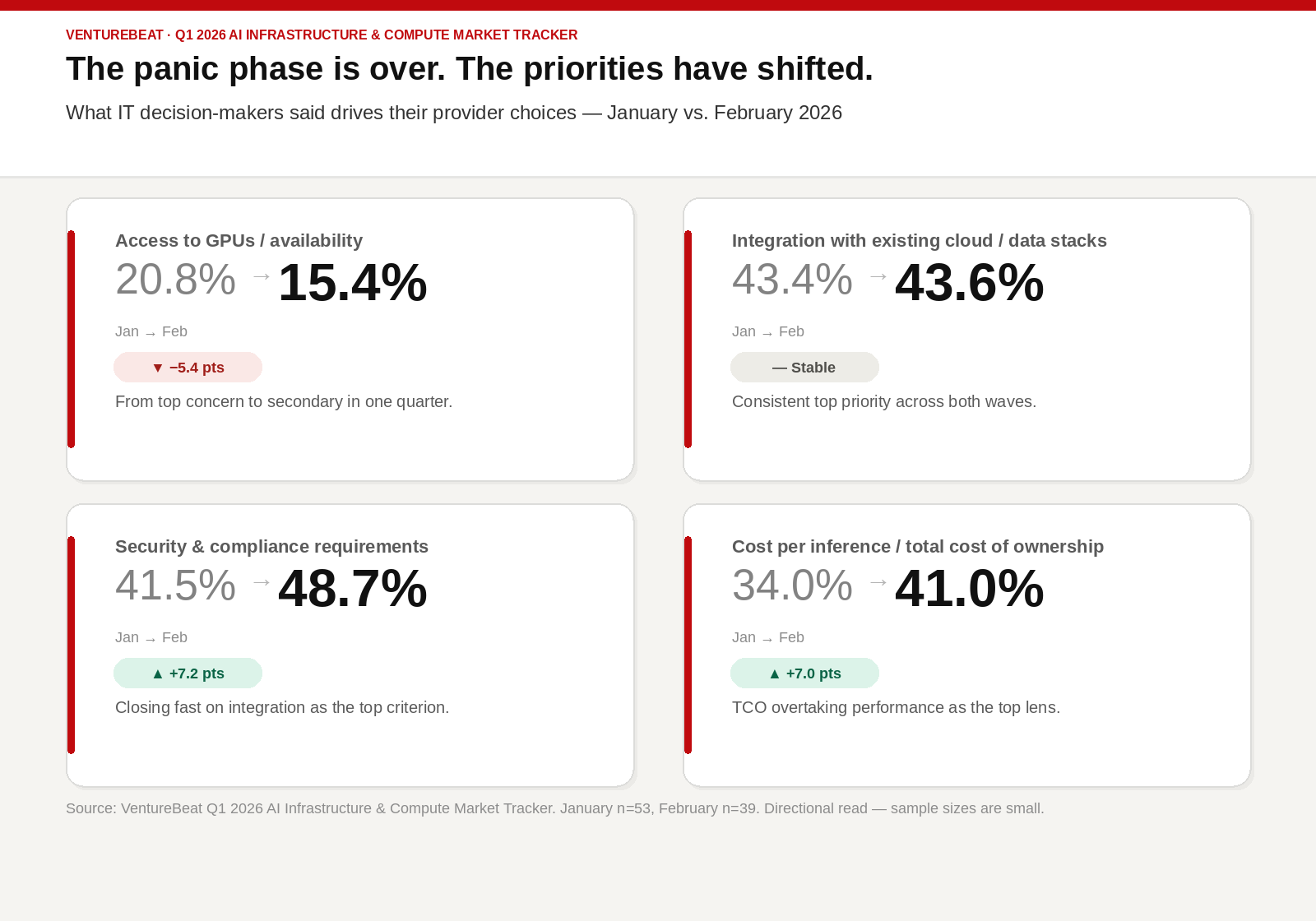
Declining Access Concerns: The emphasis on “Access to GPUs/availability” as a primary driver dropped from 20.8% to 15.4% within a single quarter, transitioning from a top concern to a secondary one in just 90 days.
-
Pragmatic Prioritization: “Integration with existing cloud and data stacks” remained the leading priority, holding steady at approximately 43% across both survey periods. Concurrently, security and compliance requirements saw a significant increase, rising from 41.5% to 48.7%, nearly matching integration as a key consideration.
-
Total Cost of Ownership (TCO) Imperative: “Cost per inference/TCO” emerged as a dominant factor, jumping from 34% to 41% in a single quarter, surpassing performance as the leading procurement lens.
The era of unchecked spending is over. Inference—the process of deploying AI models to generate predictions or insights—is where AI truly becomes a measurable financial line item.
While model training and even fine-tuning were often treated as tactical projects, inference represents a strategic business model. For a majority of enterprises, the unit economics of this model are currently unsustainable. During initial pilot phases, flat-fee licenses and bundled token packages masked architectural inefficiencies. Teams developed complex retrieval pipelines and long-context agents because the cost of tokens was effectively amortized.
As the industry transitions towards usage-based pricing in 2026, these same architectures are becoming liabilities. When metered billing is applied to infrastructure that sits idle 95% of the time, the cost per useful token can escalate into a critical budgetary emergency once a project moves into production.
Transitioning from Activity to Productivity
The strategic shift indicated by our Q1 data signifies more than a budgetary recalibration; it represents a fundamental alteration in how the success of AI initiatives is evaluated. For the past two years, success was primarily defined by “securing” the necessary infrastructure. In the current efficiency-focused era, success is measured by the ability to “optimize” that infrastructure.
This is why cost optimization platforms experienced the most substantial planned budget increases in our survey, becoming a top-tier priority as organizations recognize that simply acquiring more GPUs is often not the optimal solution.
Increasingly, IT professionals are seeking methods to reduce expenditure on unused GPU resources. The focus is moving away from measuring GPU activity—the mere state of GPUs being powered on—towards measuring GPU productivity: the quantity of valuable output generated per dollar invested.
The luxury of underutilization has become a liability. The next phase of enterprise AI adoption hinges on maximizing the economic value of existing silicon investments.
Owning the Token Generation: Producer vs. Consumer
As organizations progress from proof-of-concept stages to full production, the emphasis is shifting from the latest GPU hardware to the underlying architecture of token generation. In this evolving economic landscape, every enterprise must define its role within the token economy. The crucial decision is whether to remain a token consumer, incurring ongoing costs to model providers, or to become a token producer, owning the necessary infrastructure and its associated unit economics.
This choice extends beyond mere cost considerations; it involves how an organization manages complexity. Establishing in-house inference infrastructure demands addressing challenges such as KV cache persistence, understanding storage architectures, defining acceptable latency guarantees, and managing power constraints. It also introduces practical enterprise limitations, including power availability, data center footprint, and operational complexity, all of which directly impact the scalability and speed of AI deployment.
At the heart of this challenge lies KV cache economics. Storing context within GPU memory delivers superior performance but comes at a significant cost, limiting concurrency and inflating the cost per token. Offloading the KV cache to shared NVMe-based storage can enhance reuse and reduce prefill overhead, but it introduces trade-offs in latency and system design complexity. As NVMe costs fluctuate and GPU memory remains a constrained resource, organizations are compelled to balance performance against efficiency.
For organizations aiming to be token producers, managing these intricate trade-offs across memory, storage, power, and operations is an inherent aspect of scaling effectively. For others, the operational overhead remains prohibitive, necessitating an alternative strategic path.
The Strategic Shift to Specialized Cloud Providers
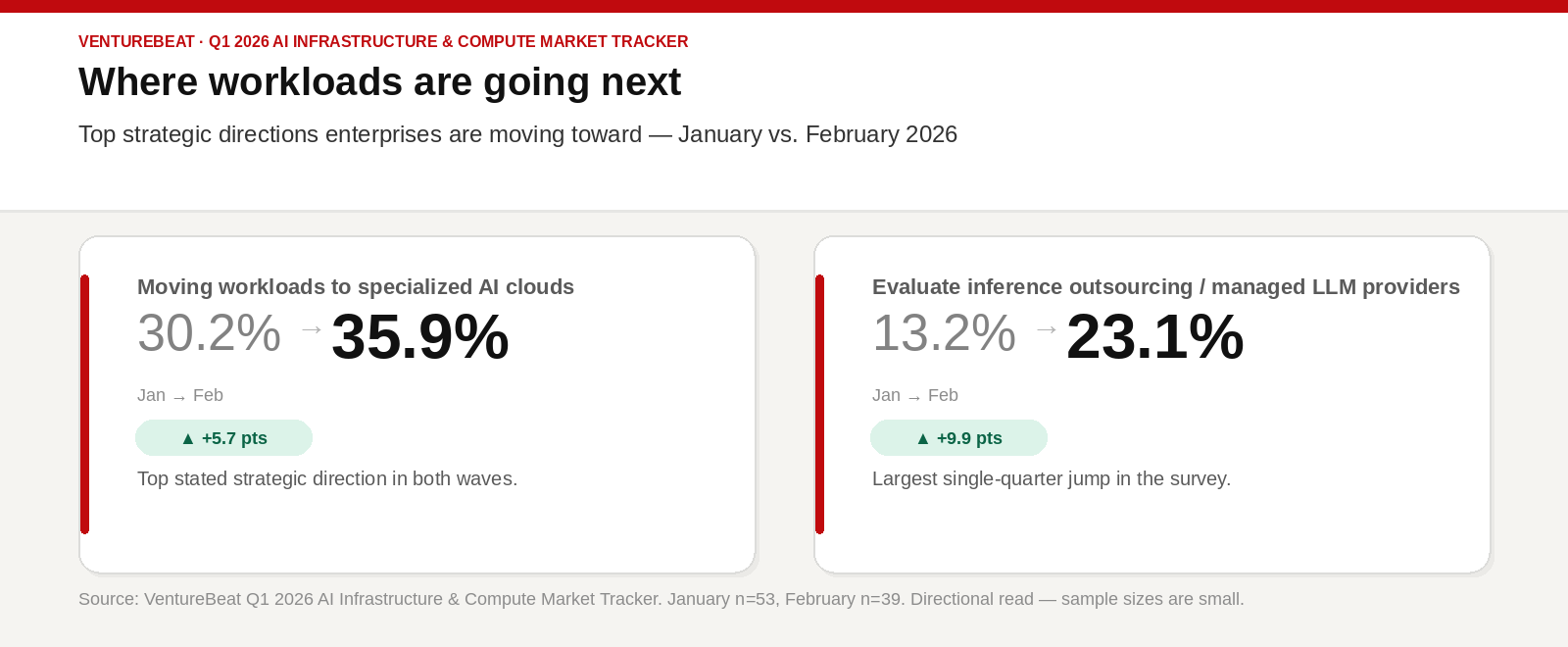
Data from VentureBeat’s Q1 tracker suggests that the market is actively responding to these strategic considerations. A prominent trend identified is the increased migration of workloads to specialized AI clouds, a category that grew from 30.2% to 35.9% in our latest survey. These providers, including entities like Coreweave, Lambda, and Crusoe, are evolving their service offerings. While initially gaining traction by serving model builders and supporting training-intensive workloads, their revenue mix is rapidly diversifying. Currently, training constitutes approximately 70% of their business volume, with inference customers accounting for the remaining 30%. Projections indicate this ratio could invert by the end of 2026 as enterprise inference use cases scale significantly.
These specialized providers are attracting strategic interest not merely by offering GPU access, but by alleviating infrastructure-related friction. They optimize the entire technology stack—encompassing storage, networking, and scheduling—specifically for inference-centric operations, rather than general-purpose cloud computing. For organizations aspiring to become token producers, these environments offer a more streamlined and efficient operational framework compared to traditional hyperscale platforms.
More VB Pulse surveys
→ The AI governance mirage: Why 72% of enterprises don’t have the control and security they think they do → The enforcement gap: 88% of enterprises reported AI agent security incidents last year → The retrieval rebuild: Why hybrid retrieval intent tripled as enterprise RAG programs hit the scale wall
The Emergence of Managed Inference Services
For enterprises that recognize the difficulty of building or managing their own inference infrastructure efficiently, an alternative trend is gaining traction. Our survey data reveals a notable increase in the intention to evaluate inference outsourcing and managed large language model (LLM) providers, rising from 13.2% to 23.1% within a single quarter. This nearly 10-percentage-point surge reflects a growing awareness that managing inference internally often incurs substantial hidden costs. Providers such as Baseten, Anyscale, FireworksAI, and Together AI are offering predictable pricing models and service-level agreements, thereby eliminating the need for customers to become experts in highly specialized areas like vLLM tuning or distributed GPU scheduling.
Under this model, enterprises continue to operate as token consumers, but with a strategic focus on outsourcing the complexities of the underlying infrastructure stack. They are increasingly realizing that managing inference operations internally is only economically viable if the required volume justifies the significant operational burden.
Simplifying the Hybrid AI Stack
The decision to operate as a token producer is also being facilitated by a new generation of hybrid-cloud AI platforms. Solutions from companies like Red Hat, Nutanix, and Broadcom are designed to streamline the operationalization of open-source inference infrastructure, reducing the need for every organization to function as a full-scale systems integrator. The inherent challenge lies in the complexity of modern inference, which relies on intricate open-source components such as vLLM for high-throughput serving, Triton for model orchestration, and Kubernetes for container management. While individually powerful, integrating and optimizing these systems for large-scale, reliable deployment presents significant operational hurdles. The key advantage offered by these emerging platforms is portability: the ability to develop an inference stack once and deploy it consistently across diverse environments, including hyperscale clouds, specialized AI clouds, and on-premises data centers.
Our Q1 2026 AI Infrastructure & Compute Market Tracker confirms a growing interest in these “do-it-yourself but managed” stack solutions, which increased from 11.3% in January to 17.9% in February. This trend is paralleled by a steady rise in organizations embracing open-source technologies. This flexibility is crucial, as enterprise AI is unlikely to be confined to a single, centralized location. Inference workloads will naturally be distributed based on data locality, sensitivity requirements, and the cost-effectiveness of execution.
In the next evolution of the token economy, success will not be determined by platforms that enforce standardization through restriction. Instead, the winners will be those that enable standardization through portability, empowering enterprises to seamlessly transition between being token consumers and producers as their strategic needs evolve.
Optimizing for Efficiency: Technical Levers for Enhanced Productivity
Addressing the pervasive issue of low GPU utilization (the “5% utilization wall”) requires more than incremental software improvements; it necessitates a foundational re-engineering of the efficiency stack. Many organizations are discovering that high computational activity does not automatically translate to high productivity. A cluster might operate at peak capacity, yet remain economically inefficient if the time-to-first-token is excessively long or if inference requests experience significant delays during the prefill stage.
Inference economics are fundamentally determined by the volume of useful output a computational cluster generates relative to its cost. This paradigm shift mandates a move from measuring GPU activity—simply confirming that GPUs are powered on—to measuring actual GPU productivity. Achieving this enhanced productivity hinges on optimizing three critical technical components: the network, the memory subsystem, and the storage architecture.
Networking: Mitigating the “Cost of Waiting”
The network infrastructure serves as the often-overlooked backbone of efficient inference operations. In distributed computing environments, the speed at which data traverses between compute nodes and storage directly dictates whether a GPU is actively processing tasks or is idly waiting for data. The adoption of RDMA (Remote Direct Memory Access) has become an indispensable standard for optimizing data flow. By enabling data to bypass the CPU and move directly between memory and the GPU, RDMA effectively eliminates the latency spikes inherent in traditional network architectures. In practical applications, an RDMA-enabled architecture can amplify the output per GPU by a factor of ten, particularly for concurrent workloads.
Without this advanced networking capability, enterprises effectively incur a “waiting tax” on every GPU within their infrastructure. As model context windows expand and multi-node orchestration becomes increasingly prevalent, the network’s performance becomes the decisive factor determining whether a cluster functions as a high-speed production facility or a bottlenecked logistical hub.
Addressing the Memory Tax: The Role of Shared KV Cache
With the increasing size of AI models and the expansion of context windows into the millions of tokens, the recurring cost of reconstructing prompt states has become economically untenable. Large language models rely on key-value (KV) caches to maintain conversational context during interactions. Historically, these caches have been stored in local GPU memory, a solution that is both prohibitively expensive and inherently limited in capacity. This creates a significant “memory tax” that severely impacts unit economics as concurrency levels rise.
To overcome this challenge, the industry is migrating towards persistent, shared KV cache architectures. By centralizing cache storage on high-performance storage systems rather than redundantly replicating it across multiple GPU nodes, organizations can substantially reduce prefill overhead and enhance context reuse. Emerging architectures are demonstrating this potential effectively. For instance, the VAST Data AI Operating System, operating on VAST C-nodes equipped with Nvidia BlueField-4 DPUs, enables pod-scale shared KV cache functionality, effectively consolidating legacy storage tiers. Similarly, the HPE Alletra Storage MP X10000, the first object-based platform to receive Nvidia-Certified Storage validation, is specifically engineered to supply data to inference resources without the coordination overhead that typically leads to bottlenecks at scale. WEKA is another notable provider in this evolving domain.
The Compression Advantage
Beyond the physical hardware, advancements in algorithmic techniques are redefining the possibilities for inference memory optimization. Google’s recent presentation of TurboQuant at ICLR 2026 exemplifies the scale of this transformation. TurboQuant offers up to a 6x compression level for the KV cache with no discernible loss in accuracy. Such techniques enable the construction of extensive vector indices with minimal memory footprints and virtually zero preprocessing time. For enterprises, this translates to supporting a greater number of concurrent users on the same hardware infrastructure without experiencing the disruptive “rebuild storms” that typically cause latency spikes. A key consideration, however, is the ongoing contention surrounding compression standards, as an open-source consensus has yet to emerge, positioning this space as a proprietary battleground between major players like Google and Nvidia.
Storage as a Strategic Financial Decision
Storage is no longer a peripheral IT consideration; it has become a critical financial decision point. Platforms such as Dell PowerScale are now achieving up to a 19x improvement in time-to-first-token compared to conventional approaches, according to Dell’s own performance metrics. By decoupling high-performance shared storage and memory-intensive data access from scarce GPU resources, these platforms facilitate more efficient scaling of inference operations. When a storage layer can consistently supply data to GPU-intensive workloads without interruption, it prevents valuable, expensive resources from remaining idle. In the current efficiency-driven era, the primary objective is to elevate the utilization rate beyond the 5% threshold by ensuring that every available computational cycle is dedicated to token generation, rather than being consumed by data movement.
However, as the technical stack becomes more efficient, the security perimeter can become more vulnerable. High-productivity tokens hold little value if the underlying data cannot be reliably trusted.
Sovereignty and the Agentic Future: Establishing a Foundation of Trust
The final significant obstacle to realizing a substantial return on AI investments is not a technical bottleneck, but rather a challenge rooted in trust. As enterprise AI evolves from rudimentary chatbots to sophisticated autonomous agents, the associated risk profile undergoes a fundamental transformation. Agents require deep access to internal systems and proprietary intellectual property to be truly effective. Without a robust sovereign architecture, this access introduces liabilities that most organizations are ill-equipped to manage effectively.
VentureBeat’s research into the state of AI governance reveals a stark discrepancy: while many organizations believe their AI environments are adequately secured, a significant 72% of enterprises concede that they lack the level of control and security they perceive they possess. This pervasive “governance mirage” is particularly perilous as agentic systems move toward production deployment. Over the past 12 months, a concerning 88% of executives reported experiencing security incidents directly related to AI agents.
Sovereignty as a Core Architectural Principle
Data sovereignty is frequently treated as a compliance requirement, either geographical or regulatory. However, for strategic enterprises, it must be embraced as a fundamental architectural principle. This approach emphasizes maintaining control, ensuring data lineage, and upholding explainability over the data that powers agentic workflows. It necessitates a novel approach to data maturity, drawing inspiration from the established medallion architecture. Within this framework, data progresses through distinct layers of usability and trustworthiness—from initial raw ingestion at the bronze level, through refinement to the gold standard, and ultimately to platinum-quality operational data. AI inference processes must adhere to this same rigorous discipline.
Agentic systems require not only accessible context but critically, trusted context. Providing inaccurate data to an agent or exposing sensitive intellectual property to a non-sovereign endpoint introduces both business and regulatory risks. Therefore, compartmentalization must be an integral design consideration from the outset of the system architecture. Organizations must possess clear visibility into which models and agents have access to specific data layers, under what precise conditions, and with comprehensive lineage tracking.
Bringing AI Capabilities to the Data’s Location
The fundamental strategic question for the future of agentic AI is whether to centralize data for AI processing or to deploy AI capabilities closer to the data’s source. For highly sensitive workloads, migrating data to a centralized model endpoint is often the suboptimal approach. The growing trend towards private AI—where inference processing occurs proximate to the location of trusted data—is gaining significant momentum. This architectural model leverages sovereign clouds, private environments, or rigorously governed enterprise platforms to maintain the integrity of the data perimeter.
This is where the decision to become a token producer confers a distinct security advantage. By retaining ownership of the inference stack, an enterprise can enforce governance and lineage controls directly at the infrastructure layer. This ensures that the intellectual property used to ground an agent’s operations never leaves the organization’s direct control.
The Next Frontier: Platform Competition
The ultimate determinant of AI leadership will not be predicated on the sheer size of GPU clusters. Victory will belong to organizations that achieve superior inference economics and establish the most robust, trusted data foundations. Enterprises that excel during this efficiency era will be those capable of delivering the lowest cost per useful token and the most accelerated path to production deployment. They will be the entities that have successfully moved beyond the “hoarding” mentality to focus intently on generating tangible, productive output.
Achieving a demonstrable return on AI investment necessitates a profound shift in organizational mindset. It entails transitioning from a culture focused on securing the infrastructure stack to one centered on optimizing its performance and efficiency. This requires architectural discipline, a keen focus on token-level return on investment, and an unwavering commitment to data sovereignty. When an organization can generate its own AI-driven insights efficiently and securely, AI transcends its status as a research project to become a reproducible, economically viable business advantage.
This is the pathway to realizing tangible ROI and the foundation upon which the next generation of enterprise competitive advantage will be built.
Rob Strechay is a Contributing VentureBeat Analyst and Principal at Smuget Consulting, a firm specializing in research and advisory services for data infrastructure and AI systems.
Disclosure: Smuget Consulting provides or has provided research, consulting, and advisory services to numerous technology companies, potentially including those mentioned in this article. The analyses and opinions expressed herein are solely those of the individual analyst and do not necessarily reflect the views of VentureBeat as a whole.
Business Style Takeaway: Enterprises are shifting from a focus on acquiring AI compute capacity to optimizing the utilization and cost-effectiveness of existing GPU infrastructure, driven by declining GPU availability concerns and rising TCO pressures. This necessitates a strategic re-evaluation of inference architectures, favoring efficiency, specialized cloud solutions, or managed services to drive tangible ROI from AI investments.
Source: : venturebeat.com