

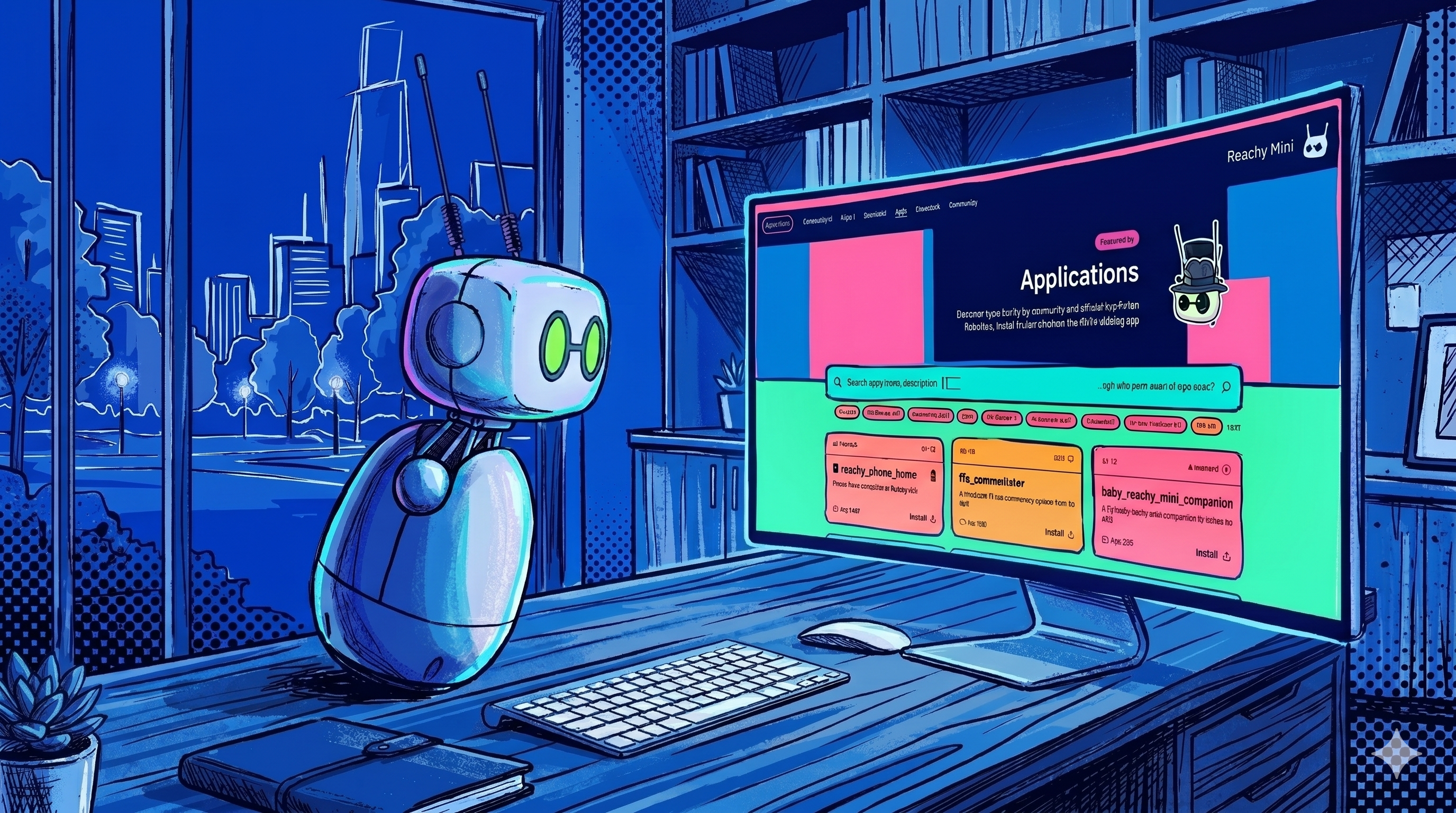
While the proliferation of mobile applications has made software accessible for virtually every conceivable task, these innovations have largely remained tethered to the smartphone ecosystem. This paradigm is now set to shift with the introduction of Hugging Face’s new App Store, specifically designed for its Reachy Mini robot.
Hugging Face, a decade-old New York-based startup renowned for its extensive platform of open-source AI models, agents, and applications, unveiled the Reachy Mini robot in July 2025. This accessible, low-cost physical robot, priced at $299, emerged from Hugging Face’s strategic acquisition of Pollen Robotics. The new App Store extends the utility of the Reachy Mini by providing a dedicated marketplace for its users.
The Reachy Mini App Store debuts with over 200 community-developed applications, all available to Reachy Mini owners at no initial cost. While currently there’s no revenue-sharing model for creators, this mirrors the early days of other software marketplaces. Owners of the approximately 10,000 Reachy Mini units sold since its launch can leverage these applications, alongside Hugging Face’s AI-powered agent, “ML Intern,” to easily create custom software for their compact desktop robots, which feature integrated cameras, speakers, and microphones.
The significance of this initiative extends beyond hardware innovation; it actively dismantles the traditional barriers to entry in robotics. For the first time, individuals without specialized engineering or coding backgrounds can deploy functional robotics software in under an hour.
“Anyone can build the apps,” stated Clément Delangue, CEO and co-founder of Hugging Face, during a recent interview. “My intuition is that more and more [AI] model builders will release on Reachy Mini as a way to test the robotics ability of new models.”
Democratizing Robotics: Making Robots as Accessible as PCs and Smartphones
Historically, the development of sophisticated robotics has been hindered by a scarcity of high-quality, specialized training data. While Large Language Models (LLMs) have achieved broad coding proficiency by analyzing vast datasets like Microsoft’s GitHub repositories, the volume of code specifically tailored for robotics remains comparatively small. Despite GitHub hosting what is likely the largest publicly available collection of robotics code, with over 17,000 dedicated repositories, AI agents have struggled to grasp the complex physical abstractions and firmware intricacies inherent in hardware interaction.
Hugging Face addresses this challenge with an agentic toolkit that acts as a crucial intermediary. This system liberates users from the necessity of mastering specific robotics Software Development Kits (SDKs) or the nuances of a robot’s firmware. Instead, users can articulate desired behaviors in natural language—such as “wave when someone says good morning”—and the AI agent undertakes the complex tasks of code generation, validation against the robot’s specific constraints, and final package deployment.
“Historically, it’s been extremely hard,” Delangue remarked regarding the development of robotics applications. “But we’ve worked really hard on the topic with a mix of open sourcing everything we do, working on the right abstractions for robotics, and making it easier for agents to understand and use it.”
The platform’s model-agnostic design ensures compatibility with a wide array of leading artificial intelligence engines. Users can develop applications using Hugging Face’s proprietary ML Intern agent or integrate external models, including advanced systems like GPT-5.5, Claude Opus 4.6, Kimmy 2.6, Mini Max GM5, and Deep Sig V4 Pro. For real-time interaction, official conversational applications leverage OpenAI Realtime and Gemini Live. By abstracting these complex processes, Hugging Face significantly reduces the traditional weeks-long integration timelines in robotics development down to mere minutes.
The Affordable Reachy Mini Robot Proves Popular
To fully utilize the new Hugging Face Reachy Mini App Store, users are encouraged to acquire the Reachy Mini robot. Launched in July 2025, this compact desktop robot offers an open-source, affordable alternative to high-end commercial robots from companies like Boston Dynamics, whose Spot robot dog commands a price tag of approximately $70,000, and even Chinese competitors starting above $1,900. The Reachy Mini’s accessible pricing makes it a viable option for hobbyists and developers.
The Reachy Mini is available in two configurations:
-
Reachy Mini Lite ($299 plus shipping): This tethered variant connects via USB and relies on an external computer for processing power.
-
Reachy Mini Wireless ($449 plus shipping): This standalone model integrates a Raspberry Pi CM 4 and offers Wi-Fi connectivity.
Delangue reported that out of the 10,000 Reachy Mini units sold to date, 3,000 were purchased in the last two weeks alone, with Hugging Face anticipating the shipment of an additional 1,000 units in the coming month.
Even individuals who do not yet own a Reachy Mini can engage in application development through the Reachy Mini App Store and the Reachy App, which provides a 3D simulation environment for the robot and its interactions. The App Store is hosted on the Hugging Face Hub, functioning as a repository for hardware behaviors akin to software libraries:
-
Search and Install: Users can easily locate applications, initiate downloads with a single click, and install them directly onto their robot.
-
Forkability: Each application is designed to be “forkable,” allowing users to duplicate an existing app and then task an AI agent with modifying it, for instance, to enable responses in a different language.
-
Simulation Mode: A key feature of the store is its browser-based simulator. This enables users without a physical Reachy Mini to develop, test, and experiment with the application catalog in a virtual setting.
These offerings are integral to Hugging Face’s ongoing “Le Robot” initiative, a project initiated in 2024. Researchers specializing in robotics and AI at Hugging Face have been developing and publicly sharing open-source code, tutorials, and hardware designs to enhance the accessibility of robotics development for a broader audience. Unlike platforms like GitHub, which cater primarily to developers, the Hugging Face Reachy Mini App Store is intentionally designed for robot owners and users who may possess minimal or no prior technical experience.
Maintaining an Open-Source Ethos and Practice
Hugging Face’s strategic approach is grounded in the conviction that closed-source hardware and software models present significant limitations to scalable development. Delangue emphasizes that proprietary systems impede agent training and stifle community-driven innovation. Consequently, the entire Reachy Mini platform operates under an open-source framework.
This open licensing model yields two primary benefits for the ecosystem:
-
Accelerated Development: With publicly accessible code integrated into the Hugging Face ecosystem through “Spaces”—a feature for hosting AI-powered web applications launched in 2021—AI agents can more readily learn and execute interactions with the hardware.
-
Community Sovereignty: Applications are not confined within proprietary boundaries. While all current applications on the store are free, the platform’s foundation on “Spaces” offers the potential for creators to monetize their work in the future.
“For the moment, all the apps are free,” Delangue stated. “It’s flexible, it’s built on [Hugging Face] Spaces, so at some point maybe people are going to make them paid.”
The Dawn of an Accessible Era for Hobbyist Robotics
The launch of the Reachy Mini App Store is accompanied by an impressive library of 200 applications, developed by over 150 distinct creators. Remarkably, many of these contributors had no prior experience in robotics coding before engaging with this platform.
Their ability to create these applications is attributed to Hugging Face’s ML Intern and the foundational resources available on GitHub. The new App Store centralizes these tools and pre-existing applications, significantly enhancing accessibility.
Delangue specifically highlighted the contributions of Joel Cohen, a 78-year-old retired marketing executive, as an exemplary case. Despite challenges such as color blindness and a lack of technical background, Cohen successfully assembled his Reachy Mini Lite over two weeks (a process typically taking three hours). Leveraging an AI agent, he developed a sophisticated “VP of Future Thinking” facilitator for his Zoom-based CEO peer groups. This application enables the robot to:
-
Recognize and greet 29 members by name.
-
Perform real-time fact-checking during discussions.
-
Summarize key themes and encourage deeper analysis by questioning superficial responses.
“I built this by describing what I needed in plain English,” Cohen shared in a press release. “No SDK. No robotics background. No developer experience.”
Additional community-developed applications include:
-
Emotional Damage Chess: A chess-playing robot designed to taunt users about their mistakes.
-
Reachy Phone Home: An anti-procrastination tool that prompts users to return to work when they pick up their phone.
-
Language Tutor: A robotic companion that provides speech recognition and accent correction.
-
F1 Race Commentator: A desktop assistant that provides live commentary for Formula 1 races.
Delangue himself shared his experience creating a receptionist application for the Reachy Mini at the Hugging Face Miami office. Within a few hours, he developed a system that uses facial recognition to detect arrivals, identify individuals, and initiate onboarding by welcoming them and notifying Delangue with the visitor’s details. “It works a little bit as my welcoming booth at the office, and it took me less than two hours to build that,” he explained.
Even for an experienced entrepreneur like Delangue, developing robot applications was previously unfeasible without the synergy of the Reachy Mini and ML Intern. “For me, it would have been impossible,” he admitted. “If you weren’t a robotics developer, it probably would have been impossible, or it would have taken a few months.”
The Path to Democratizing Robotics
The introduction of the agentic App Store signifies a profound transformation in human-machine interaction. For decades, the field of robotics has been constrained by the requirement for highly specialized technical expertise. By integrating affordable, open-source hardware with the advanced reasoning capabilities of modern AI agents, Hugging Face is pioneering a future where hardware becomes a ubiquitous commodity, and the potential behaviors of robots are limited only by human imagination and descriptive ability.
As Delangue articulated during the launch, the platform aims to empower individuals who “want to get into robotics but don’t have the hardware or the skills.” With nearly 10,000 robots now deployed and a rapidly expanding marketplace of AI-generated applications, the Reachy Mini has firmly established itself as the most widely adopted open-source desktop robot in history. The focus has now shifted from the technical challenges of robot construction to exploring the diverse applications that users will envision and implement.
Business Style Takeaway: Hugging Face’s Reachy Mini App Store represents a pivotal move towards democratizing physical robotics, mirroring the accessibility revolution seen in software. This opens new avenues for product development, R&D, and user engagement by lowering the technical barrier to entry for creating robotic functionalities, potentially fostering widespread adoption and innovation across industries.
Learn more at : venturebeat.com