


Miami-based startup Subquadratic has emerged from stealth, announcing on Tuesday that it has developed the first large language model (LLM) to overcome a fundamental mathematical constraint that has limited AI systems since 2017.
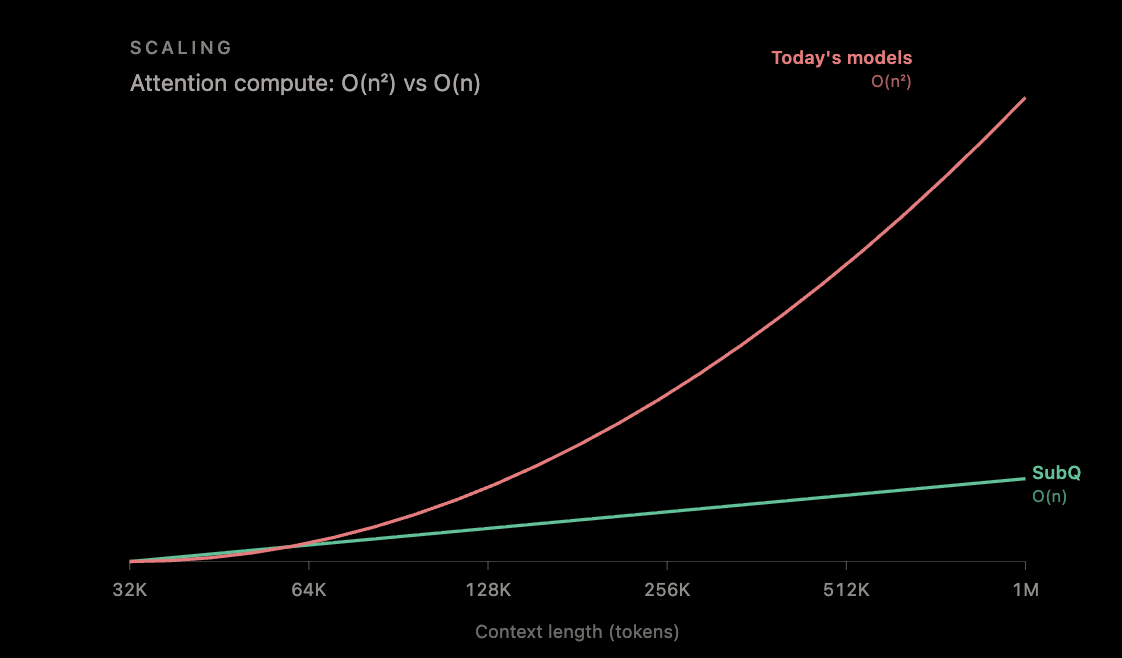
The company claims its initial model, SubQ 1M-Preview, operates on a fully subquadratic architecture. This design reportedly allows computational cost to scale linearly with context length, a significant departure from current models. If validated, this breakthrough would represent a paradigm shift in how AI systems are scaled. Subquadratic asserts that its architecture achieves nearly a 1,000-fold reduction in attention compute at 12 million tokens compared to other leading AI models, a claim that, if independently verified, would far surpass the efficiency gains of existing methodologies.
Alongside this announcement, Subquadratic is launching three products into private beta: an API offering access to its full context window, a command-line coding agent named SubQ Code, and a search tool called SubQ Search. The company has secured $29 million in seed funding from notable investors, including Tinder co-founder Justin Mateen, former SoftBank Vision Fund partner Javier Villamizar, and early backers of Anthropic, OpenAI, Stripe, and Brex. The New Stack reported this funding round values Subquadratic at $500 million.
The performance metrics published by Subquadratic are exceptionally high, eliciting a mixed reaction from the AI research community, ranging from keen interest to outright skepticism regarding the claims’ veracity.
The Quadratic Scaling Problem: An Industry-Defining Bottleneck
Virtually all contemporary transformer-based AI models, including those from industry leaders like OpenAI, Anthropic, and Google, employ an “attention” mechanism. This mechanism requires every input token to be compared against every other token. Consequently, as the input size increases, the computational resources needed to process these comparisons grow quadratically. In simpler terms, doubling the input length quadruples the processing cost, rather than simply doubling it.
This inherent scaling limitation has dictated the trajectory of AI development. Current industry standards for AI models typically range up to 128,000 tokens, with some advanced cloud models, such as Claude Sonnet 4.7 and Gemini 3.1 Pro, reaching 1 million tokens. However, even at these capacities, the expense associated with processing extended inputs becomes substantial.
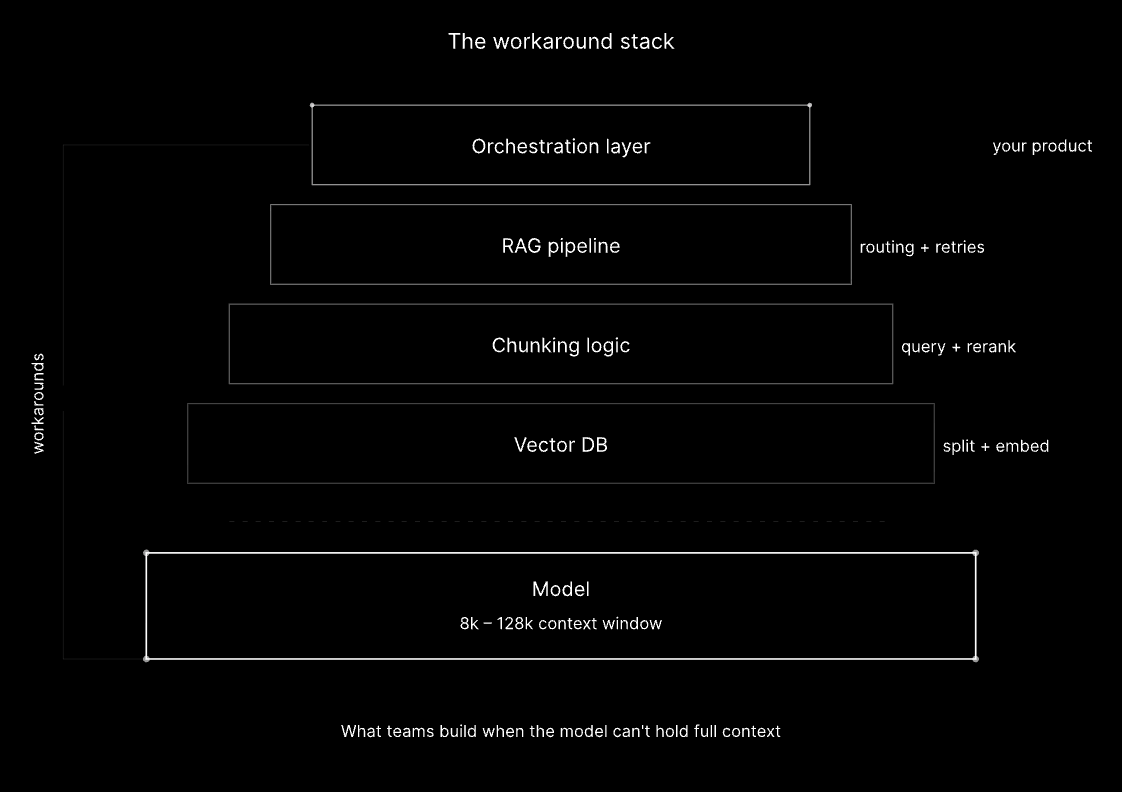
To mitigate this, the industry has developed a complex ecosystem of workarounds. Retrieval-Augmented Generation (RAG) systems, for instance, utilize search engines to retrieve a limited set of relevant information before feeding it to the model, as processing an entire corpus is often infeasible. Developers also layer retrieval pipelines, data chunking strategies, sophisticated prompt engineering, and multi-agent orchestration systems to circumvent the core challenge: a model’s inability to efficiently process vast amounts of data simultaneously.
Subquadratic argues that these mitigation strategies are costly, fragile, and ultimately restrictive. CTO Alexander Whedon articulated this view, stating in an interview, “I used to manually curate prompts and retrieval systems and evals and conditional logic to chain together the workflows. And I think that that is kind of a waste of human intelligence and also limiting to the product quality.”
Subquadratic’s Innovative Solution: Optimizing Attention Computation
Subquadratic’s core innovation, termed Subquadratic Sparse Attention (SSA), is founded on the principle that many token-to-token comparisons within standard attention mechanisms are computationally redundant. Instead of comparing every token with every other token, SSA intelligently identifies the most relevant comparisons and performs attention calculations only on those specific interactions. Crucially, this selection process is dynamic and content-dependent; the model determines where to focus based on semantic meaning rather than fixed positional patterns. This allows for the efficient retrieval of specific information from any point within a lengthy context without incurring the quadratic computational penalty.
The benefits of this approach are most pronounced as context length increases. According to the company’s technical blog, SSA demonstrates a 7.2x speedup in prefill operations compared to dense attention at 128,000 tokens, escalating to a 52.2x speedup at 1 million tokens. Whedon explained, “If you double the input size with quadratic scaling laws, you need four times the compute; with linear scaling laws, you need just twice.” The company further elaborated that its model was trained in three distinct stages: pretraining, supervised fine-tuning, and a reinforcement learning phase specifically designed to address failures in long-context retrieval. This training regimen guides the model to prioritize distant context over nearby information, a subtle but performance-degrading tendency in existing systems.
Promising Benchmarks, With Caveats
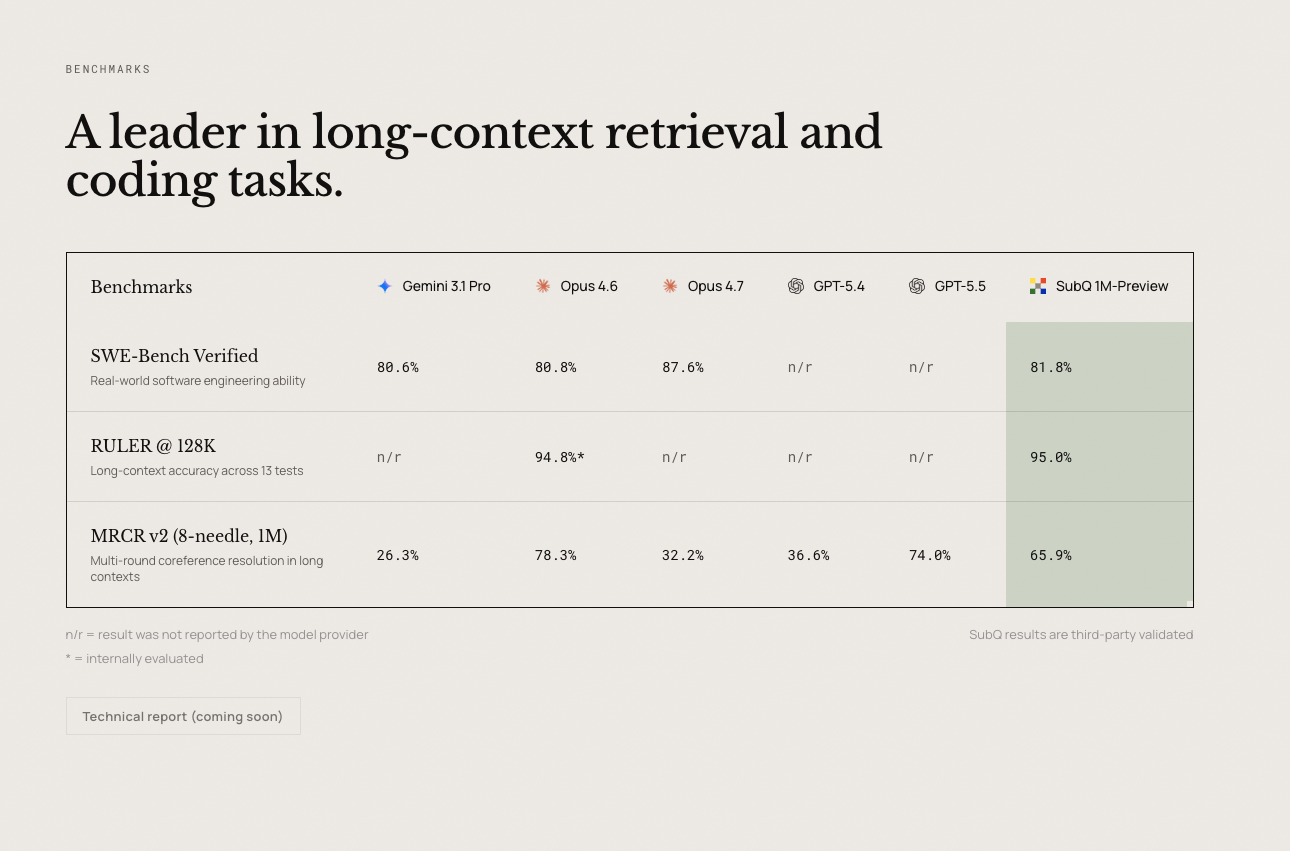
On the surface, SubQ’s benchmark results appear competitive with, or superior to, models developed by organizations with significantly larger R&D budgets. On the SWE-Bench Verified leaderboard, SubQ achieved an 81.8% score, surpassing Opus 4.6 (80.8%) and DeepSeek 4.0 Pro (80.0%). In the RULER benchmark at 128,000 tokens, a standard test for reasoning over extended inputs, SubQ scored 95%, narrowly outperforming Claude Opus 4.6 (94.8%). Furthermore, on MRCR v2, a challenging benchmark assessing multi-hop retrieval across long contexts, SubQ recorded a third-party verified score of 65.9%, significantly ahead of Claude Opus 4.7 (32.2%), GPT-5.5 (74%), and Gemini 3.1 Pro (26.3%).
However, several aspects of these benchmarks warrant closer examination. The selection is notably narrow, focusing exclusively on three tests that emphasize long-context retrieval and coding—precisely the areas where SubQ is designed to excel. Comprehensive evaluations covering general reasoning, mathematics, multilingual capabilities, and safety have not yet been published. The company has stated that a complete model card will be released soon.
Moreover, The New Stack reported that each benchmark model was run only once due to high inference costs. The claimed margin on SWE-Bench, as acknowledged in the company’s own paper, is attributed “as much as model.” In benchmarking methodology, single runs without confidence intervals can introduce variance. There is also a significant discrepancy between SubQ’s internal research findings and its production model’s performance: the company reported a research score of 83 on MRCR v2, while the third-party verified production model achieved 65.9. This notable 17-point gap between laboratory results and the deployable product remains largely unexplained.
Subquadratic also claimed that on the RULER 128K benchmark, SubQ achieved 95% accuracy at a cost of $8, compared to Claude Opus’s 94% accuracy at approximately $2,600. These cost claims are remarkable, yet the company has not disclosed specific API pricing, making independent verification impossible.
Community Reaction: Breakthrough or Vaporware?
The announcement immediately sparked intense debate within the AI research community, centering on the validity of SubQ’s claims. AI commentator Dan McAteer encapsulated the polarized sentiment, stating, “SubQ is either the biggest breakthrough since the Transformer… or it’s AI Theranos.” While the comparison to the defunct Theranos is harsh, it highlights the magnitude of Subquadratic’s assertions.
Skeptics pointed to several potential issues. Prominent AI engineer Will Depue initially suggested that SubQ might be a “sparse attention finetune of Kimi or DeepSeek,” referring to existing open-source models. Whedon confirmed on X that the company is indeed “using weights from open-source models as a starting point, as a function of our funding and maturity as a company.” Depue further critiqued the company’s O(n) scaling claims and speedup figures, stating they “don’t seem to line up” and characterizing the communication as “either incredibly poorly communicated or just not real.”
Others questioned the strategic decisions, such as limiting access through an early-access program if the model’s efficiency and cost benefits were as substantial as claimed. Developer Stepan Goncharov described the benchmarks as “very interesting cherry-picked benchmarks,” while another commenter called them “suspiciously perfect.”
Conversely, some researchers defended Subquadratic’s work. AI researcher John Rysana argued that the innovation is “just subquadratic attention done well which is very meaningful for long context workloads,” and that “odds of it being BS are extremely low.” Tech commentator Linus Ekenstam expressed intrigue regarding “the real-world implications,” particularly for complex AI software.
Echoes of Magic.dev’s Ambitious Claims
A notable point of criticism against SubQ’s launch comes from historical parallels. Magic.dev announced a 100-million-token context window model in August 2024, claiming a 1,000x efficiency advantage and raising approximately $500 million. As of early 2026, there is no public evidence of their model, LTM-2-mini, being used outside of Magic.dev.
The similarities are striking: both companies announced massive context windows, claimed roughly 1,000x efficiency gains, focused on software engineering applications, and launched with restricted external access.
The broader research landscape also warrants a cautious perspective. Several prior efforts, including Kimi Linear, DeepSeek Sparse Attention, Mamba, and RWKV, promised subquadratic scaling. However, these architectures often faced challenges: theoretically linear complexity designs sometimes underperformed quadratic attention on downstream benchmarks at scale, or they adopted hybrid approaches that diluted the pure scaling benefits. A widely cited analysis on LessWrong suggested that these methods are better viewed as “incremental improvement number 93595 to the transformer architecture,” as practical implementations often remain effectively quadratic, offering only constant-factor improvements.
Subquadratic acknowledges this history, addressing prior approaches like fixed-pattern sparse attention, state space models, and hybrid architectures in its technical blog. The company contends that SSA uniquely avoids their limitations, though this assertion awaits independent empirical validation.
The Team and Funding Behind Subquadratic
CEO Justin Dangel, a seasoned entrepreneur with five previous ventures in health tech, insurtech, and consumer goods, brings a track record of scaling companies to significant size and achieving liquidity. CTO Alexander Whedon, formerly a software engineer at Meta and Head of Generative AI at TribeAI, has extensive experience leading enterprise AI implementations.
The technical team comprises 11 PhD researchers with credentials from institutions and companies such as Meta, Google, Oxford, Cambridge, ByteDance, and Adobe—a strong pool of talent for architectural research. However, neither co-founder has published foundational AI research, and the company has not yet released peer-reviewed papers, with a technical report listed as “coming soon.”
Subquadratic’s funding structure is noteworthy for a company making frontier AI claims. The $29 million seed round, reportedly at a $500 million valuation, represents a significant valuation for a pre-revenue company without publicly available models or peer-reviewed research. The investor base, led by consumer tech and growth-oriented figures like Justin Mateen and Javier Villamizar, differs from the typical deep technical AI research funding profile. While not open-sourcing its weights, Subquadratic plans to provide enterprises with tools for post-training and aims to achieve a 50-million-token context window by Q4.
The Ultimate Test: Independent Scrutiny of the Mathematics
Beyond the marketing and social media discourse, Subquadratic poses a critical question: Can AI systems transcend quadratic scaling limitations without compromising their practical utility?
The implications are profound. If attention mechanisms can achieve true linear scaling without degrading retrieval and reasoning capabilities, the economics of AI development and deployment would undergo a fundamental transformation. Enterprise applications currently requiring complex retrieval pipelines—such as processing extensive codebases, legal documents, regulatory filings, or medical records—could potentially be handled in a single pass. This could render billions invested in RAG infrastructure, context management, and agentic orchestration partially obsolete.
Whedon’s readiness to engage with technical criticism, including publishing a technical blog shortly after pushback, indicates the company’s awareness of the need for transparency. The acknowledgment of building on open-source foundations and operating a smaller model than major labs is also a positive step.
While most frontier models in 2026 advertise context windows of a million tokens or more, their ability to effectively utilize all that information remains limited. The gap between a model’s nominal context window and its functional reasoning capacity is one of the most significant unsolved problems in AI. Subquadratic claims to have bridged this gap. Should independent evaluations validate this assertion, the impact would extend far beyond the startup’s valuation. Conversely, if the claims do not hold up, Subquadratic may join a list of promising long-context solutions that ultimately failed to meet initial expectations.
In the realm of computing, fundamental constraints are eventually overcome, often in unexpected ways. The central question surrounding Subquadratic is whether its team and funding have genuinely unlocked a solution that has eluded organizations with vastly greater resources, or if they have simply refined the description of an existing challenge.
Business Style Takeaway: Subquadratic’s claim of achieving linear scaling in LLMs could fundamentally alter AI economics by drastically reducing computational costs for processing long contexts. This breakthrough, if proven, would unlock new applications for AI in areas requiring analysis of extensive data, potentially disrupting current RAG and complex orchestration paradigms.
Information compiled from materials : venturebeat.com